
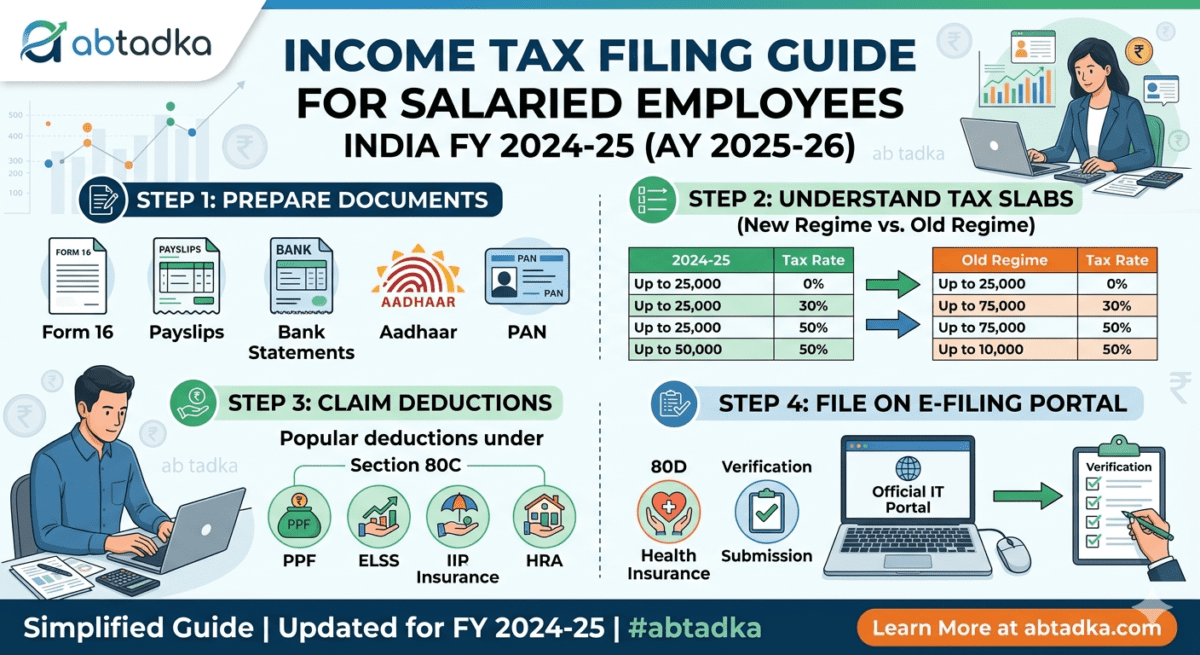
📅 Last Updated: May 2025 | ⏱️ Estimated Reading Time: 10 minutes
Every year, when July comes near, crores of salaried employees across India ask the same question — “How do I file my income tax return without making a mistake?”
If you are a salaried employee and confused about ITR filing, you are in the right place. In this complete guide, we will explain how to file income tax return (ITR) for salaried employees in India for FY 2024-25 (AY 2025-26) — step by step, in simple language.
Whether you are a first-time filer or have filed before, this guide covers everything: which ITR form to use, documents you need, old vs new tax regime, how to claim deductions, and how to track your refund.
✅ Key Takeaways — Quick Summary
- Last date to file ITR for FY 2024-25: 31 July 2025 (without penalty)
- Most salaried employees need to file ITR-1 (Sahaj) form
- New tax regime is now the default — you must opt out to use the old regime
- Maximum 80C deduction: ₹1,50,000 per year (only in old regime)
- Late filing penalty: ₹5,000 (₹1,000 if income below ₹5 lakh)
- Refund timeline: Usually 7–30 working days after e-verification
📋 Table of Contents
- What is ITR and Who Must File It?
- Which ITR Form Should a Salaried Employee Use?
- Documents Needed Before You Start
- Old Tax Regime vs New Tax Regime — Which Is Better?
- Step-by-Step: How to File ITR Online
- Top Deductions Salaried Employees Can Claim
- Common Mistakes to Avoid
- How to Track Your ITR Refund Status
- Frequently Asked Questions (FAQs)
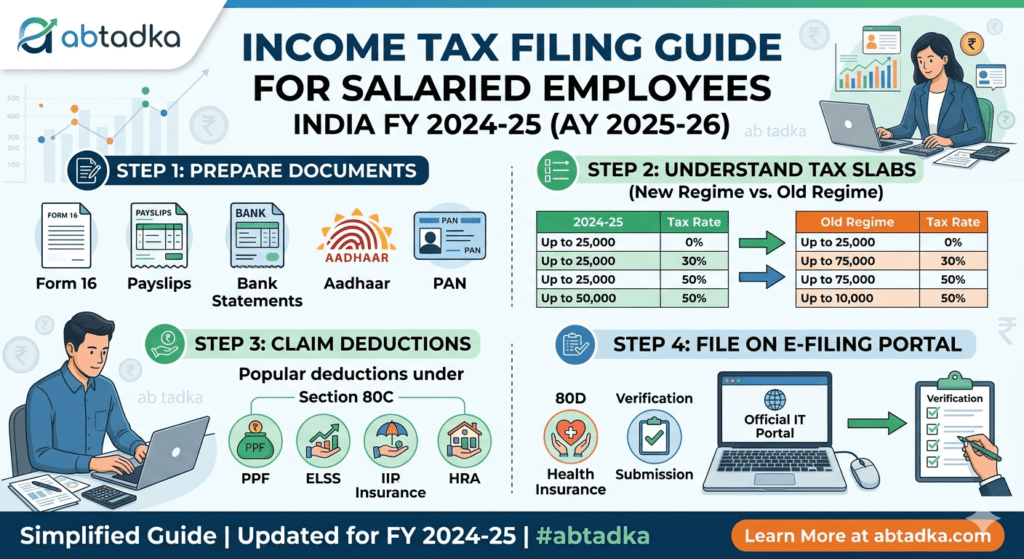
1. What is ITR and Who Must File It?
ITR (Income Tax Return) is a form that every earning individual files with the Income Tax Department of India. It declares your total income, taxes paid, and claims for any refund.
Who Must File ITR?
As per the Income Tax Act, filing ITR is mandatory if:
- Your annual income is more than ₹2,50,000 (₹3,00,000 for senior citizens aged 60–80, ₹5,00,000 for super senior citizens above 80)
- You have income from more than one source (salary + FD interest, for example)
- You want to claim a tax refund (TDS deducted by employer)
- You have income from property, capital gains, or foreign assets
- You have deposited more than ₹1 crore in a bank account in the year
💡 Tip: Even if your income is below ₹2.5 lakh, it is wise to file ITR. It is useful when applying for a home loan, visa, or government tender. It also serves as an official income proof.
What Happens If You Don’t File ITR?
- You will be charged a penalty of ₹5,000 (₹1,000 if income is below ₹5 lakh)
- You cannot carry forward capital losses to future years
- You may receive a notice from the Income Tax Department
- Loan and visa applications may get rejected without ITR proof
2. Which ITR Form Should a Salaried Employee Use?
There are different ITR forms for different types of taxpayers. Most salaried employees need to file ITR-1 (Sahaj). Here is a simple guide:
| ITR Form | Who Should Use It | Income Types Covered |
| ITR-1 (Sahaj) | Most salaried employees | Salary, one house property, FD/savings interest (Total income up to ₹50 lakh) |
| ITR-2 | Salaried individuals with capital gains | Salary + capital gains (stocks, mutual funds, property) + more than one house property |
| ITR-3 | Salaried individuals with business income | Salary + income from a business or profession (Freelancing) |
| ITR-4 (Sugam) | Small business owners & freelancers | Business income under presumptive schemes (Section 44AD / 44ADA) |
⚠️ Important: If you sold mutual funds or stocks in FY 2024-25, even at a loss, you must file ITR-2, not ITR-1. Source: incometax.gov.in
3. Documents Needed Before You Start Filing
Keep these documents ready before you open the ITR portal. This will save you time and help you avoid errors:
✅ Basic Documents
- PAN Card — your Permanent Account Number
- Aadhaar Card — linked with PAN (mandatory for e-verification)
- Bank Account Details — account number and IFSC code for refund credit
✅ Income Related Documents
- Form 16 (Part A and Part B) — provided by your employer. Shows your salary and TDS deducted. This is the most important document.
- Salary slips for April 2024 to March 2025
- Form 16A — if TDS was deducted on FD interest or any other income
✅ Tax & Income Verification
- Form 26AS — download free from incometax.gov.in. Shows all taxes paid and TDS deducted on your PAN.
- AIS (Annual Information Statement) — also available on the income tax portal. Shows all income sources the government has information about — salary, interest, dividends, mutual fund redemptions, etc.
✅ Investment and Deduction Proofs (for Old Regime)
- LIC, PPF, ELSS, EPF receipts (for 80C deductions)
- Health insurance premium receipts (for 80D deductions)
- Home loan interest certificate from your bank (for 24(b) deduction)
- House rent receipts if claiming HRA exemption
- Education loan interest certificate (for 80E deduction)
💡 Pro Tip: Before filing, always download your AIS (Annual Information Statement) from the income tax portal. It shows every income the government knows about — including your FD interest that your bank reported. Your ITR must match this exactly, or you may receive a tax notice.
4. Old Tax Regime vs New Tax Regime — Which Is Better for You?
Since FY 2023-24, the new tax regime is the default for all taxpayers in India. If you want to use the old regime and claim deductions, you must actively choose it while filing your ITR.
New Tax Regime — Tax Slabs for FY 2024-25
| Annual Income | Tax Rate (New Regime) |
|---|---|
| Up to ₹3,00,000 | Nil |
| ₹3,00,001 – ₹7,00,000 | 5% |
| ₹7,00,001 – ₹10,00,000 | 10% |
| ₹10,00,001 – ₹12,00,000 | 15% |
| ₹12,00,001 – ₹15,00,000 | 20% |
| Above ₹15,00,000 | 30% |
Note: Under the new regime, income up to ₹7 lakh is effectively tax-free due to a rebate under Section 87A. Standard deduction of ₹75,000 is also available in the new regime from FY 2024-25.
Old Tax Regime — Tax Slabs for FY 2024-25
| Annual Income | Tax Rate (Old Regime) |
|---|---|
| Up to ₹2,50,000 | Nil |
| ₹2,50,001 – ₹5,00,000 | 5% |
| ₹5,00,001 – ₹10,00,000 | 20% |
| Above ₹10,00,000 | 30% |
Which Regime Is Better? — Real Example
Let us take an example of a salaried employee with a gross salary of ₹10,00,000 per year and investments worth ₹1,50,000 under 80C, health insurance of ₹25,000 under 80D, and HRA exemption of ₹1,20,000:
| Calculation | Old Regime | New Regime |
|---|---|---|
| Gross Salary | ₹10,00,000 | ₹10,00,000 |
| Standard Deduction | ₹50,000 | ₹75,000 |
| 80C Deduction | ₹1,50,000 | Not allowed |
| 80D (Health Insurance) | ₹25,000 | Not allowed |
| HRA Exemption | ₹1,20,000 | Not allowed |
| Taxable Income | ₹6,55,000 | ₹9,25,000 |
| Tax Payable (approx.) | ₹44,200 | ₹62,500 |
📌 Conclusion: In this example, the old regime saves ₹18,300 more because of large deductions. However, if you have fewer investments and deductions, the new regime is simpler and may work out cheaper for you. Always calculate both before filing.
5. How to File ITR Online — Step by Step (FY 2024-25)
Follow these 10 simple steps to file your income tax return online on the official Income Tax e-filing portal. You do not need any CA or paid service for this if you are a simple salaried employee with ITR-1.
Step 1 — Go to the Official Income Tax Portal
Open your browser and go to www.incometax.gov.in. This is the only official government portal. Do not use any other website for direct filing.
Step 2 — Login with Your PAN
Click on “Login” on the top right. Enter your PAN number as your User ID and your password. If you are logging in for the first time, click “Register” and create your account using your PAN and Aadhaar.
Step 3 — Go to e-File Section
After login, go to the top menu → click “e-File” → then click “Income Tax Returns” → then select “File Income Tax Return”.
Step 4 — Select Assessment Year
For FY 2024-25 income, select Assessment Year (AY) 2025-26. Select filing mode as “Online” and continue.
Step 5 — Select ITR-1 Form
The portal will ask you a few questions about your income type. For most salaried employees, the system will suggest ITR-1 (Sahaj). Confirm and continue.
Step 6 — Verify Pre-Filled Data
The portal will automatically fill in your salary, TDS, and other income from your employer’s records and Form 26AS. Check every figure carefully — especially:
- Your salary income matches your Form 16
- TDS deducted matches your Form 26AS
- Interest income from FD or savings account is correctly shown
⚠️ Warning: If the pre-filled data is wrong, do NOT just change it in the form. First contact your employer or bank to issue a correct Form 16 or Form 16A. Filing incorrect data can lead to a tax notice.
Step 7 — Choose Your Tax Regime
The portal will ask you to select between Old Tax Regime and New Tax Regime. If you want to claim 80C, HRA, or 80D deductions, select the old regime. Otherwise, the new regime is selected by default.
Step 8 — Enter Deductions (If Using Old Regime)
Fill in all your eligible deductions:
- Section 80C — PPF, ELSS, LIC premium, EPF, school fees (max ₹1,50,000)
- Section 80D — health insurance premium (max ₹25,000; ₹50,000 for senior citizen parents)
- HRA — if you live in a rented house and receive HRA from employer
- Section 80E — education loan interest (no upper limit)
Step 9 — Check Tax Payable or Refund
After entering all details, the portal will calculate your tax automatically. You will see either:
- Tax Payable — you owe more tax. Pay it online using Challan 280 before filing.
- Refund — you paid more tax than required. This will be refunded to your bank account.
- Zero tax / Nil return — you have paid exactly the right amount.
Step 10 — E-Verify Your ITR
After submitting the form, you must e-verify within 30 days. Without e-verification, your ITR is not considered filed. The easiest way is:
- Aadhaar OTP — instant, recommended. You get an OTP on your Aadhaar-linked mobile number.
- Net banking (select banks)
- Demat account
- Physical ITR-V by post to CPC Bengaluru (slow — not recommended)
✅ Done! After successful e-verification, you will receive an acknowledgement number. Your ITR is now officially filed. You can download the ITR acknowledgement (ITR-V) from the portal any time.
6. Top Tax Deductions Salaried Employees Can Claim (Old Regime)
If you choose the old tax regime, you can reduce your taxable income significantly using these deductions. None of these deductions are available in the new tax regime (except standard deduction of ₹75,000).
| Section | What You Can Claim | Maximum Limit |
|---|---|---|
| 80C | PPF, ELSS, LIC, EPF, NSC, school fees, home loan principal | ₹1,50,000 |
| 80D | Health insurance for self and family | ₹25,000 (₹50,000 for senior citizen parents) |
| 80E | Interest on education loan | No upper limit (for 8 years) |
| HRA | House Rent Allowance (if living in rented house) | Calculated based on salary and rent paid |
| 24(b) | Home loan interest (self-occupied property) | ₹2,00,000 |
| 80TTA | Interest on savings bank account | ₹10,000 |
| 80GG | Rent paid (if employer does not give HRA) | ₹5,000 per month |
| Standard Deduction | Available automatically for all salaried employees | ₹50,000 (old regime) |
7. Common Mistakes to Avoid While Filing ITR
These are the most common mistakes Indian salaried employees make while filing their ITR. Avoid them to prevent tax notices and penalties:
- Not checking AIS before filing — Always download and check your Annual Information Statement (AIS) first. It shows all income the government knows about. Your ITR must match this.
- Forgetting FD interest income — Bank FD interest is fully taxable. Many people forget to declare it because the bank already deducted 10% TDS. But you still need to declare the full FD interest in your ITR.
- Not e-verifying after submission — Many people file the ITR but forget to e-verify. Without e-verification, your ITR is not legally submitted. E-verify immediately using Aadhaar OTP.
- Choosing the wrong ITR form — If you sold even one unit of mutual fund or stocks in the year, you cannot use ITR-1. You must use ITR-2.
- Missing the deadline — The last date is 31 July 2025. Missing it means paying a penalty of ₹5,000 and losing the ability to carry forward capital losses.
- Not declaring income from a previous employer — If you changed jobs during the year, you must declare salary from both employers. Add up the income and check Form 26AS carefully.
- Wrong bank account for refund — Make sure your bank account is pre-validated on the income tax portal and linked with your PAN. Otherwise your refund will fail.
- Not revising a wrong ITR — If you made a mistake, you can revise your ITR before 31 December of the assessment year. Do not panic — revision is allowed and free.
8. How to Track Your ITR Refund Status
If you are entitled to a tax refund, here is how to track when it will come to your bank account:
Steps to Check Refund Status
- Go to www.incometax.gov.in
- Login with your PAN and password
- Go to “e-File” → “Income Tax Returns” → “View Filed Returns”
- Click on the relevant ITR filing to see the refund status
Refund Status Guide
| Status Shown | What It Means | Action Needed |
|---|---|---|
| ITR Processed | Your return is accepted, refund is being processed | Wait 7–30 working days |
| Refund Issued | Money has been sent to your bank | Check bank account in 2–3 days |
| Refund Failed | Bank account issue or IFSC mismatch | Re-validate your bank account on portal |
| Under Processing | Still being reviewed by Income Tax Department | Wait — can take 30–60 days sometimes |
💡 Tip: Refunds are usually credited within 7–30 working days after e-verification. If you do not receive it in 45 days, raise a refund re-issue request from the income tax portal under “Services → Refund Reissue.”
9. Frequently Asked Questions (FAQs)
Q1: What is the last date to file ITR for FY 2024-25?
The last date to file ITR for FY 2024-25 (AY 2025-26) without any penalty is 31 July 2025. After this date, you can still file a belated return until 31 December 2025, but you will have to pay a penalty of ₹5,000 (or ₹1,000 if your income is below ₹5 lakh). Source: incometax.gov.in
Q2: Is it mandatory to file ITR if my income is below ₹5 lakh?
If your income is below ₹2,50,000, filing is not mandatory. However, if your employer has deducted TDS and you want a refund, you must file your ITR. Also, many banks and loan providers ask for the last 2–3 years of ITR as income proof — so it is always better to file.
Q3: Can I file ITR without Form 16?
Yes, you can file ITR without Form 16. Use your salary slips to calculate your total annual income. Download your Form 26AS and AIS from the income tax portal to verify TDS and other income. Many ITR filing platforms like ClearTax allow manual entry of salary details.
Q4: What happens if I miss the ITR deadline of 31 July?
You can still file a belated return until 31 December 2025 with a late fee of ₹5,000 (₹1,000 if income below ₹5 lakh). However, you will lose the ability to carry forward capital losses from stocks or mutual funds. You may also face interest charges under Section 234A on any tax due.
Q5: Is the new tax regime compulsory for salaried employees?
No, it is not compulsory. The new tax regime is the default, but you can choose the old regime every year while filing your ITR. Simply select “Old Regime” during the filing process. If you have significant investments under 80C and HRA, the old regime often saves you more tax.
Q6: What is Form 26AS and how do I download it?
Form 26AS is a consolidated tax statement that shows all TDS deducted on your PAN, advance tax paid, and self-assessment tax paid. To download: Login to incometax.gov.in → go to “e-File” → “Income Tax Returns” → “View Form 26AS.” It is free to download.
Q7: How long does ITR refund take after e-verification?
After successful e-verification, most refunds are processed and credited to the bank account within 7 to 30 working days. In some cases, if the return is selected for scrutiny, it may take up to 60 days. Always ensure your bank account is pre-validated on the tax portal for faster credit.
Q8: Can I revise my ITR after filing if I made a mistake?
Yes. You can file a revised ITR anytime before 31 December of the assessment year (31 December 2025 for FY 2024-25). Go to the income tax portal → File Return → select “Revised Return” and mention the acknowledgement number of your original filing.
Q9: Do I need to pay CA fees to file ITR? Can I do it myself?
If you are a simple salaried employee with only one employer, no capital gains, and straightforward income, you can absolutely file ITR yourself for free on the official income tax portal. It takes about 20–30 minutes. You only need a CA if your finances are complex — multiple income sources, capital gains, business income, or foreign income.
Q10: I changed jobs this year — how do I file ITR?
If you changed jobs, you have income from two employers. Collect Form 16 from both employers. Add up the salary from both, check Form 26AS that all TDS from both is reflected, and file ITR-1 with the combined income. Do not just use the Form 16 from your current employer — that is the most common mistake job-changers make.
Conclusion
Filing your income tax return is not as complicated as it seems — especially if you are a salaried employee. The Income Tax Department has made the process much simpler over the years, with pre-filled data and easy e-verification using Aadhaar.
To summarise the most important points:
- File your ITR before 31 July 2025 to avoid any penalty
- Use ITR-1 form if you have only salary and interest income
- Download and check your AIS and Form 26AS before filing
- Compare both regimes and choose the one that saves you more tax
- Always e-verify within 30 days of filing — it is mandatory
If you found this guide helpful, share it with your colleagues and family before the July deadline. They will thank you for it!
File Your ITR for Free
Use the official government portal — 100% free for all taxpayers Go to incometax.gov.in
Also Read more information on Abtadka.com
📌 Disclaimer: This article is for educational purposes only. Please consult a qualified Chartered Accountant (CA) for personalised tax advice. All tax rules mentioned are based on CBDT guidelines for FY 2024-25.
Disclaimer: This article is written for educational purposes only and represents general information about income tax filing in India as per rules for FY 2024-25. Tax laws may change. Please consult a qualified Chartered Accountant (CA) for advice specific to your financial situation. All information has been verified from official sources including incometax.gov.in and CBDT guidelines.