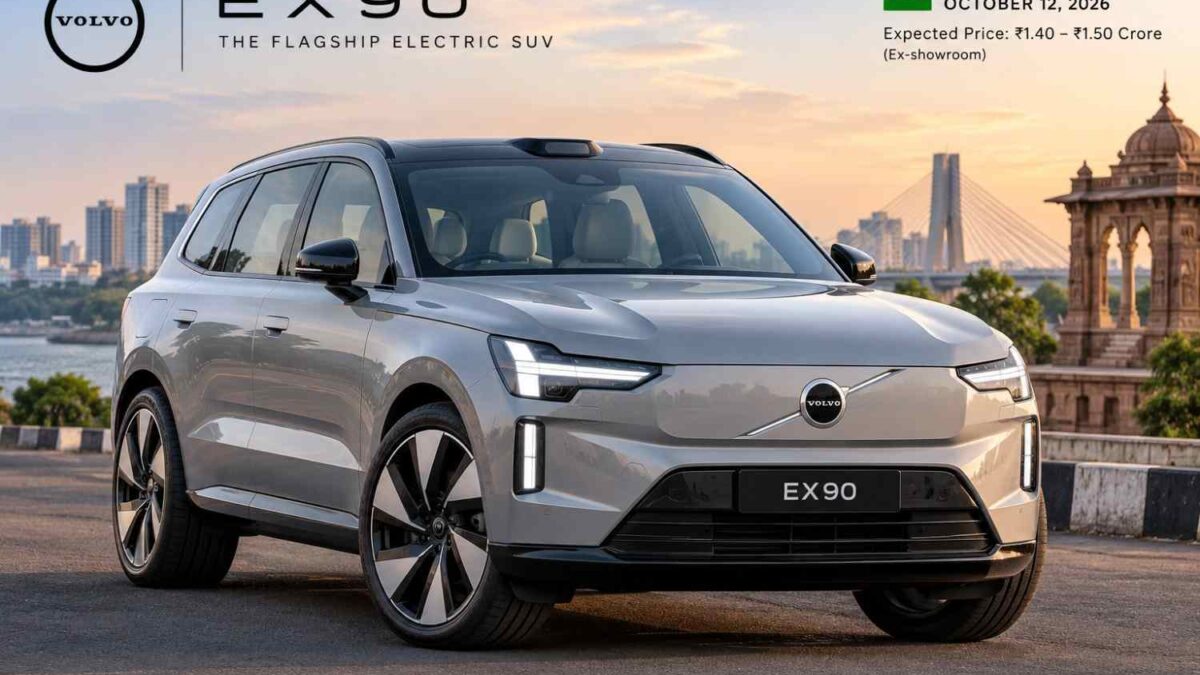
Volvo EX90 India: ₹1.5 Crore Electric SUV That Changes Volvo Forever?
I still remember the feeling of buying my first bike with hard-earned money.
At that time, I wasn’t thinking about 0-100 km/h, panoramic roofs, or 25-speaker audio systems. My biggest questions were simple: Kitna deti hai? Service ketli pade? Parts easily male, chhe?
That Indian mindset hasn’t disappeared.
Even after starting ABTADKA in 2020 and spending years writing about cars, bikes, and technology, I still look at expensive vehicles differently. A ₹1.5 crore car may be luxurious, but it still has to make sense for the person spending that money.
And that’s exactly why the Volvo EX90 caught my attention.
This isn’t just another electric SUV.
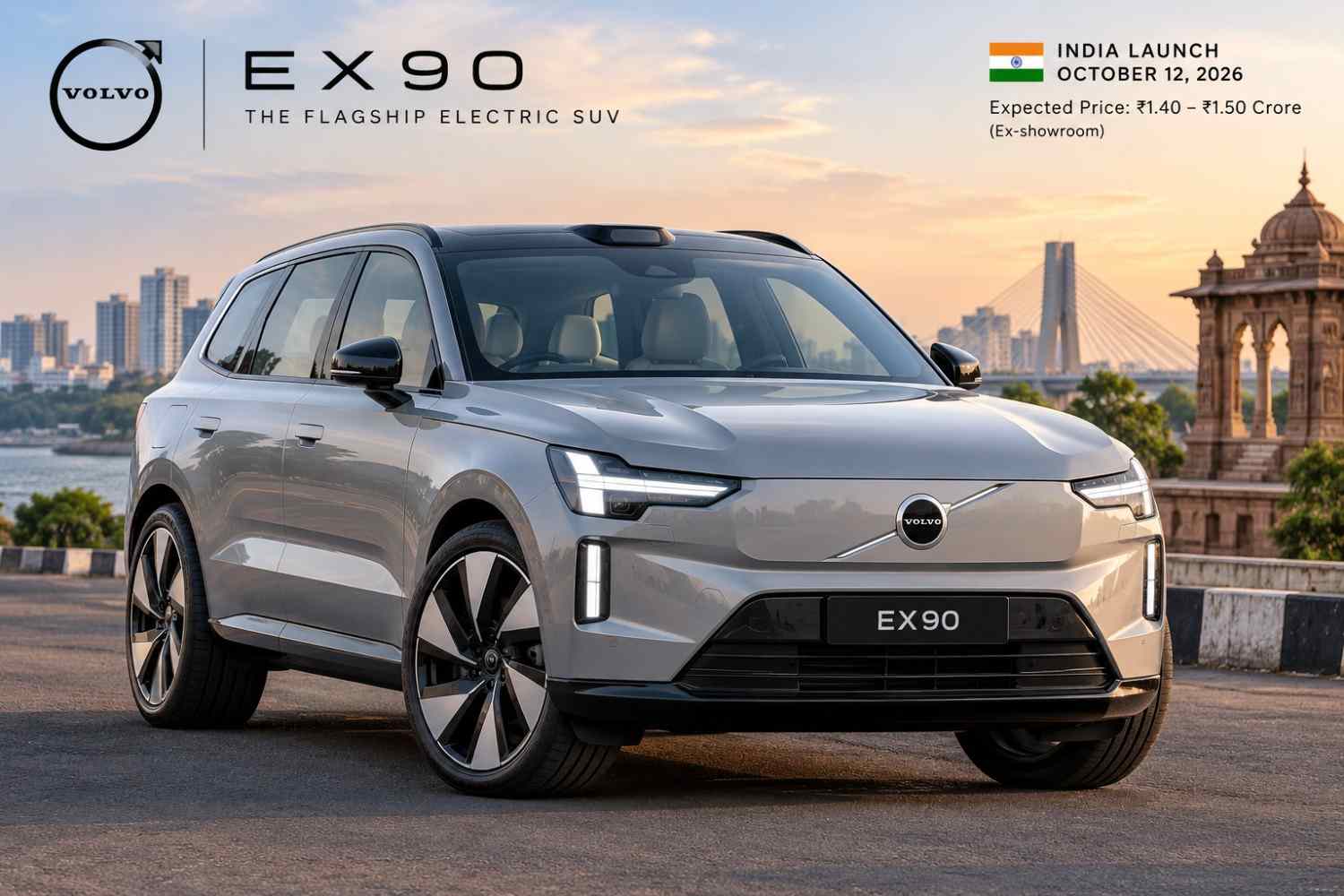
The EX90 is Volvo’s flagship full-size electric SUV, built on the company’s SPA2 architecture, and it sits above the XC90 in Volvo’s global lineup. It combines a large 106 kWh-class battery, dual-motor AWD, advanced driver assistance, LiDAR hardware, air suspension, and a technology-heavy cabin.
And now it is finally coming to India.
Volvo has confirmed the EX90 and ES90 for October 12, 2026, making the EX90 one of the company’s most important launches in India this year.
The expected EX90 price is around ₹1.40–₹1.50 crore ex-showroom.
That immediately brings up the question I would ask while sitting with a friend at a Galla in Sihor:
“Bhai, ₹1.5 crore for an electric SUV, ma, actually shu male chhe?”
Let’s break it down without showroom drama.
Volvo EX90 India: What We’ll Cover
- What exactly is the Volvo EX90?
- Volvo EX90 India launch date
- Expected Volvo EX90 price in India
- EX90 battery and electric range
- How powerful is the EX90?
- Why does the EX90 use 800V architecture?
- Can Gujarat’s 45°C heat affect the battery?
- Is the EX90 practical on Indian roads?
- EX90 interior and six-seat layout
- Volvo EX90 safety and LiDAR
- EX90 maintenance compared with a petrol SUV
- Charging cost and ownership thinking
- EX90 vs BMW iX vs Mercedes EQS SUV vs Kia EV9
- Five-year ownership logic
- Who should buy it?
- Who should save the money?
- FAQ
- Why trust ABTADKA?
1. What exactly is the Volvo EX90?
The Volvo EX90 is a battery-electric full-size luxury crossover SUV and Volvo’s flagship electric SUV.
The model is built on Volvo’s SPA2 platform and is offered globally in different powertrain configurations, including single-motor rear-wheel drive and dual-motor all-wheel drive versions.
But the Indian story is particularly interesting.
Current India launch information points towards a dual-motor AWD EX90 with a 106 kWh battery, producing around 456 hp and 670 Nm. The reported India-spec version is expected to be sold in a fully loaded Ultra configuration.
That is serious performance for a family SUV.
But Volvo isn’t selling the EX90 as a drag-racing machine.
The bigger idea is different:
Luxury + safety + electric performance + family practicality.
And honestly, that combination makes more sense to me than simply chasing a huge horsepower number.
- Volvo EX90 India: ₹1.5 Cr EV That Changes Everything?
- Audi A5 India 2027: ₹70 Lakh Price & Big Changes
2. When will the Volvo EX90 launch in India?
This is no longer just an “expected someday” launch.
Volvo has confirmed that the EX90 will launch in India on October 12, 2026. The ES90 electric sedan is scheduled for the same date.
That means the Indian market is about to get Volvo’s new flagship electric technology.
As of September 27, 2026, we’re only a few weeks away from the official launch.
So if you’re reading this article around launch time, remember that some specifications, equipment details, and final pricing may still be subject to the official India announcement.
3. Volvo EX90 price in India: Is ₹1.5 crore too much?
The current estimated EX90 price is approximately
₹1.40 crore – ₹1.50 crore
That’s the expected ex-showroom positioning reported for India.
Now let’s put that number into perspective.
This isn’t a ₹50 lakh electric SUV competing purely on practicality.
You’re entering a completely different luxury segment.
For comparison, the BMW iX is currently listed around ₹1.40 crore ex-showroom, while the Mercedes-Benz EQS SUV starts around ₹1.33 crore ex-showroom. The Kia EV9 is listed at around ₹1.30 crore ex-showroom.
So the EX90 isn’t entering an empty market.
It is entering a very expensive electric-SUV battlefield.
And that means Volvo needs to sell more than “it’s electric.”
It needs to sell why the Volvo experience is worth your money.
4. Volvo EX90 battery: How big is it?
The India-spec EX90 is expected to use a 106 kWh battery pack with the dual-motor AWD setup.
Volvo’s current global EX90 information lists the electric SUV with a claimed range of around 625km, depending on configuration and market. Volvo’s India comparison page currently shows 625 km, 456 hp, AWD, and a 5.5-second 0–100 km/h figure.
But here’s my Indian reality check.
625 km claimed range does not mean you will drive 625 km every time.
Our roads aren’t laboratory roads.
Ahmedabad traffic, summer heat, AC use, highway speeds, tire pressure, passengers, luggage, and driving style all affect energy consumption.
So I would rather see an owner consistently getting a practical real-world range than celebrate a huge brochure number.
5. 456 hp and 670 Nm: Does a family SUV really need this much power?
No.
But it’s fun.
The India-spec EX90 is expected to produce 456hp and 670Nm from its dual-motor setup. Volvo’s official support documentation lists 335 kW/456 hp and 670 Nm for the Twin Motor configuration.
The claimed 0–100km/h time is approximately 5.5 seconds.
For a large luxury SUV, that’s properly quick.
But I wouldn’t buy this car because of the 5.5-second number.
My reason would be effortless performance.
Imagine you’re driving from Ahmedabad towards Bhavnagar with four adults and luggage.
You don’t need to floor the accelerator every time.
With an electric motor, the response is immediate and smooth. That makes overtaking and joining faster roads easier without the engine noise and gear changes you’d experience in a conventional petrol SUV.
That’s where the power becomes useful.
6. Why does the Volvo EX90 use an 800V electrical architecture?
This is one of the most important technical details.
Volvo upgraded the EX90 to an 800V electrical system, replacing the earlier 400V architecture.
Why should an Indian buyer care?
Because higher-voltage architecture can help support faster charging and improve charging efficiency.
Volvo says the upgraded EX90 can add up to 250 km of range in 10 minutes under suitable charging conditions, with the company noting that charging results depend on factors such as temperature, battery condition, and charger capability.
That’s the important sentence.
Under suitable conditions.
If you’re charging at home using a relatively modest AC charger, you’re obviously not getting that kind of speed.
But on a capable DC fast charger, the 800V system becomes much more meaningful.
7. Can the EX90 handle Gujarat’s 45°C summer?
Now we’re getting into the questions I actually care about.
A luxury EV can look perfect in a Scandinavian brochure.
But Gujarat can be brutal.
Ahmedabad can become extremely hot.
Bhavnagar adds coastal humidity and salt-heavy air.
Sihor and village roads can throw dust everywhere.
And during summer, you may enter your car after it has been parked outside under direct sunlight.
So the question isn’t simply:
“Does the EX90 have a big battery?”
The question is
“How well does the entire system manage heat?”
Volvo’s EX90 uses sophisticated battery and thermal-management technology, and Volvo specifically notes that charging performance varies with outdoor temperature and battery condition.
For my own Gujarat-style testing, I’d want to check:
- Cabin cooling after 30 minutes in the sun
- Battery temperature management
- DC charging speed in hot weather
- AC energy consumption
- Range loss during summer
- Performance after extended highway driving
- Cooling after repeated acceleration
- Charging behavior at 40°C-plus ambient temperatures
I wouldn’t claim those results before actually testing the Indian car.
That’s the difference between an honest review and a copied brochure.
8. Is the Volvo EX90 practical on Indian roads?
Here’s where the EX90 becomes interesting.
It is big.
Very big.
Volvo lists the EX90 at around 5,037mm long and 1,964mm wide, making it a serious full-size SUV.
That gives it presence.
But it also gives you something else:
Parking problems.
If you live in an old Ahmedabad apartment building with narrow parking slots, check the dimensions carefully.
If you regularly drive through extremely narrow Sihor lanes, you’ll need to remember that you’re controlling a five-meter-long luxury SUV.
The good news is that Volvo offers technology designed to make maneuvering easier, including a 360-degree camera and parking assistance.
Still, cameras don’t magically make a five-meter SUV small.
9. EX90 ground clearance: Can it handle bad roads?
This is one of the areas where the EX90’s air suspension matters.
The EX90 has air suspension that can adjust its ride height. Current India information indicates approximately 210 mm of ground clearance in its lowest setting, with the system able to raise it to around 250 mm in off-road mode.
That is useful for India.
A large luxury SUV needs to deal with:
- Speed breakers
- Broken city roads
- Parking ramps
- Uneven village roads
- Deep potholes
- Flooded patches
But remember one thing.
Ground clearance doesn’t make a luxury SUV indestructible.
Large alloy wheels and expensive tires still need protection.
I would slow down for serious potholes rather than testing the suspension simply because the EX90 has an off-road mode.
- Volvo EX90 India: ₹1.5 Cr EV That Changes Everything?
- Audi A5 India 2027: ₹70 Lakh Price & Big Changes
9.01. Volvo EX90 interior: Is it actually luxurious?
This is where Volvo has taken a different path from some German rivals.
The EX90 doesn’t scream luxury.
It whispers it.
The cabin uses a minimalist Scandinavian approach rather than covering every possible surface with buttons.
The centerpiece is a 14.5-inch central display, while the driver gets a 9-inch display.
Volvo also offers premium materials, including Nappa leather in certain configurations, open-pore wood, and other natural-texture elements depending on specification.
I like this philosophy.
Because after years of using smartphones, laptops, and cars, I’ve started asking one question:
Does technology make the experience easier?
Not:
How many screens did the manufacturer fit?
9.02. Is the EX90 a six-seater or seven-seater?
This is important for Indian families.
Global EX90 versions can be configured with different seating arrangements, but the currently reported Indian version is expected to be a six-seater, with a more premium second row. Autocar India reports the India-spec car as a six-seat Ultra variant.
That means this isn’t simply a seven-seat family hauler.
It’s more like
Family SUV + luxury lounge.
If your family regularly travels with six people, captain-style seating could be extremely comfortable.
If you need seven seats every weekend, however, you should confirm the exact Indian configuration before booking.
9.03. What about the EX90 boot space?
Volvo’s India interior page currently lists the boot at up to 377 liters with the rear backrests raised, plus a 46-liter front storage compartment.
That frunk is useful.
You can put charging cables, washer fluid, and smaller items there instead of filling the main luggage area.
For a long Gujarat road trip, that extra storage can make a difference.
10. Volvo EX90 safety: This is where the story gets serious.
Volvo has built its reputation around safety.
The EX90 continues that philosophy with an extensive sensor suite and advanced driver assistance.
The India specification is reported to include:
- 9 airbags
- 5 cameras
- 5 radars
- 12 ultrasonic sensors
- 360-degree camera
- Advanced driver assistance
- LiDAR hardware
- Auto parking
- Door-opening alerts
- Post-impact braking
These features are reported for the expected India-spec EX90.
But there’s something even more useful than a feature list.
The EX90 received a five-star Euro NCAP rating in 2025. Euro NCAP reported scores of 92% for adult occupant protection, 93% for child occupant protection, and 86% for safety assist.
That’s meaningful evidence.
And I prefer talking about actual independent crash-test results rather than simply saying:
“Volvo is safe.”
10.01. What does LiDAR actually do in the EX90?
This is one of the EX90’s biggest technology talking points.
LiDAR stands for Light Detection and Ranging.
In simple language, the system uses laser light to help build a detailed picture of the environment around the vehicle.
Why does that matter?
Because cameras and radar aren’t the only sensors that can be useful.
The EX90’s technology stack is designed to help the car detect objects, understand road conditions, and support driver-assistance functions.
But here’s an important distinction:
LiDAR does not mean the EX90 is a self-driving car that you can ignore.
Driver-assistance systems are there to assist the driver.
Your hands, attention, and responsibility remain important.
That matters even more on Indian roads, where motorcycles, pedestrians, cows, auto-rickshaws, and unexpected lane changes can happen within seconds.
12. Volvo EX90 charging: Home charging vs. fast charging
This is where EV ownership becomes very different from petrol-car ownership.
With my old bike, I could stop at a petrol pump for five minutes and continue.
With the EX90, your home charging setup becomes part of the ownership experience.
Volvo’s EX90 uses an 11 kW onboard charger in published specifications, while fast DC charging capability is significantly higher depending on the version and charger.
If you have:
- Dedicated parking
- Reliable electricity
- A suitable home charger
- Daily predictable driving
An EV can become incredibly convenient.
You wake up with a charged car.
No petrol pump stop required for the normal daily commute.
How much does it cost to charge the Volvo EX90?
Let’s use a simple example.
Suppose we take a 106 kWh battery and assume an electricity rate of roughly ₹8 per kWh purely for illustration.
A complete 106 kWh charge would theoretically cost:
106 × ₹8 = ₹848
That’s a simplified calculation.
Real charging cost can be higher or lower depending on:
- Electricity tariff
- Charging losses
- Battery state
- Home charger efficiency
- Charging location
- Time-of-use rates
- DC fast-charging pricing
Still, the difference from a ₹1.5 crore petrol SUV is obvious.
The EX90 doesn’t have engine oil.
It doesn’t have spark plugs.
It doesn’t have a conventional exhaust.
It doesn’t have a multi-speed combustion gearbox.
And that’s where EV ownership can become financially interesting.
What maintenance does the Volvo EX90 need?
This is where I need to correct the original “bike maintenance” logic.
The EX90 is an EV.
So chain cleaning with kerosene and chain lube obviously doesn’t apply.
That’s something I would discuss for my motorcycle, not a Volvo EX90.
For the EX90, I’d focus on:
Tyres
Check pressure regularly.
Large luxury EVs are heavy, so tires work hard.
Brake system
Regenerative braking reduces dependence on friction brakes, but brake inspection remains important.
Battery
Don’t ignore battery warnings.
Use the recommended charging system.
Cooling system
EV batteries and electronics still require thermal management.
Software
Keep the vehicle software updated.
Volvo’s software-defined approach means updates can add or improve functions over time. Volvo has already described significant EX90 software and computer upgrades delivered through workshops and over-the-air technology.
Paint
Gujarat sun is Gujarat sun.
Use shade whenever possible.
Wash dust properly rather than rubbing dry dust into the paint.
My Sihor-style monthly EX90 maintenance routine
If I owned an EX90, my monthly routine would be very different from my bike routine.
Week 1: Tyres
Check all four tire pressures.
Inspect sidewalls for damage.
Look for uneven wear.
Week 2: Charging
Check the charging cable and connector.
Keep the charging port clean and dry.
Inspect the home charger for visible damage.
Week 3: Cabin and electronics
Check warning messages.
Check cameras and sensors.
Clean the windshield area around cameras and sensors.
Week 4: Exterior
Wash away Gujarat dust.
Don’t leave bird droppings sitting on the paint.
Check the underside after rough-road trips.
This sounds boring.
But boring maintenance is exactly what keeps an expensive vehicle expensive-looking.
13. Volvo EX90 vs BMW iX vs Mercedes EQS SUV vs Kia EV9
Now let’s put the EX90 into context.
These aren’t identical vehicles, but they’re relevant luxury-EV alternatives in India.
| SUV | Approx. India ex-showroom price | Battery / powertrain | Claimed range | Seating / character |
|---|---|---|---|---|
| Volvo EX90 | ₹1.40–₹1.50 Cr* | 106 kWh, dual-motor AWD | Up to 625km | 6-seat luxury SUV |
| BMW iX | ₹1.40 Cr | 105.2 kWh, AWD | 575–635 km WLTP | Premium 5-seat SUV |
| Mercedes EQS SUV | ₹1.33 Cr+ | 122 kWh, AWD | Up to 820km | 5/7-seat luxury SUV |
| Kia EV9 | ₹1.30 Cr | 99.8 kWh, dual-motor AWD | 561 km ARAI | 6-seat premium SUV |
*The EX90 price is an estimate before its October 12, 2026, India launch.
Current published pricing/specification information supports the figures for the BMW iX, EQS SUV, and Kia EV9.
I wouldn’t turn this table into a “winner” list.
The cars are designed around somewhat different priorities.
The EX90 puts enormous emphasis on safety, calmness, Scandinavian design, and family luxury.
The iX is more performance-oriented in character.
The EQS SUV pushes heavily into luxury.
The EV9 brings a different combination of space and value within the premium-EV segment.
12. EX90 ownership over five years: Think beyond the EMI
Here’s the Indian calculation nobody should skip.
Suppose someone tells you:
“₹1.5 crore car hai, EMI manage ho jayegi.”
That’s not enough.
You need to consider:
Down payment + EMI + insurance + charging + tyres + service + depreciation + home charging installation + unexpected expenses.
The purchase price is only the beginning.
For an EV, the fuel bill may be lower than a comparable petrol luxury SUV.
But the tires can be expensive.
Insurance can be expensive.
Luxury electronics can be expensive.
And a large battery is an important long-term ownership component.
So don’t buy an EX90 because someone told you:
“EV mein maintenance zero hota hai.”
That’s not true.
EVs generally have fewer conventional drivetrain maintenance items, but they still require maintenance.
14. EX90 five-year ownership logic
This isn’t a resale-price prediction.
It’s simply a way I would think about the ownership journey.
YEAR 1
████████████████████  New-car experience
        │
        ▼
YEAR 2
██████████████████    Tyres + service + insurance
        │
        ▼
YEAR 3
████████████████      Software + battery health + wear
        │
        ▼
YEAR 4
██████████████        Bigger ownership decisions
        │
        ▼
YEAR 5
████████████          Resale / keep / upgrade decision
And this is why I always tell Indian buyers:
Don’t calculate only the EMI.
Calculate the complete five-year ownership cost.
What happens to the range in Gujarat heat?
This is one area where real-world testing will matter enormously.
Battery-electric vehicles can experience changes in energy consumption depending on temperature and climate-control use.
In Gujarat summer, the air conditioner can work hard.
If your car sits outside for hours at 40–45°C, you may spend additional energy cooling the cabin.
Fast charging can also be affected by temperature management.
Volvo itself notes that charging times vary according to outdoor temperature, battery condition, and vehicle condition.
So my advice is simple:
Don’t buy the EX90 assuming the brochure range is your daily range.
Plan around a sensible buffer.
If the car comfortably covers your regular Ahmedabad–Bhavnagar-type travel requirements with charging margin, that’s what matters.
Can you take the Volvo EX90 from Ahmedabad to Bhavnagar?
Yes, this is exactly the sort of trip I would want to test.
Ahmedabad to Bhavnagar isn’t some fantasy European road.
You get:
- Traffic
- Trucks
- Motorcycles
- Variable road surfaces
- Highway stretches
- Dust
- Heat
- AC usage
- Different driving speeds
I’d start with a fully charged battery.
Then I would record:
Starting battery percentage → distance → average consumption → AC usage → arrival percentage.
That tells you much more than a brochure range.
And if I had the EX90 for a longer period, I’d repeat the same test in summer and winter.
That’s real ownership data.
- Volvo EX90 India: ₹1.5 Cr EV That Changes Everything?
- Audi A5 India 2027: ₹70 Lakh Price & Big Changes
15. Who should buy the Volvo EX90?
I see the EX90 making the most sense for someone who wants a premium family EV and has the financial comfort to own one without stretching.
You should look seriously at it if you want:
- A full-size luxury electric SUV
- Six-seat family practicality
- Strong AWD performance
- Very advanced safety technology
- Quiet highway driving
- Premium Scandinavian design
- Large battery capacity
- Home charging
- Modern software
- A different alternative to German luxury SUVs
It is especially interesting if you already have another conventional car and want a premium EV as part of your garage.
16. Who should save their money?
This is equally important.
If your priority is
- Lowest possible purchase cost
- Simple maintenance
- Easy roadside repairs
- Frequent remote village travel
- Limited charging access
- Maximum luggage flexibility
- Low insurance costs
Then the EX90 may not be the logical choice.
And that’s okay.
A ₹30–50 lakh car that comfortably fits your life can be a better financial decision than a ₹1.5 crore SUV that stretches your finances.
I don’t believe every expensive car needs to be justified.
Sometimes the best financial decision is simply
“Not now.”
17. Volvo EX90 FAQ
1. When will the Volvo EX90 launch in India?
Volvo has confirmed that the EX90 will launch in India on October 12, 2026. It will arrive as one of Volvo India’s flagship electric vehicles alongside the ES90.
2. What will the Volvo EX90 cost in India?
The current expected ex-showroom price is around ₹1.40–₹1.50 crore. The final price should be confirmed at the October 2026 launch.
3. What is the Volvo EX90 range?
Volvo’s current India/global specification information lists a claimed electric range of approximately 625 km, although real-world range will vary according to driving conditions, speed, temperature, AC use, and other factors.
4. Is the Volvo EX90 a 6-seater or 7-seater?
The expected India-spec EX90 is reported as a six-seat luxury SUV. Global versions can have different seating configurations, so buyers should confirm the final India specification before booking.
5. Is the Volvo EX90 safe?
The EX90 received a five-star Euro NCAP rating in 2025, with Euro NCAP reporting 92% adult occupant protection, 93% child occupant protection, and 86% safety-assist performance.
18. Why Trust ABTADKA?
I started ABTADKA in 2020.
Over these years, I’ve written about cars, bikes, technology, and the ownership questions that actually matter to Indian buyers.
My approach isn’t to copy a manufacturer’s brochure and call it a review.
I want to ask:
What will this cost?
How will it behave in Gujarat?
What happens after five years?
Can an ordinary family realistically own it?
Will the technology genuinely help?
And most importantly:
Should someone stretch their finances just because a car looks impressive?
That’s the ABTADKA way.
I also want to be clear about one thing with the EX90.
I have not personally conducted a long-term India-spec EX90 test before its official October 2026 launch. So where I discuss Ahmedabad heat, Bhavnagar roads, charging, and real-world range, I’m giving you the testing framework I would use, not pretending that I already have results.