Toyota Innova Hycross Facelift Rendered Based on Design Patent: New Hilux-Style Face Could Change Everything
I still remember the excitement around the Innova name when I started writing about cars at ABTADKA in 2020. For Indian families, this was never just another MPV. It was the car you bought when you wanted to keep it for years, travel with parents, children and luggage, and not worry too much about what the road threw at you.
Now Toyota is preparing another chapter.
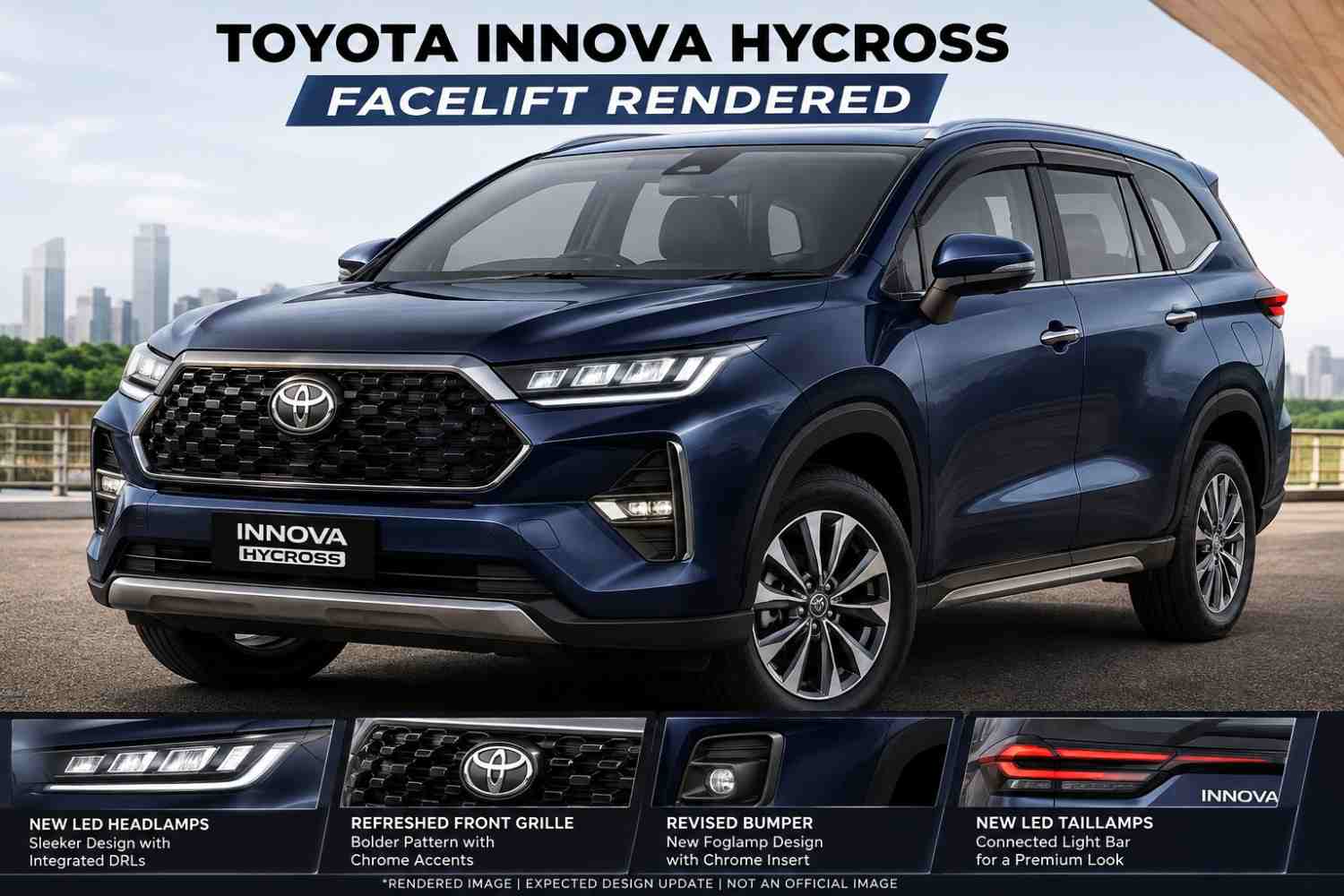
The Toyota Innova Hycross facelift has been spotted testing in India, and today we have something more interesting than another heavily camouflaged spy shot: a Toyota design patent for a new front bumper that appears very close to what has been seen on the facelift test mules. A new render based on that patent gives us a much clearer idea of where Toyota is taking the Hycross design.
And honestly, I like the direction.
The current Innova Hycross already has an SUV-inspired stance, but this facelift appears to push that idea much harder. The front could become squarer, more upright and more aggressive, with clear visual links to Toyota’s newer Hilux design language.
But before you start calling your Toyota dealer, there is one important thing to understand: this is still a facelift under testing, not a fully confirmed production specification.
So let me separate what Toyota has actually revealed, what the patent suggests, and what I think Indian buyers should realistically expect.
What is new about the Toyota Innova Hycross facelift?
The first thing I noticed from the latest information is that Toyota isn’t trying to reinvent the entire Hycross.
The overall MPV silhouette is expected to remain familiar. The biggest visual drama is happening at the front, which makes sense because a facelift is normally about refreshing the identity without throwing away the successful foundation. Recent spy shots have shown a redesigned fascia, slimmer lighting elements and a more upright nose.
The latest design patent makes the story even more interesting.
According to Autocar India’s report, Toyota has patented a new front bumper whose design is similar to the one seen on the facelifted test mules. That gives us stronger evidence than a simple unofficial render because the patented component could potentially make it to the production car.
But I would still put a big “expected” label on everything until Toyota officially unveils the car.
What does the design patent actually reveal?
This is where things get interesting for people like me who enjoy looking beyond a headline.
The patent shows a more aggressive front bumper with a squarer grille and diamond-shaped air inlets. There are also black diamond-shaped elements positioned on either side of the bumper, which could house fog lamps or related lighting elements.
That is quite different from the current Hycross.
Toyota currently markets the Innova HyCross with a muscular SUV stance, raised bonnet line, strong character lines and a prominent grille. The company itself describes the current model as having SUV styling rather than a traditional MPV appearance.
The facelift appears to take that philosophy one step further.
Instead of saying, “I am an MPV that looks slightly like an SUV,” the new face seems to say, “I am an MPV with an SUV attitude.”
And for the Indian market, that matters.
A lot.
Will the facelift really look like the new Hilux?
This is probably the biggest question I have been seeing around the new Innova Hycross facelift.
My answer is: visually, it certainly appears to borrow from the Hilux direction, but don’t expect an Innova-sized Hilux.
Recent test mules have shown an upright front fascia, slimmer lighting elements and a grille that appears to take inspiration from the newer Hilux design language. CarWale and Autocar India have both highlighted the Hilux connection in their reports.
The patent render strengthens that impression.
For me, this is a smart move by Toyota.
The current Hycross is comfortable and premium, but the front doesn’t have the road presence of something like a Fortuner. A more upright nose could give family buyers that “big Toyota” feeling without turning the Hycross into a completely different vehicle.
What changes can we expect at the front?
Let’s break the front fascia down.
1. Squarer grille
The current grille has a more conventional MPV-inspired shape.
The facelift’s patent design appears more upright and squared-off, giving the nose a tougher appearance.
2. Diamond-shaped air inlets
This is one of the most obvious details in the patent.
The bumper features diamond-shaped openings that add visual aggression without requiring Toyota to completely redesign the vehicle.
3. New bumper
The bumper is arguably the star of this update.
Since the patent specifically concerns the front bumper, this isn’t just something a rendering artist invented from imagination. The design registration gives us a tangible clue about Toyota’s direction.
4. Slimmer headlights
Spy shots have indicated slimmer headlight units, with projector elements visible on the test vehicles.
If Toyota carries those elements into production, the Hycross could look considerably more expensive from the front.
5. New lighting signature
A facelift usually gives manufacturers an opportunity to change the DRL and LED signature.
The Hycross appears to be following that route, although the exact production lighting design is still not confirmed.
What about the rear design?
The rear is a much smaller story compared with the front.
Spy shots have indicated new LED elements in the tail-lights, while the overall rear bumper and side profile are expected to remain relatively familiar. New alloy wheel designs are also possible.
Honestly, I think that’s the right approach.
Toyota doesn’t need to disturb the proportions that make the Hycross practical.
Indian families buying a three-row MPV care about the second row, third row, luggage space, ingress and comfort far more than whether the rear bumper has five extra design lines.
That is why I would rather Toyota spend money improving the cabin and safety technology.
Could the interior get a major upgrade?
This is where I am waiting for Toyota to surprise us.
The facelift test mules have already been spotted with a free-standing touchscreen infotainment system and a driver’s display, broadly following the current cabin philosophy.
However, the exact production interior remains unclear.
There is speculation around a larger screen setup, revised upholstery, new trims and more technology. Some reports have also suggested that Toyota could borrow elements from newer products, but I would not treat every leaked feature as confirmed yet.
For a ₹20 lakh-plus family car, I personally want Toyota to focus on things that we actually use:
- Better ventilated seats
- Faster infotainment
- Better 360-degree camera quality
- More useful USB-C charging
- Stronger rear-seat climate control
- Better phone connectivity
- Improved ADAS calibration
- Better cabin storage
Give me those before another decorative screen.
Read More : Toyota Cars & Upcoming Toyota Models
Will Toyota change the petrol and hybrid engines?
This is one area where the facelift is expected to remain conservative.
Current reports indicate that Toyota is likely to continue the existing petrol and strong-hybrid powertrains rather than introduce an entirely new engine with the facelift. Autocar India reports expected outputs of around 173hp for the 2.0-litre petrol and 184hp for the 2.0-litre petrol-hybrid, with CVT and e-CVT transmissions respectively.
That makes sense.
Toyota doesn’t need to change something that already works.
The current Innova HyCross uses Toyota’s TNGA-era engineering approach and offers a strong-hybrid system designed around efficiency and refinement. The broader Innova nameplate moved from its earlier body-on-frame, rear-wheel-drive generations to the current-generation front-wheel-drive, unibody architecture in 2022.
That was a huge philosophical change for the Innova family.
But the market accepted it.
What mileage can Indian buyers expect?
Here comes the famous Indian question:
“Kitna deti hai?”
I can already imagine someone standing outside a Toyota showroom in Ahmedabad asking exactly that before asking about the colour.
The hybrid remains the version I would look at if fuel efficiency is important.
Toyota’s current HyCross uses a 2.0-litre strong-hybrid system, while the petrol version uses a 2.0-litre petrol engine. Toyota itself positions the hybrid as a self-charging hybrid system.
But don’t make the mistake of assuming that an advertised efficiency figure will be your daily number.
Ahmedabad traffic, Rajkot highway runs, full seven-seat loads, AC usage and summer temperatures can change consumption dramatically.
At 45°C in Gujarat, the AC is not optional. It is survival equipment.
So my advice is simple: buy the hybrid because you value lower fuel consumption and smoother urban driving, not because you expect one magic mileage number every day.
How will the facelift handle Gujarat heat and dusty roads?
This is something I care about more than another glossy brochure feature.
If you drive around Gujarat, your car sees conditions that a showroom display car never will.
Summer temperatures can get brutal. Dust gets everywhere. Village roads around Sihor and Bhavnagar can throw fine dust into every corner of the vehicle. Near coastal areas, salt-laden humidity can add another layer of long-term stress.
Toyota’s reputation for durability is one reason Innova buyers keep their cars for years, but durability doesn’t mean you can ignore maintenance.
My practical Gujarat routine
If this were my Hycross, I would do the following:
Every week
- Check tyre pressure.
- Look for unusual tyre wear.
- Wash dust off rather than rubbing dry dust into the paint.
- Check windshield washer fluid.
- Inspect visible scratches and stone chips.
Every month
- Clean the engine bay carefully without blasting electronics.
- Inspect coolant level.
- Check brake fluid condition.
- Inspect the 12V battery.
- Check underbody for damage.
- Clean AC filters when required.
- Check the spare wheel and toolkit.
Before a long Bhavnagar-Ahmedabad drive
I would inspect tyres, brakes, lights, coolant and engine oil before leaving.
That five-minute habit can save you from a roadside headache.
Why Indians don’t want to replace a car every two years
I think this is where the Innova has always understood India better than many competitors.
We don’t necessarily buy a ₹25 lakh car because we want a new car every 24 months.
We buy it because we want something that can serve our family for 8, 10 or even 15 years.
A middle-class buyer thinks differently.
The purchase isn’t just:
“Can I afford the EMI?”
It is:
“Can I maintain this car for the next decade?”
That is why Toyota’s service network, reliability reputation and resale perception matter so much.
If I spend ₹25–30 lakh on a family car, I want to know that my son can still sit in the same car years later.
[Image: toyota-innova-hycross-long-term-family-use-india.jpg | Alt: Toyota Innova Hycross used as a long-term family car on Indian roads with luggage and passengers]
My long-term maintenance thinking
The prompt for this article originally talks about chain cleaning and kerosene because those are important for motorcycles.
But the Innova HyCross is a car, so there is no motorcycle chain to clean or lubricate.
I would not recommend applying kerosene or chain lubricant anywhere simply because somebody says it is a “Toyota maintenance trick.”
For the Hycross, follow Toyota’s recommended maintenance schedule.
And for the paint, Gujarat’s sun deserves respect.
Park under shade whenever possible.
If your car sits outside every day, a good quality exterior protection treatment can help reduce the visual ageing caused by intense sun exposure, but don’t expect any coating to make the paint bulletproof.
The simplest protection is still boring:
Shade + regular washing + correct drying + no dry-dust rubbing.
That is my Sihor-style rule.
Toyota Innova Hycross facelift vs current Hycross: should you wait?
This is where my answer becomes more personal.
If you urgently need a family car today, don’t stop your life waiting for an unconfirmed feature list.
But if you can comfortably wait several months, I would absolutely wait for the facelift announcement before making a large purchase.
Why?
Because the facelift appears to bring:
| Area | Current Innova HyCross | Facelift Expectation | My Take |
|---|---|---|---|
| Front grille | Large trapezoidal SUV-style grille | Squarer Hilux-inspired grille | Big visual improvement |
| Headlights | Current LED design | Slimmer/projector-style units | Likely better |
| Front bumper | Current design | New patented bumper | Strongest update |
| Rear lights | Current LED setup | Revised LED elements expected | Small improvement |
| Engines | 2.0L petrol + hybrid | Expected unchanged | Good decision |
| Transmission | CVT/e-CVT | Expected unchanged | No need to disturb |
| Interior | Current premium MPV cabin | Expected tweaks/features | Wait for official reveal |
| Price | ₹18.90–31.84 lakh reported current range | Expected premium | Watch carefully |
The current model’s reported ex-showroom price range is ₹18.90 lakh to ₹31.84 lakh, while the facelift is expected to command a premium. Autocar India has also listed an estimated facelift range around ₹20.50–34 lakh, though this remains an estimate rather than an official Toyota price.
Expected Toyota Innova Hycross facelift launch date
Toyota has not officially confirmed a launch date in the reports available to me.
However, testing is clearly underway in India, and Autocar India currently lists the facelift for early 2027. CarWale has also reported a tentative March 2027 launch window.
So I would treat early 2027 as the sensible expectation, not a guaranteed date.
Toyota could move the timing depending on validation, production and market strategy.
Expected Toyota Innova Hycross facelift price
Here I want to be very clear.
There is no official facelift price yet.
The current HyCross is reported at ₹18.90 lakh–₹31.84 lakh ex-showroom, while estimates for the facelift sit around ₹20.00–₹34.00 lakh depending on the source.
My expectation would be for Toyota to position the facelift slightly above the current car.
That means buyers should not assume:
“New facelift = same price.”
New styling, features and inflation generally mean a price increase.
Five-year resale value: why Innova buyers think differently
Nobody can accurately predict the resale price of a car that hasn’t launched yet.
But the Innova name has historically had strong resale demand, particularly because buyers associate it with durability, practicality and Toyota ownership.
Here is how I would think about the risk rather than pretending to know exact future prices:
Indicative 5-Year Resale Confidence

Toyota Innova HyCross
Very Strong
Maruti Suzuki Invicto
Strong
Kia Carens
  Good
Typical 7-seat MPV
  Depends on model
This is my qualitative buying assessment, not an official resale forecast.
The important point is that a strong resale market can reduce the real cost of ownership.
If you buy a car for ₹25 lakh and later sell it for ₹14 lakh, your effective depreciation is ₹11 lakh.
That matters more to me than saving ₹500 on a service bill.
Will the facelift improve safety?
I expect Toyota to retain and potentially refine the existing safety philosophy rather than make the facelift a completely different vehicle.
The current Innova HyCross has been associated with Toyota Safety Sense and ADAS functions such as pre-collision assistance, lane departure alert, dynamic radar cruise control and automatic high beam, depending on variant and market specification.
For my family, this is more valuable than a giant sunroof.
If Toyota improves camera resolution, calibration and ADAS behaviour, I will consider that a genuine upgrade.
Especially on long highway drives between Ahmedabad, Bhavnagar and other Gujarat cities.
What about fuel and maintenance costs?
The petrol and hybrid versions serve different buyers.
If you mostly drive short urban distances, the hybrid’s ability to operate electrically under suitable conditions can make it attractive.
If you drive relatively fewer kilometres each year, the extra purchase price of the hybrid deserves careful calculation.
This is where I always tell readers:
Don’t buy a hybrid simply because the word “hybrid” sounds economical.
Calculate your annual kilometres.
For example:
| Driving Pattern | Petrol HyCross | Hybrid HyCross | My View |
|---|---|---|---|
| 8,000 km/year | ₹ Fuel cost varies | ₹ Fuel cost varies | Petrol may make more sense |
| 15,000 km/year | Higher running cost | Lower potential running cost | Hybrid becomes interesting |
| 20,000+ km/year | Higher fuel exposure | Stronger efficiency case | Hybrid worth serious consideration |
| Mostly highway | Depends on speed/load | Depends on conditions | Calculate carefully |
| Heavy city traffic | Fuel consumption can rise | Hybrid has a strong advantage | Hybrid gets my vote |
These aren’t fixed rupee fuel-cost figures because petrol prices differ by city and change over time.
Instead, I recommend calculating using your own local petrol price and actual monthly kilometres.
That gives you a number you can trust.
What does the Toyota Innova name actually mean for buyers?
Wikipedia describes the Innova as a Toyota-produced MPV that has been sold since 2004, with three-row seating and multiple generations. The third generation introduced in 2022 moved to front-wheel drive and a unibody platform, unlike the earlier rear-wheel-drive body-on-frame generations.
That history is important.
Because when somebody says:
“Old Innova was stronger.”
They are partly comparing two completely different engineering philosophies.
The current HyCross is not simply an updated Crysta.
It is a different generation, different platform, different drivetrain philosophy and a more efficiency-focused product.
Yet Toyota deliberately kept the Innova identity.
That’s why the facelift matters.
Toyota isn’t rebuilding the Innova from zero. It is refining the formula it believes today’s Indian family buyer wants.
Why trust ABTADKA?
I started ABTADKA in 2020, and over these years I have learned one thing about automobile writing:
A car can look amazing in a render and still be the wrong car for your family.
That is why I don’t want to sell you excitement.
I want to explain what actually matters after the showroom smell disappears.
My approach is simple:
- Look beyond brochure claims.
- Separate confirmed information from rumours.
- Think about Indian roads.
- Think about service and fuel costs.
- Think about resale.
- Think about what the car will be like after five years.
That is how I would advise a friend sitting beside me at a Galla in Sihor.
Is the Toyota Innova Hycross facelift worth waiting for?
For me, yes — if you don’t urgently need a car.
The new patent-backed bumper and Hilux-inspired styling are enough to make the facelift interesting, while the expected continuation of the petrol and hybrid powertrains means Toyota isn’t gambling with the formula that already works.
The biggest unanswered question is the cabin.
If Toyota combines the new exterior with a noticeably better infotainment system, improved ADAS, better cameras and more premium interior materials, the facelift could be a very strong family-car package.
But if the company only changes the bumper and increases the price by ₹2 lakh, I would think twice.
My Personal Recommendation
If you are a family of six or seven, travel frequently between cities, want a comfortable three-row vehicle and plan to keep it for 7–10 years, the Toyota Innova HyCross facelift deserves a place on your shortlist.
I would especially look at the hybrid if your annual running is high and a large portion of your driving happens in cities.
If you already own a relatively new Innova HyCross, however, I would not rush to upgrade just because the facelift looks tougher.
Your existing car isn’t suddenly bad.
Keep it.
Drive it.
Maintain it.
That’s actually the Indian way of getting value from a car.
If you need a new car immediately, negotiate hard on the current HyCross instead of waiting indefinitely.
But if your current car can survive another six months, I would wait for Toyota’s official facelift reveal.
Because once the camouflage comes off, we will finally know whether this Hilux-inspired face is genuinely worth the premium.
And honestly, that’s the version I want to see before I put my money down.
Toyota Innova Hycross Facelift FAQs
1. When will the Toyota Innova Hycross facelift launch in India?
The facelift is expected to arrive in early 2027, although Toyota has not officially announced a launch date. CarWale currently lists March 2027 as a tentative timing.
2. Will the Innova Hycross facelift get a Hilux-inspired design?
Yes, the latest spy shots and design-patent-based render strongly suggest a more upright, squarer front inspired by Toyota’s newer Hilux design language. The exact production design will only be confirmed when Toyota officially reveals the vehicle.
3. Will the Toyota Innova Hycross facelift get a new engine?
Current reports suggest the petrol and strong-hybrid powertrains will continue. The expected setup is a 2.0-litre petrol with CVT and a 2.0-litre petrol-hybrid with e-CVT.
4. Is the Toyota Innova HyCross hybrid worth buying?
It can make strong financial sense for buyers who drive many kilometres, particularly in city traffic. If your annual running is low, calculate the additional purchase cost against your expected fuel savings before choosing the hybrid.
5. Is nitrogen air worth using in the Innova HyCross?
Nitrogen is not a magic mileage booster. For most private-car owners, maintaining the manufacturer’s recommended tyre pressure regularly is far more important than paying extra for nitrogen.
Final Word From Bhavik
I have always believed that the best car isn’t necessarily the one with the longest feature list.
It is the one that still makes sense when the EMI, petrol bill, service bill, family trips and resale value are all sitting on the same piece of paper.
The Toyota Innova HyCross facelift looks promising because Toyota seems to be changing exactly what needed changing: the visual identity, while leaving the core petrol-hybrid formula largely alone.
The design patent is the most interesting clue yet.
The Hilux-inspired grille gives the MPV a tougher face. The slimmer headlights should make it look more modern. And if Toyota improves the cabin technology at the same time, this could become one of the most sensible premium family cars to watch for 2027.
But remember my rule:
Don’t buy the render. Buy the production car.
Until Toyota officially reveals every specification and price, keep your excitement — but keep your money in your pocket too.