
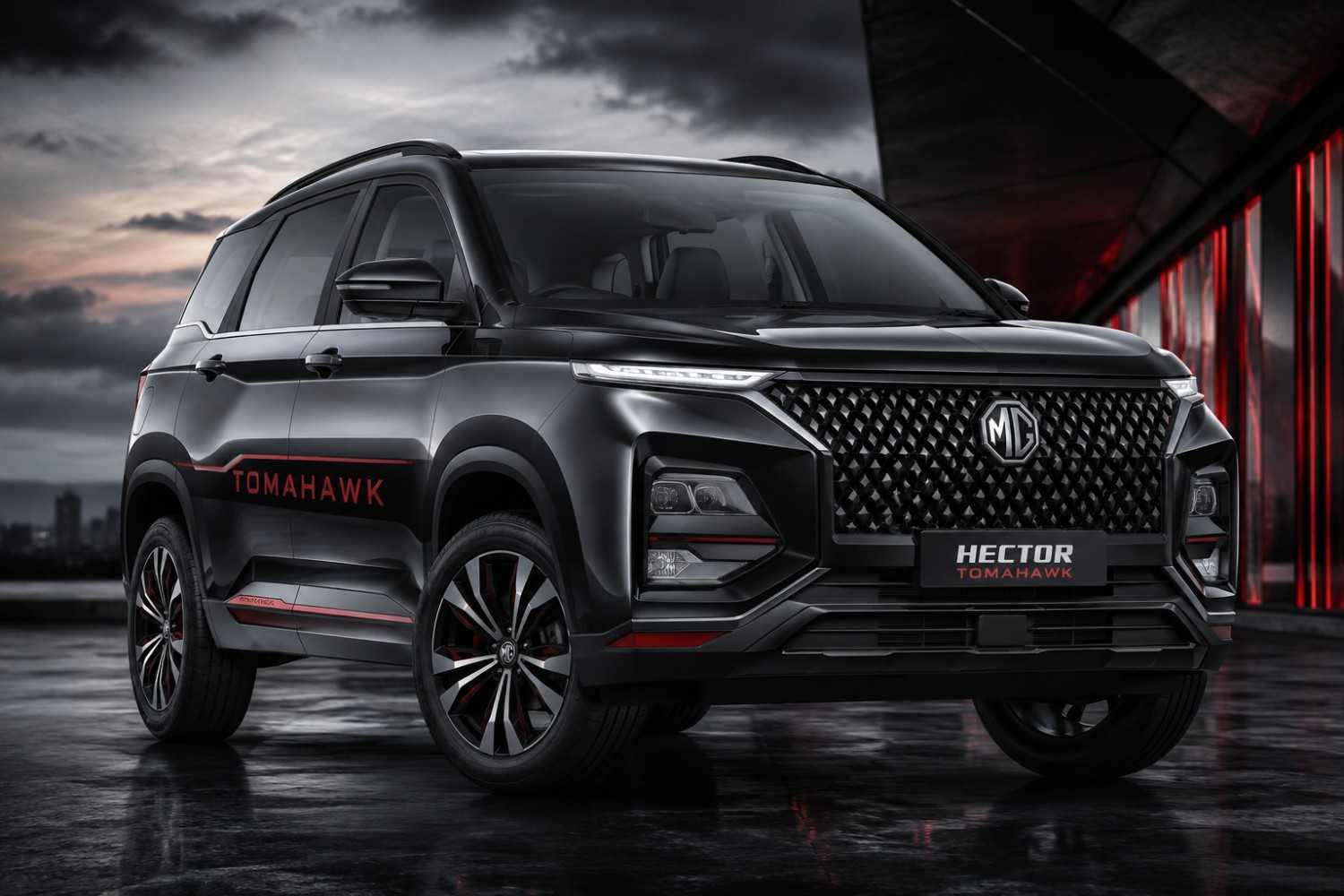
MG Hector Tomahawk EV & PHEV: Price, Range, Features and My Honest Buying Advice for India
I still remember buying my first bike with hard-earned money. That feeling is different. When you spend your own money on a vehicle, you don’t just look at the screen size, sunroof or road presence—you ask the simple question every Indian asks: “Bhai, paisa vasool che ke nahi?”
I have been writing about automobiles and technology since 2020 through ABTADKA, and I have seen the Indian buyer become much smarter. People now check running costs, battery warranty, service expenses, resale value and real-world practicality before signing an EMI.
That is exactly how I am looking at the new MG Hector Tomahawk.
The Tomahawk has arrived in India on August 26, 2026, and this is not simply another version of the Hector we already know. It is a new SUV based on MG’s ADAPT (Advanced Drive Architecture Platform Technology), offered as a pure EV and as a plug-in hybrid (PHEV). The EV gets a 69.2 kWh LFP battery and a claimed 517 km MIDC range, while the PHEV gets a 20.5 kWh battery and a claimed 115 km electric range.
And honestly, there is one thing that immediately caught my attention: MG is trying to make a big seven-seat SUV feel much more future-ready without forcing every buyer to go fully electric.
[Image: mg-hector-tomahawk-front-three-quarter.jpg | Alt: MG Hector Tomahawk electric SUV front three-quarter view showing its bold futuristic seven-seat design and LED lighting]
Table of Contents
- What is the MG Hector Tomahawk?
- MG Hector Tomahawk EV and PHEV prices
- How much range does the Hector Tomahawk offer?
- Will the Tomahawk work in Gujarat’s 45°C summer?
- What is the ADAPT platform?
- How practical is the seven-seat interior?
- Which technology actually matters?
- EV vs PHEV: Which one should you buy?
- MG Hector Tomahawk vs rivals
- Long-term ownership and maintenance
- My Sihor-style vehicle maintenance routine
- Who should buy the Tomahawk?
- Who should save their money?
- Why trust ABTADKA?
- Frequently Asked Questions
- My final verdict
- SEO information
- Article + FAQ Schema
What exactly is the MG Hector Tomahawk?
Let me clear up one confusion first.
Despite carrying the Hector name, the Hector Tomahawk is not simply the current MG Hector with a new body kit. MG describes it as a model based on its new ADAPT platform, and the EV website highlights a 2,810 mm wheelbase, flexible five- and seven-seat layouts, 23 cm ground clearance and an LFP battery.
That matters because the regular Hector remains a separate petrol SUV in MG’s Indian lineup. The current Hector starts at ₹11.99 lakh and continues with 1.5-litre turbo-petrol power, manual and CVT options, and five- and seven-seat configurations depending on variant.
The Tomahawk is therefore better understood as a new-generation SUV positioned around electric and plug-in-hybrid technology rather than just another Hector facelift.
And that is why I think this launch is more important than the name initially suggests.
MG Hector Tomahawk price in India: Is it actually affordable?
This is where the Tomahawk becomes interesting.
The Hector Tomahawk EV starts at ₹19.49 lakh ex-showroom under conventional ownership. MG also offers a Battery-as-a-Service structure, with an entry price of ₹13.99 lakh plus ₹4.90 per km according to current launch information.
The PHEV starts at ₹25.69 lakh ex-showroom. It is offered as a seven-seater and combines a petrol engine with electric propulsion.
So don’t make the mistake of seeing ₹13.99 lakh and thinking that is the complete cost of the EV.
With BaaS, the battery cost is separated from the upfront vehicle price, so you have to calculate your expected kilometres and compare the total ownership cost before deciding.
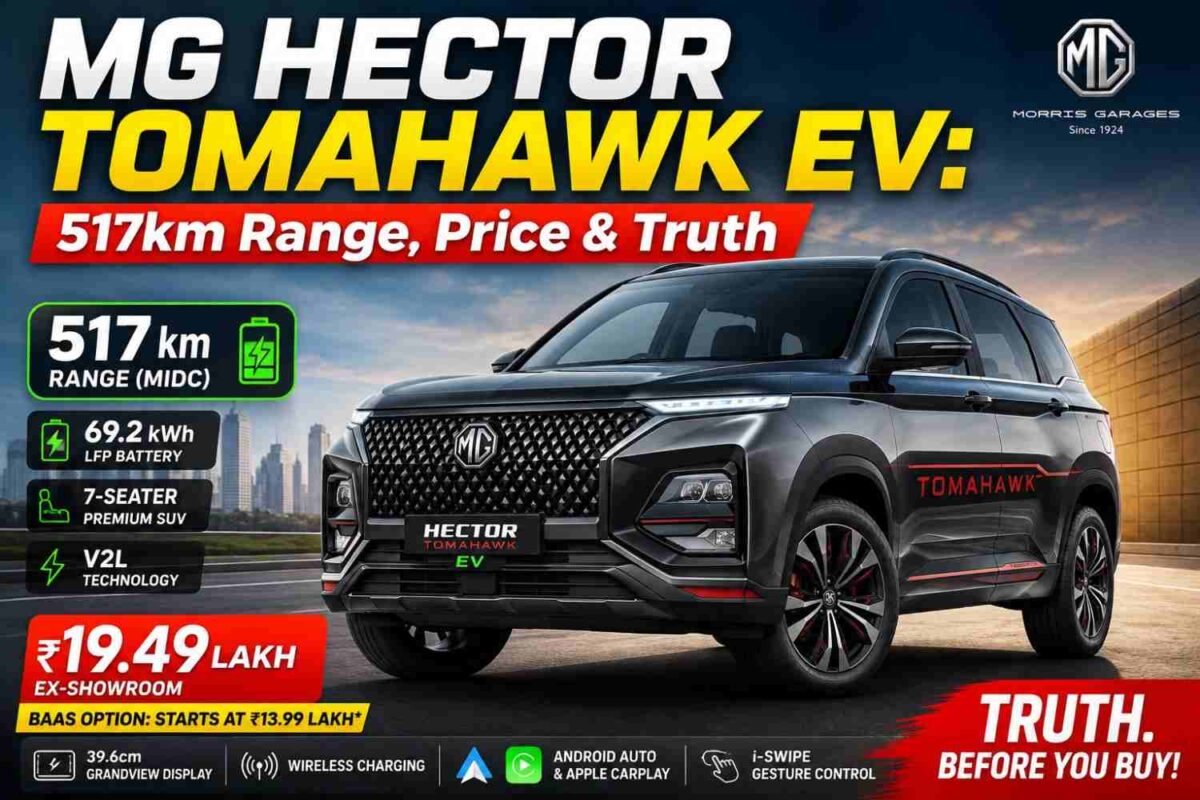
MG Hector Tomahawk price snapshot
| Version | Battery / Powertrain | Claimed range | Starting price |
|---|---|---|---|
| Tomahawk EV | 69.2 kWh LFP | 517 km MIDC | ₹19.49 lakh |
| Tomahawk EV BaaS | 69.2 kWh LFP | 517 km MIDC | ₹13.99 lakh + ₹4.90/km |
| Tomahawk PHEV | 20.5 kWh + petrol | 115 km EV range | ₹25.69 lakh |
| Existing MG Hector | 1.5L Turbo Petrol | Petrol mileage varies | ₹11.99 lakh |
The PHEV price makes it a premium proposition, while the EV looks much more aggressive at its starting price.
[Image: mg-hector-tomahawk-price-baas.jpg | Alt: MG Hector Tomahawk EV price and Battery as a Service BaaS ownership concept for Indian buyers]
How much range does the MG Hector Tomahawk EV offer?
MG claims a 517 km MIDC range for the Tomahawk EV with its 69.2 kWh LFP battery.
I want to make one thing very clear here: 517 km is a certified test figure, not a promise that you will always drive 517 km on Indian roads.
Your real-world range will change with speed, air-conditioning, passengers, tyre pressure, traffic, temperature and driving style.
And Gujarat is a perfect example.
Drive from Ahmedabad towards Bhavnagar in summer with the AC working hard, luggage in the boot and five people inside, and your consumption will not look like a laboratory figure.
What about Gujarat’s 45°C heat?
This is the question I would ask MG before buying any EV.
Our Gujarat summer can touch around 45°C. Then you have dusty village roads, highway heat, strong air-conditioning requirements and, near Bhavnagar’s coastal side, salty humid air.
The Tomahawk EV uses an LFP battery, and MG says the battery has gone through more than 2,000 bench tests and 490+ vehicle validations. MG also lists 23 cm ground clearance for battery protection.
That’s encouraging.
But I would still avoid making a purchase decision purely from the brochure. Battery thermal management, charging behaviour in extreme heat and long-term degradation are the things I would watch over several years.
[Internal Link: EV battery maintenance guide → How to Maintain an EV Battery in India]
Will the Tomahawk survive Ahmedabad heat and Sihor-style roads?
This is where my thinking becomes very Indian.
A car can look fantastic inside a showroom with cold AC and clean flooring. Our roads are different.
Take a route around Sihor. You can get dust, broken patches, speed breakers, village traffic and occasional rough shoulders. Then take the same car to Ahmedabad, where traffic and heat put completely different demands on it.
The Tomahawk’s 23 cm ground clearance is one specification I genuinely like for Indian conditions. MG specifically highlights it in relation to battery protection.
For a family travelling between villages and cities, that matters more to me than having another fancy screen.
What about coastal humidity?
Bhavnagar’s coastal influence means humidity and salty air deserve attention.
I would regularly wash the underside and inspect exposed components, particularly if the car spends considerable time near coastal roads.
EVs don’t have the traditional engine-and-exhaust maintenance list, but that doesn’t mean maintenance becomes zero.
What is MG’s ADAPT platform?
The Hector Tomahawk is MG’s first model in India based on its ADAPT platform.
This is important because the platform has been designed around electrified powertrains rather than simply converting an existing petrol architecture.
The Tomahawk EV uses a single electric motor, while the PHEV combines a petrol engine and electric propulsion.
For a normal buyer, the technical platform name isn’t the important part.
What matters is what it gives you:
- EV and PHEV choices
- Flexible five- and seven-seat configurations for the EV
- 23 cm ground clearance
- 2,810 mm wheelbase
- LFP battery
- V2L capability
- Multiple drive modes
- Advanced connected technology
MG also says the EV has 85% usable floor space, which should help interior packaging.
[Image: mg-hector-tomahawk-interior-dashboard.jpg | Alt: MG Hector Tomahawk EV premium dashboard with large display, ambient lighting, wireless charging and modern cabin]
Is the MG Hector Tomahawk really practical for a family?
This is probably more important than its acceleration.
A family SUV in India has a very different job.
You may have parents sitting in the second row, children in the third row, luggage for a wedding, and five people asking whether the AC is cooling properly.
MG offers the Tomahawk EV with five- and seven-seat flexibility, while the PHEV is offered exclusively as a seven-seater.
The 2,810 mm wheelbase should help cabin space.
But I would personally test the third row before paying the booking amount.
Don’t sit in the first row, look at the huge screen and decide.
Put an adult in the third row.
Then put luggage behind it.
Then test the AC.
That is the real family test.
Which Tomahawk features actually matter to me?
MG has loaded the SUV with technology.
But I don’t want to praise every feature simply because it appears in a brochure.
Here are the ones I think actually matter.
1. 39.6 cm Grand View Display
MG says the Tomahawk gets a 39.6 cm display with Gen AI and karaoke functionality, including access to more than 8,000 songs.
Nice feature, but I would rank it below safety, battery management and charging.
2. Wireless charging
This is genuinely useful.
If I am travelling from Bhavnagar to Ahmedabad and using navigation continuously, having a convenient wireless charging pad is practical.
3. Android Auto and Apple CarPlay
For me, this is more useful than many proprietary entertainment features.
I want my phone navigation, calls and music to work without unnecessary drama.
4. V2L
This is one of my favourite Tomahawk features.
Vehicle-to-load technology can allow the vehicle to power compatible external equipment.
Imagine camping, powering small equipment or using the vehicle as an emergency power source.
That’s technology with a real use case.
5. i-Swipe gesture control
MG describes this as a segment-first feature that lets users control functions such as AC temperature, fan speed, music and volume through hand gestures.
It sounds futuristic.
But I will be honest: I would only call it useful after spending proper time with the system.
If it works reliably, great.
If I have to wave my hand five times to change the temperature, give me a physical button.
What is the MG Hector Tomahawk PHEV?
Now we reach the more interesting question.
What if you want electric driving but you’re still nervous about charging infrastructure?
That’s where the Tomahawk PHEV makes sense.
The PHEV combines a 1.5-litre Atkinson-cycle petrol engine, electric motor and a 20.5 kWh battery. MG claims 115 km of pure-electric range and a combined range of more than 1,100 km.
The engine produces 102 bhp and 125 Nm, while the electric motor produces 201 bhp and 237 Nm according to launch information.
For someone who drives mostly inside Ahmedabad but occasionally travels long distances to smaller towns, that combination can be attractive.
You can use electric power for daily commuting and petrol for longer journeys.
[Image: mg-hector-tomahawk-phev-side-profile.jpg | Alt: MG Hector Tomahawk PHEV seven-seater SUV side profile showing its family-focused design and road presence]
EV vs PHEV: Which MG Hector Tomahawk should you buy?
Here is how I would simplify it over a cup of chai.
Buy the EV if:
- You can charge at home.
- Most of your driving is predictable.
- You want lower routine running costs.
- You travel regularly within cities.
- You are comfortable planning highway charging.
- You want the simpler electric powertrain.
Consider the PHEV if:
- You travel long distances frequently.
- Charging availability is a concern.
- You want electric driving around town.
- You don’t want range anxiety.
- You are willing to pay more upfront.
But don’t buy the PHEV simply because you think “hybrid means mileage automatically.”
Your charging habits will determine how much value you get from its electric capability.
MG Hector Tomahawk vs Tata Harrier EV: Which one makes more sense?
The most obvious electric SUV comparison is the Tata Harrier EV.
The Harrier EV currently starts around ₹21.69 lakh ex-showroom and offers 65 kWh and 75 kWh battery options, with claimed ranges up to 627 km. It also offers RWD and AWD versions, while the Tomahawk EV starts lower at ₹19.49 lakh.
The Harrier EV also has a major safety credential: it has a five-star Bharat NCAP rating for adult and child occupants.
So my comparison isn’t simply “MG wins because it is cheaper.”
My quick comparison
| SUV | Powertrain | Claimed range | Starting ex-showroom | Best reason to consider |
|---|---|---|---|---|
| MG Hector Tomahawk EV | EV, 69.2 kWh | 517 km | ₹19.49 lakh | Price + space + technology |
| MG Hector Tomahawk PHEV | PHEV | 115 km EV | ₹25.69 lakh | Electric + petrol flexibility |
| Tata Harrier EV | EV, 65/75 kWh | Up to 627 km | ₹21.69 lakh | Range + AWD + safety credentials |
| MG Hector | 1.5L turbo petrol | Petrol | ₹11.99 lakh | Lower entry price + conventional ownership |
Prices are ex-showroom and can change; final on-road cost depends on state taxes, insurance, registration and applicable offers.
[Internal Link: Best electric SUVs in India → Best EV SUVs for Indian Families]
What about the MG Hector Tomahawk’s running cost?
This is where Indians naturally ask:
“Kitna deti hai?”
With an EV, we don’t talk about petrol mileage in the traditional sense.
We talk about ₹ per kilometre.
The actual number depends on your home electricity tariff, charging losses, driving style and conditions.
For example, if your car consumes 18 kWh for 100 km and your effective electricity cost is ₹8 per kWh, the energy cost works out to roughly ₹1.44 per km.
At ₹10 per kWh, it becomes about ₹1.80 per km.
That’s before considering charging losses and other ownership costs.
This is why I always tell friends: don’t compare only the showroom price. Compare five-year ownership.
Why Indians should think about longevity before buying
We don’t normally buy a ₹20 lakh-plus SUV thinking we’ll replace it after two years.
We expect it to stay with us.
Maybe five years.
Maybe eight.
Maybe even ten.
So battery health, suspension durability, tyres, electronics, software updates, service network and resale value matter.
An EV has fewer conventional moving powertrain components than a petrol car, but that doesn’t mean every component lasts forever.
Tyres still wear.
Brakes still need inspection.
Suspension still takes punishment.
12V systems still matter.
Air-conditioning still needs servicing.
Software still needs updating.
My Sihor-style monthly maintenance routine
I won’t pretend I have already completed a five-year personal test of the Tomahawk. It has only launched now, so anyone claiming long-term ownership experience today would be misleading you.
Instead, this is the kind of routine I would follow based on how I maintain a long-term vehicle.
Every month
I would check:
- Tyre pressure
- Tyre condition
- Wiper performance
- Washer fluid
- Exterior paint
- Underbody condition
- Charging cable and connector
- Warning lights
- 12V battery condition
- AC performance
And I would clean the car properly.
Gujarat dust doesn’t care how expensive your SUV is.
Protecting the paint from Gujarat sun
Parking under direct sunlight every day is not ideal.
If possible, park under shade.
If not, use a quality car cover when the vehicle is parked for long periods.
Don’t repeatedly wash a dusty car with a dry cloth.
That is how tiny scratches appear.
What about chain cleaning, kerosene and lube?
This is one area where people often mix motorcycle maintenance with car maintenance.
The Tomahawk EV does not have a motorcycle-style exposed drive chain that you clean with kerosene and lubricate with chain lube.
So don’t apply a bike chain-maintenance routine to an EV car.
For your motorcycle, however, I prefer cleaning accumulated grime carefully and using a proper chain cleaner/lubricant according to the manufacturer’s recommendations rather than treating kerosene as a universal solution.
The lesson is simple:
Use the maintenance method designed for the machine you own.
Will the battery survive five to ten years?
This is the question I expect many Indian buyers to ask.
The Tomahawk EV uses an LFP battery, which is generally known for strong cycle-life characteristics.
MG also highlights battery testing and vehicle validation.
But battery longevity depends on more than chemistry.
Charging habits, temperature, battery management, driving pattern and time all matter.
I would avoid constantly running the battery to extremely low levels when it isn’t necessary.
For everyday use, I would follow MG’s recommended charging limits and procedures rather than inventing my own “battery hacks.”
MG Hector Tomahawk resale value after five years
This is the part nobody can honestly guarantee today.
The vehicle launched on August 26, 2026.
So anyone telling you exactly what your Tomahawk will sell for in August 2031 is guessing.
Here is the way I would think about it.
The Tomahawk has several things going for it—MG’s existing Indian presence, a practical SUV format and multiple powertrain choices.
But used-EV battery health reporting and future technology changes could influence resale.
So if resale value is your number-one priority, don’t buy solely on the promise of future appreciation.
Who should buy the MG Hector Tomahawk EV?
I would put the EV on your shortlist if you are a family buyer who:
- Drives 40–100 km regularly.
- Has home charging.
- Wants a spacious SUV.
- Wants lower energy costs.
- Likes technology.
- Plans to keep the car for several years.
- Doesn’t want to spend heavily on petrol every month.
For a professional commuting around Ahmedabad, the EV could make a lot of sense.
For a family travelling between Bhavnagar, Ahmedabad and nearby towns, I would first map the charging network around your actual routes.
Don’t buy an EV based on a charging map of India.
Check your roads.
Who should consider the PHEV?
The PHEV is more interesting for people whose lives are unpredictable.
Suppose you commute in Ahmedabad during the week but suddenly need to drive hundreds of kilometres for family work.
The electric portion can handle regular short trips, while the petrol engine gives you another energy source for longer journeys.
But there is a price.
At ₹25.69 lakh ex-showroom, it costs substantially more than the Tomahawk EV’s ₹19.49 lakh starting price.
So you need to genuinely use the PHEV’s flexibility.
Who should save their money?
I would tell you to wait if:
- You don’t have convenient charging.
- Your monthly driving is very low.
- You mainly drive long highway distances with no charging planning.
- ₹20–₹25 lakh is stretching your budget.
- You are buying only because the SUV looks futuristic.
- You care heavily about predictable resale value.
- You want a proven long-term ownership track record.
There is nothing wrong with waiting.
A vehicle purchase should make your life easier, not create financial stress.
Is the MG Hector Tomahawk good for middle-class Indian families?
This is where I think MG has done something clever.
Instead of saying:
“Everyone must buy an EV.”
MG is effectively saying:
“Choose your electrification level.”
The EV gives you a fully electric route.
The PHEV gives you electric driving plus petrol flexibility.
And the conventional Hector continues separately for buyers who aren’t ready to move away from petrol.
That gives customers more choice.
- All New Bajaj Bikes Price List in India 2026 – Latest Prices

- EV Scooter & Bike Sales Grow 56% in India: 2026 EV
[Image: mg-hector-tomahawk-family-suv-india.jpg | Alt: MG Hector Tomahawk family SUV concept on Indian roads representing practical seven-seat family travel]
Why trust ABTADKA?
I started ABTADKA in 2020 because I wanted to explain technology and vehicles in a way that normal Indian buyers could actually understand.
I don’t believe in copying a specification sheet and calling it a review.
And because the Hector Tomahawk has only launched today, I am not going to pretend that I have personally driven it for 50,000 km.
The pricing, range and specifications in this article are based on current launch information and MG’s published material, while my ownership advice is based on practical Indian vehicle-ownership considerations.
Once long-term real-world ownership data becomes available, that is when I would be comfortable judging battery degradation, service costs and resale value.
That honesty matters more to me than saying “I tested everything.”
MG Hector Tomahawk: My personal recommendation
Here is my blunt answer.
The MG Hector Tomahawk EV is one of the more interesting new SUV launches for Indian families in 2026.
The ₹19.49 lakh starting price puts it in a serious fight with established electric SUVs, while the 69.2 kWh LFP battery, 517 km claimed MIDC range, spacious architecture and five/seven-seat flexibility make the package attractive.
The PHEV is even more unusual.
Its ₹25.69 lakh price is high, but the 115 km claimed electric range and more than 1,100 km combined range target buyers who want electric commuting without giving up long-distance flexibility.
But I wouldn’t blindly book one tonight.
I would first take a proper test drive.
I would sit in all three rows.
I would test the AC.
I would inspect the charging arrangements at home.
I would calculate five-year running costs.
And I would ask the MG dealer one simple question:
“What exactly will my total ownership cost look like after five years?”
That answer is more important than a panoramic sunroof.
For my Gujarat buyer, especially someone driving regularly between Ahmedabad, Bhavnagar and smaller towns, the EV is the Tomahawk version I would investigate first if home charging is available.
If your life includes unpredictable long-distance driving and you genuinely want electric commuting, the PHEV deserves a serious look.
But if your budget is already stretched, don’t let a giant screen and futuristic design push you into a ₹20–₹25 lakh EMI.
A good car should fit your life. Your life should not have to fit the car.
MG Hector Tomahawk FAQ
1. What is the MG Hector Tomahawk price in India?
The MG Hector Tomahawk EV starts at ₹19.49 lakh ex-showroom. MG also offers a Battery-as-a-Service model starting at ₹13.99 lakh plus ₹4.90 per km. The Tomahawk PHEV starts at ₹25.69 lakh ex-showroom.
2. What is the MG Hector Tomahawk EV range?
MG claims a 517 km MIDC range from the 69.2 kWh LFP battery. Actual range will depend on temperature, speed, AC usage, traffic, load and driving style.
3. Is the MG Hector Tomahawk available with seven seats?
Yes. The Tomahawk EV is available with five- and seven-seat configurations, while the PHEV is offered exclusively as a seven-seater.
4. Is the MG Hector Tomahawk PHEV worth buying?
It can make sense for buyers who want electric driving for regular trips but frequently travel long distances. However, at ₹25.69 lakh ex-showroom, it is considerably more expensive than the EV, so your charging and driving pattern should justify the extra cost.
5. Is nitrogen air worth it for the Tomahawk?
For normal road use, I would not make nitrogen a deciding factor. Maintaining the manufacturer’s recommended tyre pressure and checking it regularly is far more important for range, tyre life and safety.
Any Colour option in car ?