
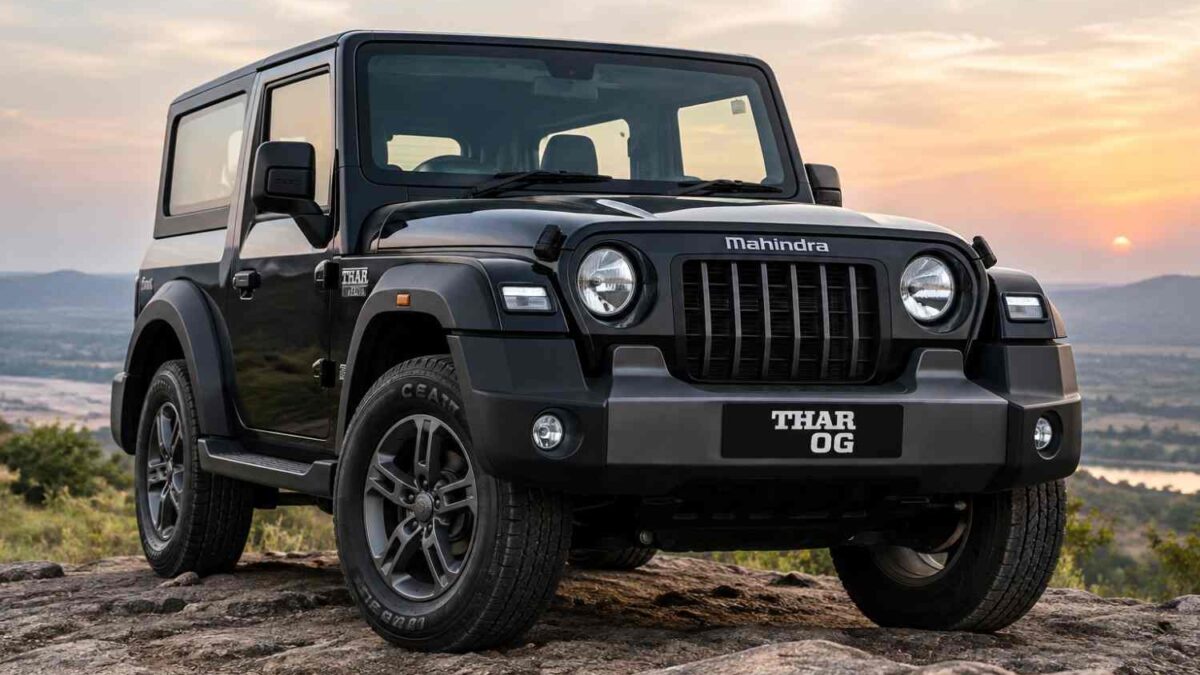
Mahindra Thar OG New Features: Is This the Thar We Were Waiting For?
There is something special about the Mahindra Thar in India. I have watched it go from a rugged, slightly impractical off-roader to one of the most recognizable lifestyle SUVs on our roads.
Since I started ABTADKA in 2020, I’ve seen the Thar become a dream vehicle for everyone from college students and young professionals to business owners in Gujarat. But there has always been one question: can the Thar become easier to live with without losing the rough-and-tough character that made people love it?
Now we have an interesting answer.
Mahindra & Mahindra has launched the Mahindra Thar OG, the heavily updated three-door Thar, at an introductory price starting at ₹10.32 lakh ex-showroom. Deliveries are scheduled to begin on 11 October 2026.
And this isn’t just another grille-and-bumper facelift.
Mahindra has changed the platform, suspension, steering, engines, safety equipment, and off-road hardware. That makes the Thar OG much more interesting than a simple cosmetic update.
Mahindra Thar
One important note before we start: I haven’t physically tested a customer-delivery Thar OG yet, so I won’t pretend that my Sihor road impressions are something I personally experienced. Where I discuss performance or ride quality below, I’m separating Mahindra’s claimed specifications from my practical Indian-owner analysis.
- Mahindra Thar OG New Features: What Really Changed?
- BYD Atto 2 India: The EV SUV Everyone Is Watching
Mahindra Thar OG: What Are We Covering?
Here is everything I’ll break down:
- Mahindra Thar OG price and variants
- What’s actually new in the 2026 Thar
- New M_Glyde 4G platform
- Suspension and ride-quality changes
- New electric power steering
- New terrain modes
- Electronic locking differential
- More powerful petrol and diesel engines
- Six-airbag safety package
- New exterior and interior features
- Thar OG vs older Thar
- Fuel economy and ownership costs
- Gujarat heat, dust, and monsoon maintenance
- Long-term ownership guide
- Which variant makes financial sense
- Frequently asked questions
- My final Thar OG verdict
What Exactly Is the Mahindra Thar OG?
The name can initially be confusing.
This isn’t the five-door Thar ROXX. It is the updated three-door Thar that follows the second-generation model introduced in 2020.
According to Mahindra, the Thar OG is effectively a substantial re-engineering of that three-door formula, rather than merely a visual facelift.
The biggest mechanical changes include:
- M_Glyde 4G platform
- Rear PENTALINK suspension with Watts Link
- DAVINCI damping technology
- Electric power steering
- Electronic locking differential
- Mud, sand, and snow terrain modes
- More powerful 2.2-liter diesel
- More powerful 2.0-litre turbo-petrol
- Six airbags
- Four-disc-brake setup on higher equipment levels
That is quite a list.
And honestly, this is where I think the “OG” name starts making sense. Mahindra isn’t trying to turn this into a completely different SUV. It is trying to make the original three-door concept more sophisticated.
Mahindra Thar OG Price: How Much Does It Cost?
The introductory ex-showroom price starts at ₹10.32 lakh for the AXT 1.5-litre diesel manual RWD.
The range goes up to ₹18.99 lakh ex-showroom for the ZXT 2.2-litre diesel 4WD automatic. Mahindra says these introductory prices are valid for deliveries until November 30, 2026.
That’s the OG introductory price table.
| Variant | Engine | Drivetrain | Transmission | Price* |
|---|---|---|---|---|
| AXT | 1.5L Diesel | RWD | 6MT | ₹10.32 lakh |
| LXT | 1.5L Diesel | RWD | 6MT | ₹12.99 lakh |
| LXT | 2.0L Petrol | RWD | 6AT | ₹14.77 lakh |
| LXT | 2.0L Petrol | 4WD | 6MT | ₹15.60 lakh |
| LXT | 2.2L Diesel | RWD | 6AT | ₹16.49 lakh |
| LXT | 2.2L Diesel | 4WD | 6MT | ₹16.43 lakh |
| LXT | 2.2L Diesel | 4WD | 6AT | ₹18.00 lakh |
| ZXT | Various | RWD/4WD | MT/AT | ₹13.99–₹18.99 lakh |
*Introductory ex-showroom pricing.
The on-road price will obviously be considerably higher depending on your state, insurance, registration, and other charges.
For a Gujarat buyer, therefore, I wouldn’t look at ₹10.32 lakh and immediately assume that is the cheque amount.
What’s Actually New in the Mahindra Thar OG?
This is the part I find much more interesting than the new grille.
The 2026 Thar OG gets a new M_Glyde 4G platform, which Mahindra says has greater structural stiffness. It also gets a new rear suspension setup with PENTALINK architecture and Watts Link.
Why should an ordinary buyer care?
Because platform and suspension changes can affect things you notice every single day:
- stability
- cornering behavior
- ride comfort
- steering response
- highway confidence
- off-road wheel control
A flashy 19-inch alloy gets Instagram attention.
A better suspension setup affects your backside every time you drive over a broken Gujarat road.
Will the New Thar OG Be More Comfortable on Indian Roads?
This is one of the most important changes for me.
Mahindra has added DAVINCI Damping technology with Frequency Dependent Damping (FDD). The company says this is designed to improve ride quality.
The rear suspension also uses PENTALINK with Watts Link.
In simple language, the Thar isn’t just being designed to bounce over rocks anymore. Mahindra is also paying more attention to how the vehicle behaves when you’re driving it every day.
Think about a route between Bhavnagar and Ahmedabad.
You can have smooth highway sections, expansion joints, rough patches, traffic, speed breakers, and suddenly a village road.
An SUV that is brilliant only on an off-road trail isn’t necessarily brilliant as your only family vehicle.
That’s why these changes matter.
- Mahindra Thar OG New Features: What Really Changed?
- BYD Atto 2 India: The EV SUV Everyone Is Watching
New Electric Power Steering: A Small Change That Could Feel Big
The old-school heavy steering feel is part of the Thar’s personality, but parking a large, boxy SUV in a tight Indian market isn’t always fun.
The Thar OG now uses Electric Power Steering (EPS) instead of the previous hydraulic setup. Mahindra specifically highlights easier maneuvering.
This could be particularly useful in:
- crowded markets
- apartment parking
- narrow village lanes
- U-turns
- supermarket parking lots
- tight petrol stations
If you live in Sihor or another smaller Gujarat town, you know exactly what I mean.
You can have a ₹17-lakh SUV, but the road outside your house may still be barely wide enough for two cars.
Terrain Modes: Is the Thar Actually Better Off-Road Now?
This is where things get properly interesting.
The Thar OG 4WD variants get dedicated mud, sand, and snow terrain modes. These modes are designed to adjust the vehicle’s behavior for different surfaces.
There is also an Electronic Locking Differential (ELD) on the relevant 4WD variants.
The ELD is important because it can help send power through the axle when one wheel has less traction, improving the vehicle’s ability to deal with slippery surfaces such as mud or sand.
But let me make one thing very clear.
Don’t buy a 4WD Thar just because Instagram makes it look cool.
If your actual driving is
Home → office → mall → highway → home
Then you may rarely use the full capability.
But if you regularly visit:
- farms
- rocky trails
- beaches where driving is permitted
- muddy tracks
- rural roads
- hill areas
Then the 4WD hardware becomes much more meaningful.
And please don’t take a vehicle onto environmentally sensitive areas or restricted beaches simply because it has a 4WD button.
Mahindra Thar OG Engine Options Explained
The Thar OG continues with three engine options.
1.5-liter diesel
The entry-level D117 CRDe continues to produce:
119 PS and 300 Nm
It is paired with a six-speed manual and offered in RWD configuration.
For someone who wants the Thar look and lifestyle without spending ₹18 lakh, this is the entry point.
But there is a trade-off.
You don’t get the full mechanical firepower of the larger engines.
2.2-liter mHawk diesel
This is one of the biggest changes.
The updated 2.2-liter diesel now produces:
152 PS and 330 Nm
That’s up from the previous 132 PS and 300 Nm according to Autocar India’s comparison.
For people who genuinely use their Thar on highways, hills, or off-road terrain, this is a much more interesting powertrain.
Diesel also fits the Indian “Kitna Deti Hai?” conversation better than a turbo-petrol, although actual mileage will depend heavily on driving conditions.
2.0-litre MStallion turbo-petrol
The 2.0-litre turbo-petrol now produces:
162 PS and 330 Nm
Mahindra lists 119 kW and 330 Nm for this engine.
This is the choice for buyers who prioritize performance and refinement over maximum fuel economy.
But Gujarat summers deserve some thought.
When the outside temperature starts approaching the kind of 40–45°C heat we can experience in Gujarat, frequent hard acceleration, traffic idling, and air-conditioning load can all affect fuel consumption.
So don’t buy a turbo-petrol Thar expecting small-car running costs.
Thar OG Interior: What Has Changed?
The exterior gets attention, but the cabin changes are arguably more useful.
Mahindra has introduced Truffle Brown leatherette upholstery, a second-row soft armrest with cupholder, rear AC vents, and an updated infotainment package on higher variants.
The LXT and ZXT variants get a 26.03 cm HD touchscreen infotainment system, while equipment varies by trim.
The top ZXT also adds things such as
- 19-inch alloy wheels
- wireless charger
- leatherette seats
- leather-wrapped steering
- front parking sensors
- TPMS
- rear camera
- six airbags
- FDD dampers
This is where the Thar is slowly moving away from being a purely rugged toy.
It is becoming easier to justify as an everyday SUV.
Six Airbags: Probably More Important Than the New Alloys
Let’s be honest.
If someone asks me whether I would rather have a beautiful alloy wheel or additional safety equipment, the safety equipment deserves more attention.
The Thar OG gets six airbags, including four HPTS airbags, according to Mahindra. Higher safety equipment also includes all-disc brakes and front parking sensors.
Mahindra also lists ESP with rollover mitigation on the AXT variant.
This is a meaningful upgrade because the Thar is a relatively tall lifestyle SUV.
Safety isn’t something I would treat as an accessory.
Thar OG vs Older Thar: What Changed?
| Area | Previous 3-door Thar | Thar OG |
|---|---|---|
| Platform | Previous-generation architecture | M_Glyde 4G |
| Steering | Hydraulic | Electric Power Steering |
| Rear suspension | Previous setup | PENTALINK + Watts Link |
| Damping | Conventional | DAVINCI/FDD technology |
| 2.2 diesel | 132 PS / 300 Nm | 152 PS / 330 Nm |
| 2.0 petrol | 152 PS | 162 PS |
| Terrain modes | No dedicated system | Mud/Sand/Snow on 4WD |
| Differential | Conventional setup | Electronic locking differential on 4WD |
| Safety | Variant-dependent | Six airbags on higher equipment |
| Styling | Earlier, Thar designed | New grille, C-shaped DRLs, new bumpers |
The engine figures and equipment changes are based on Mahindra and current automotive reporting.
What About Mileage? The Indian “Kitna Deti Hai?” Question
Nobody buys a Thar because they expect Alto-like fuel economy.
Still, fuel consumption matters because ₹100+ fuel bills don’t care how cool your SUV looks.
Current published estimates for the earlier Thar generation put diesel versions around the low-teens km/l and turbo-petrol versions around the single-digit-to-high-single-digit range under typical conditions; real-world results can vary considerably.
For the Thar OG, I would not treat a brochure or online mileage figure as a guarantee.
Your actual number will depend on:
- traffic
- tire pressure
- AC usage
- highway speed
- load
- driving style
- 4WD usage
- terrain
- tire selection
If you are driving through Ahmedabad traffic every day, don’t compare your fuel bill with someone doing relaxed highway kilometres.
Can a Thar OG Survive Gujarat’s Heat and Dust?
This is where Indian ownership is different from reading a specification sheet.
Gujarat can be brutally hot.
Add dust, road construction, summer traffic, monsoon mud, and the saltier coastal environment around parts of Bhavnagar, and your vehicle gets a much harder life than a showroom display car.
My advice for long-term ownership is simple:
1. Don’t ignore air filters.
Dusty roads mean the engine air filter deserves attention.
If you regularly drive on village roads, farms, or construction-heavy routes, ask the service center to inspect it rather than blindly following an assumption that Indian roads are all the same.
2. Watch the cooling system.
In peak summer, the cooling system is critical.
Don’t ignore coolant warnings, unusual temperature behavior, or a cooling fan that suddenly sounds different.
3. Keep the underbody clean.
If you’ve been through mud, wash the underbody properly.
Mud left around mechanical components isn’t a badge of honor.
It’s future maintenance.
4. Protect the paint.
Gujarat’s sun can be harsh.
If possible, park under shade or use a good-quality car cover when the vehicle is stationary for long periods.
My Long-Term Thar Maintenance Routine
I have always believed that Indians don’t want to replace an expensive vehicle every two years.
If someone spends ₹15–18 lakh on an SUV, the sensible question is:
“How do I keep it healthy for 7–10 years?”
For a Thar OG, my practical monthly checklist would be:
Every month:
- Check tire pressures.
- Inspect tires for cuts or uneven wear.
- Check engine oil level.
- Check coolant level.
- Inspect brake behavior.
- Clean the exterior and underbody after muddy drives.
- Check lights and indicators.
- Look for unusual suspension noises.
- Check battery terminals.
- Inspect wiper blades.
Every service interval:
Follow Mahindra’s prescribed service schedule rather than inventing one from YouTube comments.
And don’t use cheap lubricants simply because they save ₹300 today.
That ₹300 can become a much bigger repair bill later.
What About Kerosene and Chain Lubrication?
This question is common among bike owners, but there’s an important distinction.
The Thar does not have a motorcycle-style exposed chain drive that you clean and lubricate with kerosene and chain lube.
So please don’t apply motorcycle chain-maintenance advice to your SUV.
If you’re maintaining your bike alongside the Thar, use the motorcycle manufacturer’s recommended chain-cleaning procedure and a proper chain lubricant. Kerosene is commonly discussed for cleaning chains, but the safe procedure depends on the chain and manufacturer’s guidance.
For the Thar, your attention should instead go toward:
engine → transmission → differential/4WD system → brakes → suspension → tires → battery → cooling system.
That is the maintenance chain that matters here.
Thar OG Ownership Cost: Where Your Money Really Goes
| Ownership area | Approx. concern level | What you should watch |
|---|---|---|
| Fuel | High | Turbo-petrol can consume significantly more in traffic. |
| Tyres | Medium–High | Larger wheels/tyres can be expensive. |
| Insurance | Medium–High | Depends on variant and coverage |
| Routine service | Medium | Follow the manufacturer’s schedule. |
| 4WD hardware | Usage dependent | More important if you are actually off-road |
| Paint/body | Medium | Gujarat sun, dust, and scratches |
| Suspension | Usage dependent | Rough roads and off-road use increase wear. |
These aren’t official annual cost figures; they are practical ownership categories rather than promises of a fixed rupee expense.
Thar OG vs Thar ROXX: Which Is More Practical?
The Thar ROXX is the five-door member of the Thar family, introduced in 2024. It uses the longer 2,850 mm wheelbase and provides additional cabin practicality.
That makes the decision relatively straightforward from a use-case perspective.
Three-door Thar OG
Better suited to someone who prioritizes:
- compact dimensions
- traditional Thar styling
- lifestyle appeal
- occasional off-roading
- two-door-plus-rear-seat configuration
- a more traditional Thar experience
Five-door Thar ROXX
More suitable for someone who regularly needs:
- easier rear access
- more family practicality
- greater cabin space
- more convenient everyday use
The ROXX isn’t simply “better” or “worse”; it solves a different use case.
[Image: mahindra-thar-og-vs-thar-roxx.jpg | Alt: Three-door Mahindra Thar OG and five-door Mahindra Thar ROXX conceptually compared for Indian family and off-road use]
Simple Decision Chart
Here’s my practical way of thinking about it:
                 YOUR USE
                    |
          +---------+---------+
          |                   |
      Mostly city         Off-road / trails
          |                   |
       Need family?        Need 4WD?
       /       \            /     \
     YES       NO          YES     NO
      |         |           |       |
    ROXX      Thar OG    Thar OG   Thar OG
   5-door    RWD/4WD      4WD      RWD
The key isn’t buying the most expensive Thar.
The key is buying the configuration that matches your actual life.
Thar OG Resale and 5-Year Ownership Thinking
I don’t want to invent a five-year resale percentage for a vehicle that has only just launched.
But the ownership logic can be shown honestly:
Fuel Expense
Turbo Petrol       ██████████
Large Diesel       ███████
1.5 Diesel         ██████

Complexity
4WD + ELD          █████████
RWD                ██████
Basic Variant      █████

Off-road Capability
4WD + Terrain     ██████████
RWD + Assist      ██████
Basic RWD         ███
These bars are illustrative, not measured test results.
Your actual running costs depend heavily on kilometers, fuel prices, tires, service history, and driving conditions.
Which Thar OG Variant Makes Sense?
The AXT starts at ₹10.32 lakh, but it is deliberately basic.
You get the entry-level 1.5-liter diesel manual RWD configuration, while the higher trims bring substantially more equipment.
The LXT is where the equipment list becomes much more substantial.
Depending on the powertrain, it brings features such as the touchscreen, color MID, terrain-related hardware on applicable 4WD variants, and additional convenience equipment.
The ZXT adds premium touches, including 19-inch alloys, wireless charging, leatherette upholstery, front parking sensors, and other equipment.
So don’t select a variant only because the starting price looks attractive.
Calculate the on-road price + EMI + insurance + fuel + tire costs.
That’s the number that affects your bank account.
Who Should Buy the Mahindra Thar OG?
I can see the Thar OG making sense for someone who genuinely wants the three-door lifestyle SUV format.
It makes particular sense if you:
- love the Thar’s design
- occasionally travel on bad roads
- want genuine 4WD capability
- enjoy weekend road trips
- don’t need a conventional family SUV
- are comfortable with higher running costs
- want a vehicle that feels different from ordinary crossovers
For a buyer in Gujarat who regularly heads toward rural roads, farms, or outdoor locations, the 4WD hardware can have genuine value.
- Mahindra Thar OG New Features: What Really Changed?
- BYD Atto 2 India: The EV SUV Everyone Is Watching
Who Should Save Their Money?
If your entire requirement is
office → traffic → mall → home
Then don’t buy a Thar merely because everyone around you is buying SUVs.
A compact crossover or more practical five-door SUV may be easier to live with.
Also think twice if you are stretching your finances just to reach the Thar.
A ₹17 lakh SUV with a painful EMI isn’t a victory.
Your emergency fund, insurance, and monthly expenses still exist after the showroom photographs.
Why Trust ABTADKA?
I’ve been writing about technology, automobiles, and consumer products through ABTADKA since 2020.
My approach is simple: don’t just repeat the brochure.
I want to understand what a product means for a normal Indian buyer.
For the Thar OG, that means asking questions like
Will the feature actually be useful?
Will it increase maintenance?
Does the extra ₹2–3 lakh buy something meaningful?
Can a person comfortably maintain it for years?
Those questions matter much more to me than simply counting LED lamps.
Frequently Asked Questions
Is the Mahindra Thar OG a new-generation Thar?
The Thar OG is the substantially updated three-door Thar launched in September 2026. It uses the M_Glyde 4G platform and receives significant suspension, steering, powertrain, safety, and feature changes.
What is the Mahindra Thar OG starting price?
The introductory starting price is ₹10.32 lakh ex-showroom for the AXT 1.5-litre diesel manual RWD.
Does the Thar OG have 4WD?
Yes, selected LXT and ZXT powertrain combinations are available with 4WD. The 4WD versions also get features such as terrain modes and an electronic locking differential.
Does the Thar OG get six airbags?
Higher equipment includes six airbags, and Mahindra specifically highlights four HPTS airbags for head, pelvis, thorax, and shoulder protection.
Is the Thar OG good for daily driving?
The new electric power steering, revised suspension, DAVINCI damping, and improved NVH insulation are specifically aimed at making the three-door Thar more comfortable and easier to use every day.
Mahindra Thar OG: My Final Take
The biggest story about the 2026 Mahindra Thar OG isn’t the new grille.
It isn’t even the 19-inch wheels.
For me, the interesting part is that Mahindra has worked on the things you normally don’t see in a showroom photograph.
Platform. Suspension. Steering. Damping. Differential. Engines. Safety.
That tells me this update is aimed at making the three-door Thar a more complete vehicle rather than simply giving it another cosmetic refresh.
The new 2.2-litre diesel’s 152 PS and 330 Nm, the 2.0-litre petrol’s 162 PS and 330 Nm, the M_Glyde 4G platform, PENTALINK suspension, terrain modes, and ELD make the mechanical package considerably more serious.
But there is still a practical Indian question.
Do you actually need all of it?
If you want the Thar experience and can comfortably afford its running costs, the OG is a much more interesting proposition than a simple facelift would have been.
If you are buying purely for city commuting, calculate the total ownership cost before signing that loan document.
Because in my kind of Sihor-style thinking, the best vehicle isn’t the one with the biggest feature list.
It’s the one you can happily maintain, enjoy, and keep for years without your monthly budget becoming a headache.