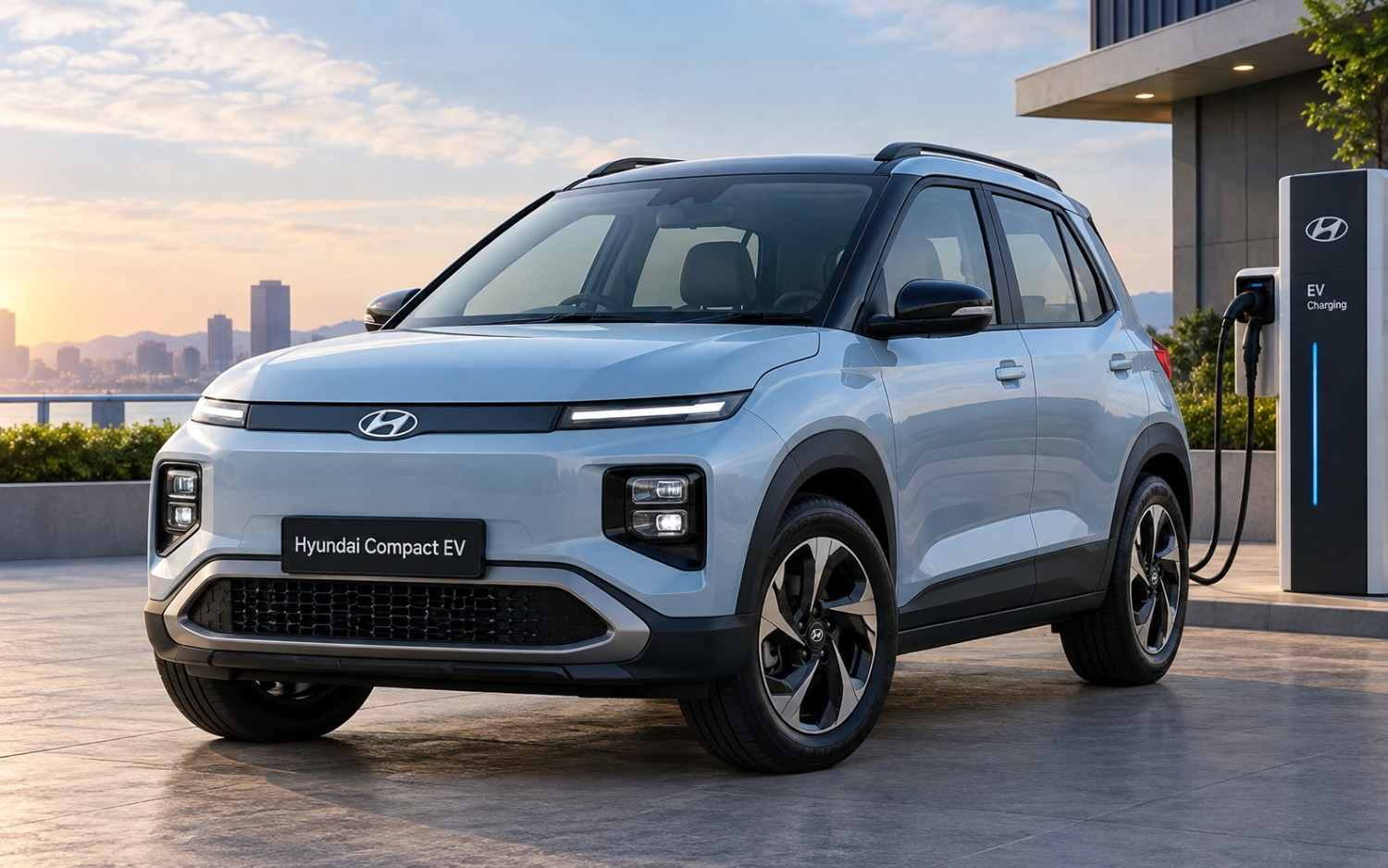
Hyundai Compact EV India: The Small Electric SUV That Could Change Hyundai’s Game
Updated: September 27, 2026
There is one thing I have learned after years of watching Indian car buyers: we don’t buy a vehicle only because it looks good in a showroom.
We ask much simpler questions.
Kitna deti hai? Service kitni padegi? Battery kitne saal chalegi? Ahmedabad ki garmi mein kya hoga? Aur resale mein kitna milega?
I understand that mindset because I have been around Indian automobiles and technology since I started ABTADKA in 2020. Over these years, I have seen how quickly a flashy specification can attract attention—and how quickly practical ownership questions bring buyers back to reality.
Now Hyundai is preparing another important move for India: a localized compact electric SUV.
The model is currently being reported under the internal/codename HE1i, and Hyundai has confirmed that a dedicated compact SUV EV is part of its India product plan. Recent reporting says the vehicle is expected before the end of 2026, although Hyundai’s broader investor communication had pointed to the compact dedicated EV debut within FY2026-27.
This is important because Hyundai already sells the CRETA Electric and IONIQ 5 in India. The new compact EV would sit much lower in the market and potentially bring Hyundai’s electric-car technology to a much larger group of Indian families.
But should you start saving your money for it?
Let’s talk about it like two friends sitting at a Galla in Sihor—not like a brochure.
Table of Contents
- What is Hyundai’s new Compact EV?
- Is the Hyundai Compact EV the same as the Inster?
- When will the Hyundai Compact EV launch in India?
- What could the Hyundai Compact EV cost?
- What battery and range can we expect?
- Will it handle Gujarat’s 45°C summer?
- What could charging look like?
- What features could Hyundai offer?
- How practical will it be for an Indian family?
- Hyundai Compact EV vs. Tata Punch EV and other rivals
- What about maintenance after 5 years?
- My Sihor-style EV ownership checklist
- Resale value: the question nobody should ignore
- Who should wait for Hyundai’s Compact EV?
- Who should buy an EV right now?
- Why trust ABTADKA?
- Frequently Asked Questions
- Bhavik’s Verdict
- SEO Information
- Article + FAQ Schema
What exactly is Hyundai’s new Compact EV?
The easiest way to understand Hyundai’s upcoming compact EV is this:
It is supposed to be Hyundai’s localized, more affordable electric SUV for the Indian mass market.
Hyundai India has already confirmed that it plans to introduce a localized dedicated EV in the compact SUV space. Its FY2026-27 outlook specifically describes one of its new nameplates as the debut of a localized dedicated EV in the compact SUV segment.
Recent automotive reporting identifies the project as HE1i and says it will use the E-GMP (K) platform, the architecture also associated with the international Hyundai Inster.
That doesn’t mean the Indian car will simply be an Inster with an Indian number plate.
This is where buyers need to be careful.
The globally sold Inster is an A-segment subcompact EV. Hyundai describes it as an urban-focused EV with a compact footprint, flexible interior, and projected range of up to 355 km WLTP in its long-range configuration.
The India project is expected to be positioned more aggressively for our market.
And that is exactly what makes it interesting.
Is the Hyundai Compact EV the same car as the Hyundai Inster?
Not necessarily.
This is probably the biggest point I would highlight for an Indian buyer.
The Hyundai Inster is already an established global product. Hyundai introduced it internationally in June 2024 as its A-segment subcompact EV. It uses 42 kWh and 49 kWh battery options internationally, depending on configuration.
The India-bound compact EV, however, is being described as a localized product.
Automotive reporting currently connects it to the Inster’s E-GMP (K) architecture, but the final India-spec battery, motor, dimensions, equipment, and pricing should not be treated as confirmed until Hyundai announces them.
So when you see someone online writing:
“Hyundai Inster India will definitely have an X km range.”
Take that with a little salt.
Global specifications are not automatically India specifications.
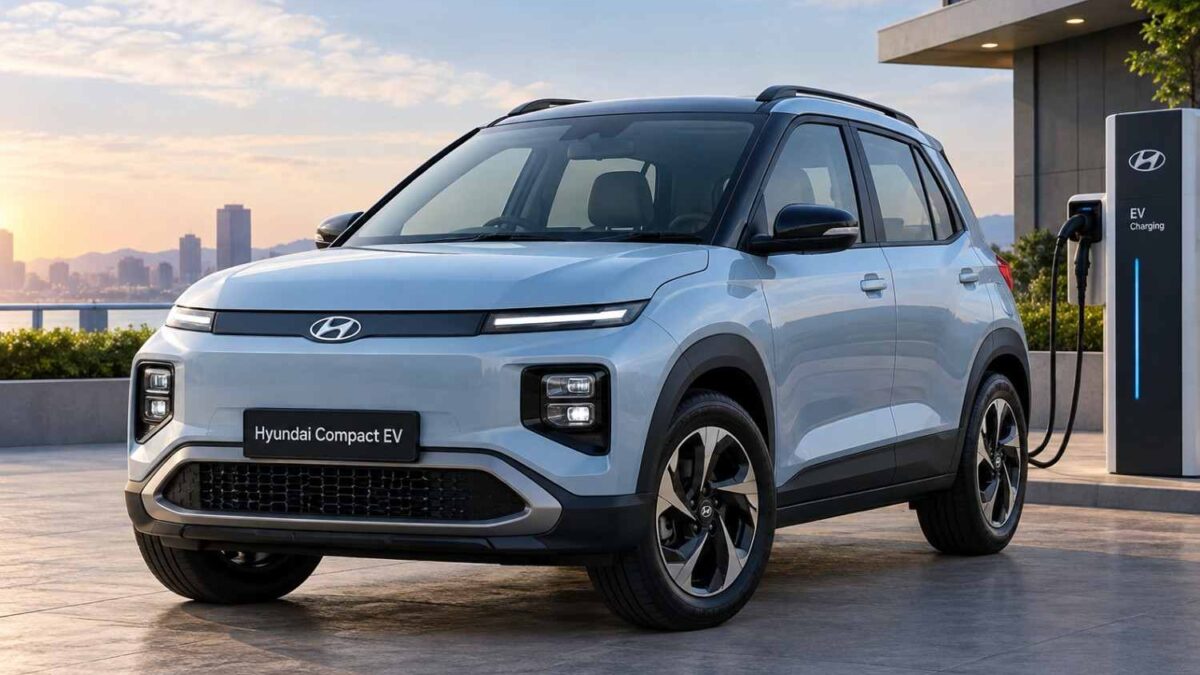
- Hyundai Compact EV India: The Small EV to Watch
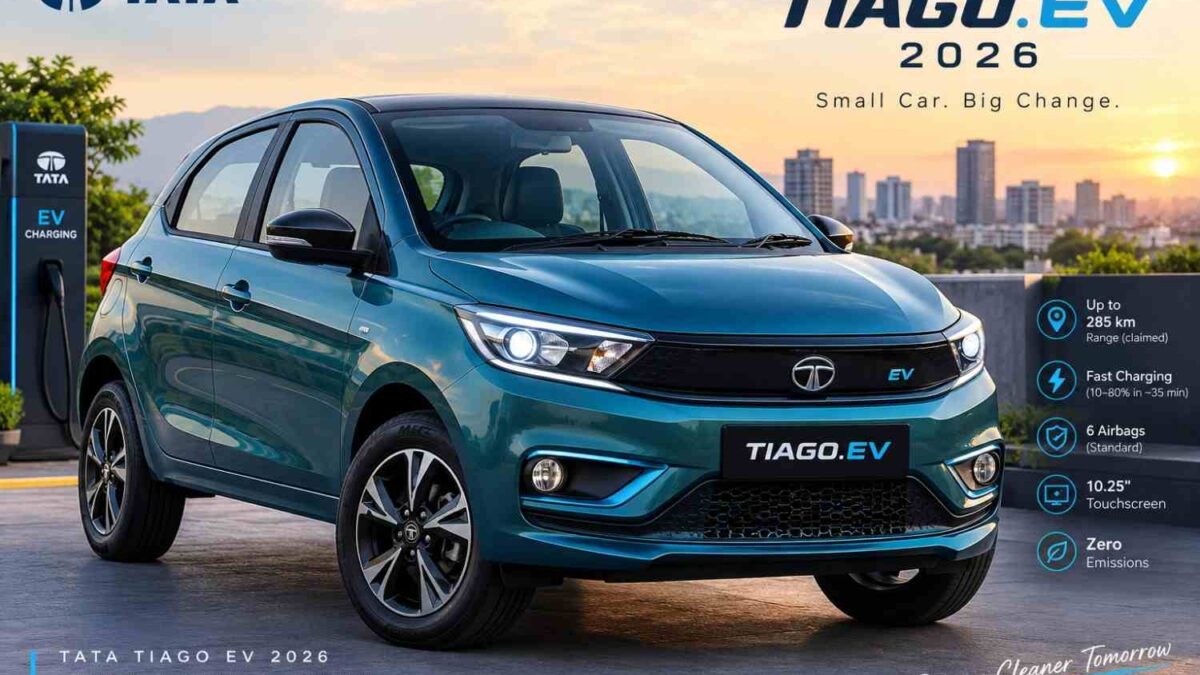
- Tata Tiago EV 2026: Is it ₹6.99 Lakh? Really Worth It?
When will the Hyundai Compact EV launch in India?
This is where the story has become particularly interesting.
A September 2026 report from Autocar India says Hyundai’s compact EV is expected by the end of 2026, while Hyundai’s own FY2026-27 outlook places the localized dedicated EV launch within the financial year.
However, expected dates are not the same as an official launch date.
So I would not put a hard booking date in your diary until Hyundai officially announces it.
The good news is that Hyundai is clearly preparing its EV ecosystem.
In September 2026, Hyundai India said it had 185 DC fast-charging stations across 105 cities, with plans to scale its proprietary network further. Hyundai also said its myHyundai app provides access to more than 38,000 charging points through charging-operator partnerships.
For an EV buyer in Gujarat, that infrastructure story matters almost as much as the car itself.
What could the Hyundai Compact EV cost?
This is still an estimate, not an official price.
Current automotive reporting places the expected Hyundai compact EV around the ₹10 lakh–₹13 lakh territory, while another current listing estimates roughly ₹12 lakh.
I would personally wait for Hyundai’s official price announcement before comparing EMI or on-road cost.
Why?
Because ₹10 lakh ex-showroom and ₹13 lakh ex-showroom are two completely different ownership stories.
If Hyundai manages to position the car aggressively, it could enter a part of the market where many middle-class families currently consider petrol compact SUVs or smaller EVs.
But if the fully equipped versions move much higher, buyers may naturally start comparing it with larger electric SUVs.
That is where the final pricing will become critical.
What battery and range can we expect?
This is one area where we have some useful clues—but not final India specifications.
The global Hyundai Inter is available with:
| Specification | Global Internet Reference |
|---|---|
| Standard battery | 42 kWh |
| Long-range battery | 49 kWh |
| Base motor output | 97 PS |
| Long-range motor output | 115 PS |
| Torque | 147 Nm |
| Maximum projected WLTP range | Up to 355 km |
| DC charging | Up to 120 kW |
These are global Inster figures and should not be copied into an India-spec Hyundai Compact EV article as confirmed specifications. Hyundai’s official global material lists the 42 kWh and 49 kWh configurations and the 355 km projected WLTP figure for the long-range model.
For India, I would rather see Hyundai prioritize usable real-world range than chase a giant number on a brochure.
Because Gujarat is not Europe.
Here we have 40°C-plus summer days, air-conditioning running hard, dusty roads, highway speeds, and sometimes long distances between convenient charging points.
For me, usable range is more important than headline range.
Will the Hyundai Compact EV survive Gujarat’s 45°C heat?
This is the question I would personally ask Hyundai before asking about ambient lighting.
I live around Gujarat and know what summer feels like.
Leave a car outside in the sun around Ahmedabad or Bhavnagar, and the cabin can become brutally hot. Add the coastal salt-air humidity around Bhavnagar and dusty village roads, and Indian EV ownership has different challenges from a laboratory test.
The battery management system therefore matters enormously.
Hyundai says its existing EV portfolio uses battery-management technology and liquid-cooled battery layouts.
But don’t automatically assume that every final detail of the upcoming compact EV will match the existing CRETA Electric.
That is something I would verify from the final technical specification sheet.
For a buyer, I would specifically ask about:
- Battery cooling system
- Battery warranty
- High-temperature charging behavior
- DC fast-charging limits
- Battery thermal protection
- Recommended charging practices
- Warranty conditions
- Underbody battery protection
Those questions are much more important than whether the dashboard has one extra screen.
How expensive will it be to charge?
This is where EV ownership becomes attractive for many daily commuters.
Suppose your home electricity cost effectively works out around ₹8 per kWh.
A hypothetical 40 kWh charging session would consume approximately:
40 × ₹8 = ₹320
The actual amount depends on your tariff, charging losses, battery state, and charging setup.
That is not an official running-cost figure for the Hyundai Compact EV. It is simply an example to explain the calculation.
This is the calculation I recommend every buyer perform.
Don’t ask only:
“Petrol car kitna deti hai?”
Ask:
“Meri daily running kitni hai, aur mujhe actual energy cost kitni padegi?”
If someone drives 50–70 km every day, the economics can look very different from someone who drives 200 km a month.
What could charging look like?
The global Inster supports DC fast charging, with Hyundai quoting approximately 10–80 percent charging in around 30 minutes under suitable conditions.
Again, that is the global internet.
The India-spec compact EV may differ.
For my kind of Indian buyer, I would look for three charging situations:
Home charging
This should be your primary charging method if you have reliable parking and electrical access.
Overnight charging is the biggest convenience of an EV.
You come home.
Plug in.
Sleep.
In the morning, the car is ready.
Public AC charging
Useful when you’re shopping, working, or travelling around town.
DC fast charging
This becomes important for Bhavnagar–Ahmedabad-type highway trips.
I would not want a compact EV to be judged only by its city range. The real test is how easily an owner can manage an unexpected highway journey.
- Hyundai Compact EV India: The Small EV to Watch
- Tata Tiago EV 2026: Is it ₹6.99 Lakh? Really Worth It?
What features could Hyundai offer?
Hyundai’s international Inster already demonstrates the sort of technology that can fit into a small EV.
Depending on market and variant, the global model offers features such as dual 10.25-inch displays, wireless charging, ambient lighting, V2L capability and advanced driver assistance systems.
The upcoming India compact EV has also been reported to receive a next-generation infotainment system and Level 2 assisted driving technology.
But here I would again put a big asterisk.
Expected feature ≠ confirmed India feature.
Indian variants often differ.
So wait for the official brochure before making a booking decision.
Why does a compact EV make sense for Indian families?
Because size matters.
A massive electric SUV is not always the answer.
If you live in Ahmedabad, Surat, Rajkot, Bhavnagar or another growing city, you may spend plenty of time squeezing through traffic, finding parking and navigating narrow lanes.
A compact electric SUV can make much more sense for that lifestyle.
You get:
- Easier parking
- Instant electric torque
- Lower routine powertrain maintenance
- Quiet city driving
- Potentially lower running costs
- SUV-style seating position
- Easier daily commuting
That last point matters to me.
Technology is useful only when it makes your everyday life easier.
Hyundai Compact EV vs Tata Punch EV and other rivals
The competitive picture is likely to become crowded.
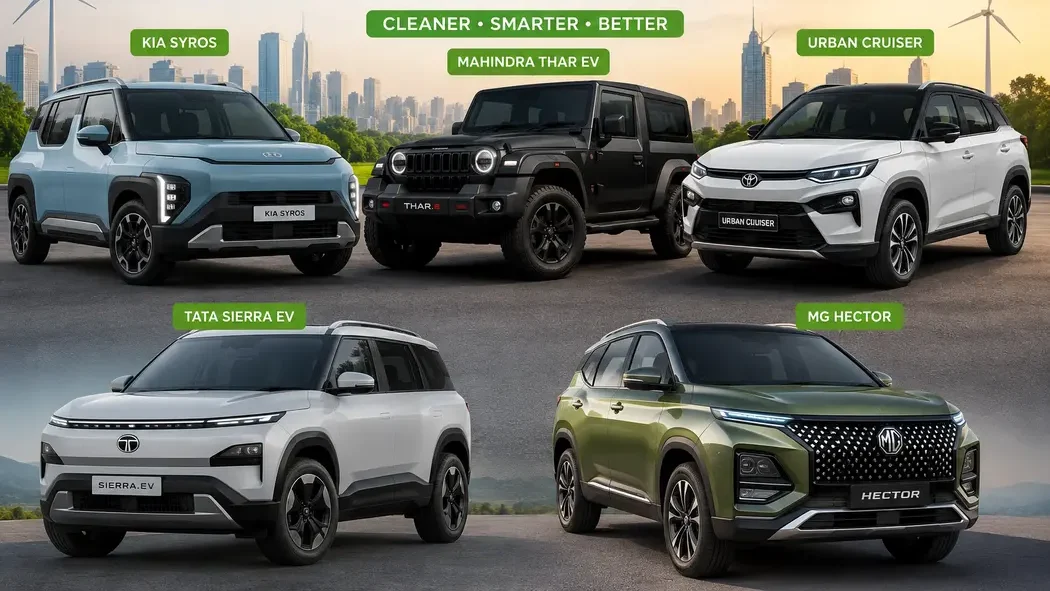
Current reporting identifies the Tata Nexon EV, Mahindra XUV 3XO EV and Kia Syros EV as relevant competitors for Hyundai’s upcoming compact EV.
Depending on final pricing, smaller EVs such as the Tata Punch EV, Tata Tiago EV and MG Comet EV may also enter a buyer’s consideration set.
| Vehicle / Project | Powertrain | Approx. positioning | Key buyer question |
|---|---|---|---|
| Hyundai Compact EV | Electric | Compact SUV | Price + range + Hyundai service |
| Tata Punch EV | Electric | Compact SUV | Value + established EV presence |
| Tata Nexon EV | Electric | Compact SUV | Space + performance + range |
| Mahindra XUV 3XO EV | Electric | Compact SUV | SUV practicality + technology |
| Hyundai Inster | Electric | Global sub-compact | Reference for Hyundai’s small-EV technology |
The Hyundai model’s biggest unknown today is not whether the concept is interesting.
It is where Hyundai finally places it on the price ladder.
What about maintenance after 5 years?
Here is where EVs are fundamentally different from petrol bikes and cars.
I have spent years talking about traditional vehicle maintenance, and I still believe the basic Indian rule remains:
Take care of the machine before it asks for help.
But an EV changes the checklist.
There is no traditional engine oil to replace.
There is no petrol engine air filter in the conventional sense.
There is no engine timing system to maintain in the same way.
And there is no conventional manual transmission clutch to wear out.
But that does not mean an EV is maintenance-free.
You still have:
- Tyres
- Brake components
- Suspension
- Steering components
- Wipers
- Air-conditioning system
- Cabin filter
- 12V electrical system
- Cooling systems
- Battery electronics
- Software
- Charging hardware
So don’t believe anyone who says:
“EV mein maintenance zero hai.”
That is not how ownership works.
What about chain cleaning?
This is where I need to correct the traditional bike-maintenance section for an EV.
A car like the Hyundai Compact EV does not have a motorcycle drive chain that you should clean with kerosene and lubricate.
So please don’t take an old bike-maintenance routine and apply it to an EV.
For my own two-wheeler maintenance, chain cleaning and lubrication are relevant.
For an EV car, I would instead focus on:
Tyre pressure → brake inspection → suspension → underbody inspection → cooling system → charging equipment → software → battery health.
That’s the Sihor-style practical checklist.
My monthly Sihor-style EV maintenance routine
If I eventually own a compact EV, this is the kind of routine I would follow.
Week 1: Tyres
Check tyre pressure when the tyres are cold.
Gujarat heat can make pressure readings behave differently after a long drive, so don’t blindly compare a hot-tyre reading with the recommended cold pressure.
Week 2: Exterior
Wash dust and road grime.
If the car spends time under the Gujarat sun, I would prefer covered parking whenever possible.
Week 3: Charging equipment
Inspect the home charger, cable and connector.
Don’t use damaged charging equipment just because the car still starts charging.
Week 4: Underbody and brakes
If I’ve driven on dusty village roads or rough surfaces, I would have the underbody checked during scheduled service.
Regenerative braking can reduce friction-brake use, but brake components still need inspection.
This is not complicated.
It is simply the same Indian habit of caring for an expensive machine.
How should you protect the EV from Gujarat’s sun?
Paint protection isn’t only about making Instagram photographs look good.
The combination of strong sunlight, dust and heat can age exterior surfaces.
My basic routine would be:
Covered parking > shade > regular washing > gentle drying > occasional paint protection.
Avoid wiping a completely dusty car with a dry cloth.
That is how tiny scratches start appearing.
And if your car is parked near the Bhavnagar coast, remember that salty air adds another reason to keep the exterior clean.
What could resale value look like after 5 years?
This is where I would not make a fake prediction.
Nobody can honestly tell you today exactly what this unreleased Hyundai EV will be worth in 2031.
Battery health, new EV technology, government policies, charging infrastructure, used-EV demand and Hyundai’s future products will all influence resale.
So rather than giving you a fake resale percentage, here’s the logic I would use.
NEW EV
  |
  v
Battery health + warranty
  |
  v
Service history
  |
  v
Accident history
  |
  v
Charging condition
  |
  v
Used-EV market demand
  |
  v
RESALE VALUE
A clean service history will matter.
Battery documentation will matter.
And buyers will increasingly ask for battery-health information.
That could become as normal as checking kilometres on an odometer.
Five-year ownership thinking
Here’s how I think a value-conscious Indian should approach the Hyundai Compact EV.
| Ownership factor | Year 1 | Year 3 | Year 5 |
|---|---|---|---|
| Battery health | Critical | Very important | Extremely important |
| Tyres | Low wear | Medium | Replacement may arise |
| Brake wear | Usually low | Inspection | Inspection/replacement depending on use |
| Software | Updates | Updates | Updates |
| Paint | Protect early | Inspect | Maintain |
| Resale documentation | Start record | Maintain | Very important |
The mistake would be buying an EV today and thinking only about today’s EMI.
Think about the person who will buy your car five years later.
That mindset saves money.
Is Hyundai’s service network ready for EV owners?
This is actually one of Hyundai’s stronger areas to watch.
In September 2026, Hyundai India said it had 2,600+ trained dealership service personnel available for EV maintenance and repair, and it plans to expand its EV-ready network further.
Hyundai also said it plans to expand to 820 EV-ready sales and 650 workshop touchpoints by the end of FY2026-27.
For me, this matters more than a fancy launch event.
If you’re buying a car for five to ten years, the question isn’t:
“How cool is it on launch day?”
The question is:
“Who will repair it when something goes wrong on a Tuesday morning five years later?”
That is where network strength matters.
- Hyundai Compact EV India: The Small EV to Watch
- Tata Tiago EV 2026: Is it ₹6.99 Lakh? Really Worth It?
What should a Gujarat buyer check before booking?
If you’re sitting in Ahmedabad, Bhavnagar, Rajkot or Surat and considering the Hyundai Compact EV, save this checklist.
1. Ask for the battery warranty
Don’t rely on a salesperson saying “long warranty.”
Ask for the exact duration, kilometres and conditions.
2. Ask about battery replacement cost
Even if you never need replacement, you should know the number.
3. Ask about DC charging limits
Frequent fast charging can be useful, but you should understand the manufacturer’s recommended charging practices.
4. Ask for the real dimensions
Don’t buy from photographs.
Check whether it fits your parking space.
5. Sit in the rear seat
Take your parents.
Take your family.
Check knee room and headroom.
6. Check the boot
A compact EV should still handle normal Indian family luggage.
7. Test the AC
This is Gujarat.
I don’t care how beautiful the touchscreen looks if the cabin takes forever to cool.
8. Test it with your family
Don’t test-drive alone.
Load the car with the people who will actually use it.
Who should wait for the Hyundai Compact EV?
I would keep an eye on this car if you:
- Drive mainly inside a city
- Have home parking
- Can install reliable charging
- Travel around 30–100 km on typical days
- Want lower running costs
- Prefer a compact SUV footprint
- Are comfortable waiting for a new model
- Want Hyundai’s service ecosystem
The final price will determine whether the car makes financial sense.
Who should NOT rush into buying it?
If you regularly drive huge highway distances and don’t have reliable charging access, don’t buy an EV simply because everyone is talking about EVs.
Similarly, if your parking situation doesn’t allow convenient charging, think carefully.
An EV is fantastic when your charging routine is easy.
It becomes frustrating when charging is a daily logistical problem.
What about long trips from Bhavnagar to Ahmedabad?
This is the kind of trip I would use to judge the car.
Not a five-kilometre showroom test.
A proper highway journey.
Bhavnagar to Ahmedabad means thinking about:
Starting battery → AC usage → highway speed → charging point → traffic → return plan.
And I would not plan the trip based on the dashboard’s maximum range alone.
I’d maintain a buffer.
That’s the difference between brochure driving and Indian driving.
Hyundai Compact EV: My Pros and Concerns
What looks promising
Localized product
A dedicated localized EV should have better relevance to Indian conditions than simply importing a global model unchanged.
Compact size
This could be useful for urban Indian driving.
Hyundai service ecosystem
Hyundai is actively expanding EV-trained service capability.
Potentially lower running costs
Electric propulsion can substantially reduce energy costs for high-mileage users, particularly when charging mainly at home.
Modern technology
The project is expected to bring newer infotainment and assisted-driving technology.
What I would wait to verify
Final price
This could make or break the value proposition.
India-spec range
Global Inster figures cannot simply be copied across.
Battery warranty
This needs to be read carefully.
Real-world highway efficiency
Brochure numbers don’t tell the entire story.
Rear-seat space
Especially important for Indian families.
Boot space
A compact SUV must remain practical.
FAQ: Hyundai Compact EV
1. What is Hyundai’s upcoming Compact EV in India?
Hyundai is preparing a localized dedicated electric SUV for India’s compact-SUV segment. Current reports identify the project as HE1i and connect it with the E-GMP (K) platform used by the global Inster.
2. When will the Hyundai Compact EV launch in India?
Current reporting indicates a launch by the end of 2026, while Hyundai’s official FY2026-27 outlook confirms the localized dedicated compact EV as one of its planned new nameplates. The exact public launch date should be confirmed by Hyundai.
3. What will the Hyundai Compact EV price be?
Current estimates place it roughly around ₹10 lakh–₹13 lakh, but this is not an official Hyundai price. The final ex-showroom and on-road prices will depend on the variants and launch strategy.
4. What range will Hyundai Compact EV offer?
The India-spec range has not been officially finalized in the public information currently available. The global Inster uses 42 kWh and 49 kWh batteries, with the long-range version targeting up to 355 km WLTP, but those figures should not be treated as confirmed India-spec numbers.
5. Is Hyundai Compact EV suitable for Gujarat?
Potentially, yes—particularly for urban owners with home charging. But Gujarat buyers should wait for confirmed battery cooling, charging, warranty and India-specific range information before making a purchase decision.