Tata Tiago EV 2026 Review: Is This ₹6.99 Lakh EV Actually Worth It?
I still remember the excitement of buying my first vehicle with hard-earned money.
That feeling has stayed with me since I started ABTADKA in 2020. Whether it is a ₹70,000 bike or a ₹10 lakh car, an Indian buyer doesn’t just look at the showroom price. We immediately start calculating EMI, charging or fuel cost, service bills, insurance, and resale value.
And then comes the most Indian question of all:
“Kitna kharcha padega?”
With an EV, that question becomes even more interesting.
The Tata Tiago.ev is now one of India’s most affordable electric cars, and the 2026 facelift has made the proposition considerably more interesting. Tata has refreshed the design, upgraded the cabin, added six airbags as standard, introduced more technology, and reduced the starting ex-showroom price to ₹6.99 lakh for the 19.2 kWh Smart variant.
But a low sticker price doesn’t automatically make an EV cheap to own.
You need to ask a much bigger question:
Can the Tata Tiago EV actually replace a petrol hatchback for a normal Indian family?
Let’s discuss it like two friends sitting over cutting chai in Sihor.
Table of Contents
- What is new in the Tata Tiago EV 2026?
- Tata Tiago EV 2026 price in India
- What battery options does the Tiago EV get?
- Tata Tiago EV range: 226 km or 285 km?
- How much does it cost to charge?
- Is the Tiago EV practical in Gujarat?
- What happens to an EV in 45°C heat?
- Tata Tiago EV charging time
- Tata Tiago EV safety features
- What do you get inside the Tiago EV?
- Is the Tiago EV good for a family?
- Tiago EV maintenance and long-term ownership
- My Sihor-style monthly EV maintenance routine
- Tiago EV vs. petrol and other affordable EVs
- Who should buy the Tiago EV?
- Who should avoid it?
1. What Is New in the Tata Tiago EV 2026?
The 2026 update is not just a new bumper and a different color.
Tata has given the Tiago EV a proper mid-life makeover.
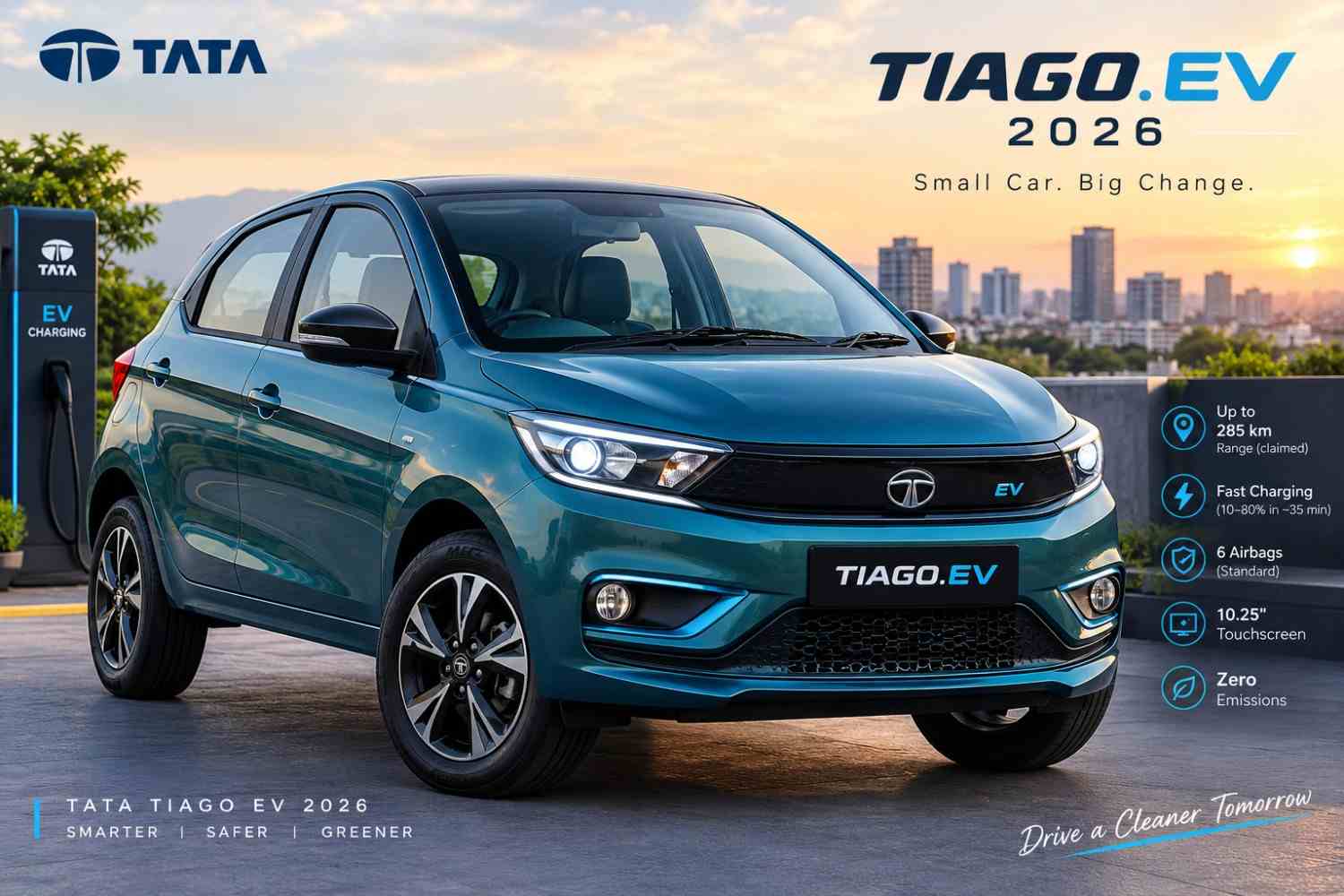
The front gets revised LED lighting, a redesigned body-colored closed grille, and new bumper treatment. At the back, the car gets connected LED tail lamps and a revised bumper. The overall design now looks more closely related to Tata’s newer electric-car family.
[Image: tata-tiago-ev-2026-front.jpg | Alt: Tata Tiago EV 2026 electric hatchback showing its redesigned front LED lighting and modern Indian city-car styling]
Inside, the change is even more noticeable.
The Tiago EV now gets a free-standing 10.25-inch touchscreen infotainment system, a redesigned dual-tone dashboard, an updated center console, and a part-digital instrument cluster. Wireless Android Auto and Apple CarPlay are also available.
For a car that sits in the affordable EV segment, these changes matter.
A student using Google Maps every day, an office worker commuting through Ahmedabad traffic, or a family wanting a second car doesn’t necessarily need a huge SUV.
Sometimes a small car with the right technology makes more sense.
2. Tata Tiago EV 2026 Price: ₹6.99 Lakh Really Possible?
This is where Tata has made the biggest headline.
The 2026 Tiago EV starts at ₹6.99 lakh ex-showroom for the Smart 19.2kWh variant. The range currently extends to ₹9.99 lakh for the Creative+ 24kWh variant under the non-battery-rental pricing structure.
The current variant structure is
| Variant | Battery | Ex-showroom price |
|---|---|---|
| Smart | 19.2 kWh | ₹6.99 lakh |
| Pure+ | 19.2 kWh | ₹8.49 lakh |
| Pure+ | 24 kWh | ₹9.49 lakh |
| Creative+ | 24 kWh | ₹9.99 lakh |
Prices above are ex-showroom and can change. Tata’s own website says final prices should be confirmed with an authorized dealer because prices, taxes, and applicable charges can change.
- Hyundai Compact EV India: The Small EV to Watch
- Tata Tiago EV 2026: Is it ₹6.99 Lakh? Really Worth It?
There is another interesting option.
Tata also offers a Battery-as-a-Service (BaaS) structure that can bring the upfront vehicle price down to ₹4.69 lakh, with a battery rental charge of ₹2.60 per kilometre under the applicable scheme. This is a finance/rental structure rather than a simple ₹4.69 lakh purchase price, so don’t compare that number directly with the conventional ex-showroom price without calculating the battery rental.
This is exactly where my advice becomes blunt:
Don’t choose an EV because the advertisement says ₹4.69 lakh. Calculate the complete ownership cost first.
3. What Battery Options Does the Tiago EV Get?
The 2026 Tiago EV continues with two battery choices.
19.2 kWh battery
The smaller battery is paired with an electric motor producing around 62 hp and 110 Nm, according to current listings.
Tata’s current official information lists the 19.2 kWh battery with an ARAI P1+P2 figure of 221 km, while current market reporting on the 2026 model lists the combined claimed figure at around 226 km depending on the testing presentation/model information.
For normal city commuting, the smaller battery can be perfectly reasonable.
24 kWh battery
This is the battery I would pay more attention to if the Tiago EV is going to be your primary car.
It produces around 75 hp and 114 Nm, and the current facelift is rated at up to 285 km claimed range in Tata’s current product information. Tata also gives a C75 real-world range estimate of approximately 205–215 km for the 24 kWh battery.
That distinction is extremely important.
285 km is not the same thing as promising 285 km in your daily Gujarat driving.
4. Tata Tiago EV Range: 226 km or 285 km?
This is where EV ownership gets misunderstood.
A petrol-car buyer asks:
“Kitna mileage?”
An EV buyer should ask:
“How many kilometers can I comfortably drive between charges?”
The current Tiago EV offers approximately 226km to 285km of ARAI-claimed range, depending on the battery configuration.
But Tata’s own C75 estimates for the current model are lower: approximately 150–160 km for the 19.2 kWh battery and 190–210 km for the 24 kWh battery.
That is much more useful for planning.
Imagine I live in Sihor and mostly use the car for:
- Sihor town
- Bhavnagar trips
- Office commuting
- Grocery shopping
- Family visits
- Occasional highway travel
If my daily distance is 30–50 km, the Tiago EV could fit that routine comfortably.
But if I’m regularly driving 250–300km in a day without a charging plan, I would think differently.
5. How Much Does It Cost to Charge Tata Tiago EV?
This is one of the strongest reasons to consider an EV.
Let’s use a simple example rather than pretending electricity prices are identical across Gujarat.
Suppose your effective home electricity cost is ₹8 per kWh.
A 24 kWh battery theoretically represents roughly:
24 × ₹8 = ₹192
That’s the simple battery-energy calculation.
Real charging cost can be somewhat higher because charging isn’t perfectly efficient and there can be other electricity-use considerations.
Still, compare that with filling a petrol hatchback.
This is where EV ownership can become financially interesting for someone who drives every day.
- Hyundai Compact EV India: The Small EV to Watch
- Tata Tiago EV 2026: Is it ₹6.99 Lakh? Really Worth It?
But there is an important catch.
You need convenient charging.
If you live in an apartment where installing a charger is difficult, the calculation changes.
If you have your own parking space and a reliable electricity connection, the Tiago EV becomes much easier to live with.
6. Is the Tata Tiago EV practical for Gujarat?
Now let’s bring this car into our actual environment.
Gujarat gives cars a tough combination:
45°C summer heat + dust + traffic + long highway stretches + humidity near coastal areas.
Near Bhavnagar, salt-heavy coastal air is another environmental factor that vehicle owners should not ignore.
An EV doesn’t have engine oil or a conventional exhaust system, but that doesn’t mean environmental conditions don’t matter.
Tyres, brakes, suspension, 12V electrical systems, air-conditioning, and the high-voltage battery system still need proper care.
The Tiago EV is a city-focused electric hatchback.
And that’s exactly where it makes the most sense.
If 80–90% of your driving is inside town, the car’s compact dimensions become an advantage.
Parking is easier.
Traffic is less tiring.
And regenerative braking can recover energy during deceleration.
7. What Happens to an EV in 45°C Gujarat Heat?
This is one question I would ask before buying any EV in Gujarat.
High ambient temperatures can affect battery performance and charging behavior. EV battery-management systems are designed to monitor operating conditions, but that doesn’t mean extreme heat should be ignored.
My practical advice is simple:
Don’t leave the car baking in direct sun unnecessarily when shaded parking is available.
If you have covered parking at home, use it.
Keep the charging area properly ventilated and follow Tata’s charging instructions.
And don’t treat an EV battery like a smartphone power bank that you can abuse every day.
Tata’s current 24kWh Tiago EV gets a lifetime high-voltage battery warranty for the first registered owner, while the 19.2kWh battery gets an 8-year/1.6 lakh km warranty, according to Tata’s 2026 launch information.
That is a meaningful ownership consideration.
8. Tata Tiago EV Charging Time: How Fast Can It Charge?
The 2026 Tiago EV gets improved charging capability.
Tata says the updated model can add around 100km of range in 18 minutes under the relevant charging conditions.
With DC fast charging, the battery can charge from 10% to 80% in about 35 minutes using a 30 kW DC charger, according to Tata’s launch information.
For home charging, AC charging remains the normal overnight solution.
And honestly, that’s how I would use it.
Come home.
Plug in.
Sleep.
Wake up.
Drive.
That is a much more relaxed EV routine than visiting a public charging station every morning.
9. Tata Tiago EV Safety: What Has Improved?
The 2026 Tiago EV gets a meaningful safety-equipment upgrade.
Six airbags are now standard, replacing the earlier dual-airbag setup. Tata has also added equipment such as
- ABS with EBD
- ESP
- Traction control
- Hill-hold assist
- TPMS
- 360-degree camera
- Blind-view monitor
- Rear parking assistance
- ISOFIX
- Automatic headlamps on applicable variants
- Rain-sensing wipers on higher variants
Tata also says the updated Tiago EV has increased structural rigidity.
There is an important distinction here.
The conventional Tiago was tested by Global NCAP in 2020, and the Tiago/Tigor result was four stars for adult occupant protection and three stars for child occupant protection in that specific test configuration.
I would not describe that old crash-test result as a direct 2026 Tiago EV crash-test result.
For buyers, the safest approach is to check the exact model-year crash-test applicability rather than assuming every new safety feature automatically changes an old rating.
10. What Do You Get Inside the Tiago EV?
The 2026 cabin is much more modern than the original Tiago EV.
The biggest visual change is the large 10.25-inch touchscreen.
You also get wireless Android Auto and Apple CarPlay on applicable variants, connected-car technology, automatic climate control, cruise control, a cooled glovebox, rear AC vents, and a rotary drive selector on higher variants.
The Creative+ version adds more equipment, including the 360-degree camera, blind-view monitor, LED lighting, rain-sensing wipers, and other convenience features.
For a young professional, these features are useful.
But I would still tell you:
Don’t buy the Creative+ only because it has a bigger screen.
First decide whether you need the 24 kWh battery.
Then decide which features are genuinely useful.
11. Is Tata Tiago EV Good for a Family?
For a small family, yes, the basic formula makes sense.
It is a five-door hatchback rather than a large SUV.
That means compact dimensions, easier city driving, and easier parking.
For a couple with one or two children, it can work very well as an everyday urban car.
But if your family regularly travels long distances with five adults and luggage, I would test the rear-seat space personally before booking.
No specification table can tell me whether my parents will be comfortable after two hours.
Only my parents can tell me that.
The Biggest Tiago EV Advantage: Running Cost
This is where I think Indian buyers should stop looking at the showroom price alone.
Suppose a petrol hatchback gives you around 15 km/l in your actual use.
If petrol costs ₹100/l for simple calculation, your fuel cost is roughly:
₹6.67 per kilometer.
Now suppose your Tiago EV effectively consumes around 0.14–0.16 kWh/km in a particular usage pattern and electricity costs ₹8/kWh.
That’s roughly
₹1.12–₹1.28 per kilometer.
These are examples, not guaranteed real-world figures.
Your electricity tariff, driving style, charging losses, traffic, and climate can change the number.
But the difference shows why an EV becomes increasingly interesting as annual kilometers rise.
12. What About Maintenance?
Here’s something I love about EV ownership.
There is no conventional petrol engine.
So there is no engine oil change.
There is no engine oil filter in the conventional ICE sense.
There is no exhaust system to maintain like a petrol car.
And there is no motorcycle-style chain to clean.
That last point is worth mentioning because many people use generic vehicle-maintenance advice online.
Don’t clean the Tiago EV like a bike.
Kerosene versus chain lube is a motorcycle maintenance question.
The Tiago EV has no exposed motorcycle drive chain.
So please don’t take a “chain cleaning” YouTube tutorial and apply it to your electric hatchback.
Instead, focus on:
- Tire pressure
- Tire wear
- Brake condition
- Suspension
- Wiper blades
- Coolant where applicable
- 12V battery
- Charging equipment
- High-voltage system warnings
- AC performance
- Software/vehicle updates
- Scheduled Tata service
Why Indians Keep Cars for 7–10 Years
This is something I understand deeply.
We don’t always want to replace a car every two years.
A middle-class family often spends years paying the EMI.
Once the loan is finished, the car becomes much more valuable emotionally.
That’s why battery warranty matters.
That’s why service history matters.
That’s why accident-free ownership matters.
And that’s why I would never tell someone to buy an EV without thinking about how they will use it five years from now.
- Hyundai Compact EV India: The Small EV to Watch
- Tata Tiago EV 2026: Is it ₹6.99 Lakh? Really Worth It?
13. My Sihor-Style Monthly EV Maintenance Routine
If this were my own Tiago EV, my monthly check would be simple.
1. Check all four tires.
Look for low pressure, cuts, and uneven wear.
2. Check the charging cable.
Look for visible damage, heat marks, or loose connections.
If something looks abnormal, don’t experiment with electrical repairs yourself.
3. Check the 12V system.
Modern EVs still rely on a low-voltage 12V system for many vehicle functions.
4. Test the air-conditioning
This is especially important in Gujarat.
If cooling performance suddenly drops before summer peaks, get it checked.
5. Listen for new suspension noises.
Dusty village roads and potholes can eventually make themselves known through unusual noises.
6. Clean the exterior properly.
Don’t aggressively rub dry Gujarat dust over the paint.
Use proper washing techniques.
7. Check charging behavior.
If charging suddenly becomes unusually slow or inconsistent, don’t ignore it.
14. How Do You Protect a Tiago EV From Gujarat Sun?
Paint protection doesn’t have to mean an expensive ceramic coating.
Simple habits matter.
Park under shade whenever practical.
Use a quality car cover if appropriate for your parking environment.
Wash dust away rather than rubbing it across the body.
And if the car stays outdoors for hours every day, don’t expect the paint to remain showroom-perfect without some care.
The same principle applies to the cabin.
A car sitting under the Gujarat sun repeatedly will heat up enormously.
Sunshades and shaded parking can make daily life more comfortable.
Tata Tiago EV vs. Affordable Alternatives
Instead of declaring one car universally “best,” I prefer looking at what each type is trying to solve.
| Option | Powertrain | Main Use Case | Approx. Price/Cost Position |
|---|---|---|---|
| Tiago EV Smart | 19.2 kWh EV | Affordable city EV | ₹6.99 lakh ex-showroom |
| Tiago EV Pure+ | 19.2 kWh EV | More equipment | ₹8.49 lakh |
| Tiago EV Pure+ | 24 kWh EV | More range | ₹9.49 lakh |
| Tiago EV Creative+ | 24 kWh EV | Higher equipment | ₹9.99 lakh |
These are current 2026 non-BaaS ex-showroom prices and can change.
If you’re comparing electric hatchbacks, also look at the MG Comet EV and Citroën ë-C3 before making a purchase.
The important comparison isn’t only price.
Look at:
range + charging access + rear-seat comfort + warranty + service network + annual kilometres.
A Simple Tiago EV Buying Logic Chart
                  YOUR DAILY DRIVING
                         │
              ┌──────────┴──────────┐
              │                     │
          UNDER 50 KM           50–100+ KM
              │                     │
              ▼                     ▼
       EV makes sense          EV can make sense
              │                     │
              └──────────┬──────────┘
                         │
                HOME CHARGING?
                    /          \
                  YES           NO
                   │             │
                   ▼             ▼
              MUCH EASIER     THINK CAREFULLY
                   │             │
                   ▼             ▼
              Tiago EV       PUBLIC CHARGING
                fits           dependency
The biggest question isn’t actually battery size.
It is whether charging fits your life.
15. Who Should Buy the Tata Tiago EV?
I would seriously consider it if you:
Drive mostly in a city.
This is where the Tiago EV’s compact size and EV drivetrain make the most sense.
Have home charging
This is almost the secret ingredient.
Drive many kilometers every month.
The more you drive, the more meaningful low energy cost can become.
Want a second family car?
For school runs, office commuting, and shopping, an affordable EV can be practical.
Want lower routine mechanical maintenance
The electric drivetrain removes many conventional engine-related maintenance tasks.
16. Who Should Save Their Money?
I would pause if:
You don’t have reliable charging access.
Public charging dependency can make everyday EV ownership less convenient.
You regularly do long highway journeys.
The Tiago EV can travel outside the city, but frequent long-distance trips require proper charging planning.
Your annual driving is extremely low.
If you drive only a few thousand kilometers a year, the financial case for spending extra on an EV should be calculated carefully.
You expect SUV space.
The Tiago EV is a hatchback.
Don’t buy it expecting Punch or Nexon interior dimensions.
Is the 24kWh Tiago EV Worth Paying More For?
This is probably the most useful question in the entire review.
The 19.2kWh version gets you into EV ownership at a much lower price.
But the 24 kWh version provides more usable range potential and, in the current lineup, the stronger motor.
Tata also gives the 24 kWh battery a lifetime high-voltage battery warranty for the first registered owner under its stated terms.
If I were planning to keep the car for many years and drive it regularly, I would look very carefully at the 24 kWh option.
But I would still calculate the ₹2.5–3 lakh-ish price difference between variants against my actual annual driving.
Don’t spend extra money for a range you never need.