Maruti Suzuki Victoris On-Road Price in Ahmedabad: What You Actually Pay
I still remember the feeling of buying a vehicle with hard-earned money. Since I started working on ABTADKA in 2020, I have learned one thing very clearly: the price printed on a car’s brochure is rarely the amount that leaves your bank account.
That is especially true when you are buying a mid-size SUV like the Maruti Suzuki Victoris.
If you are sitting in Ahmedabad, Bhavnagar, Sihor, Rajkot or anywhere else in Gujarat and searching “Victoria car price on road”, there is one small correction first: the car you are probably looking for is Maruti Suzuki Victoris, not Victoria.
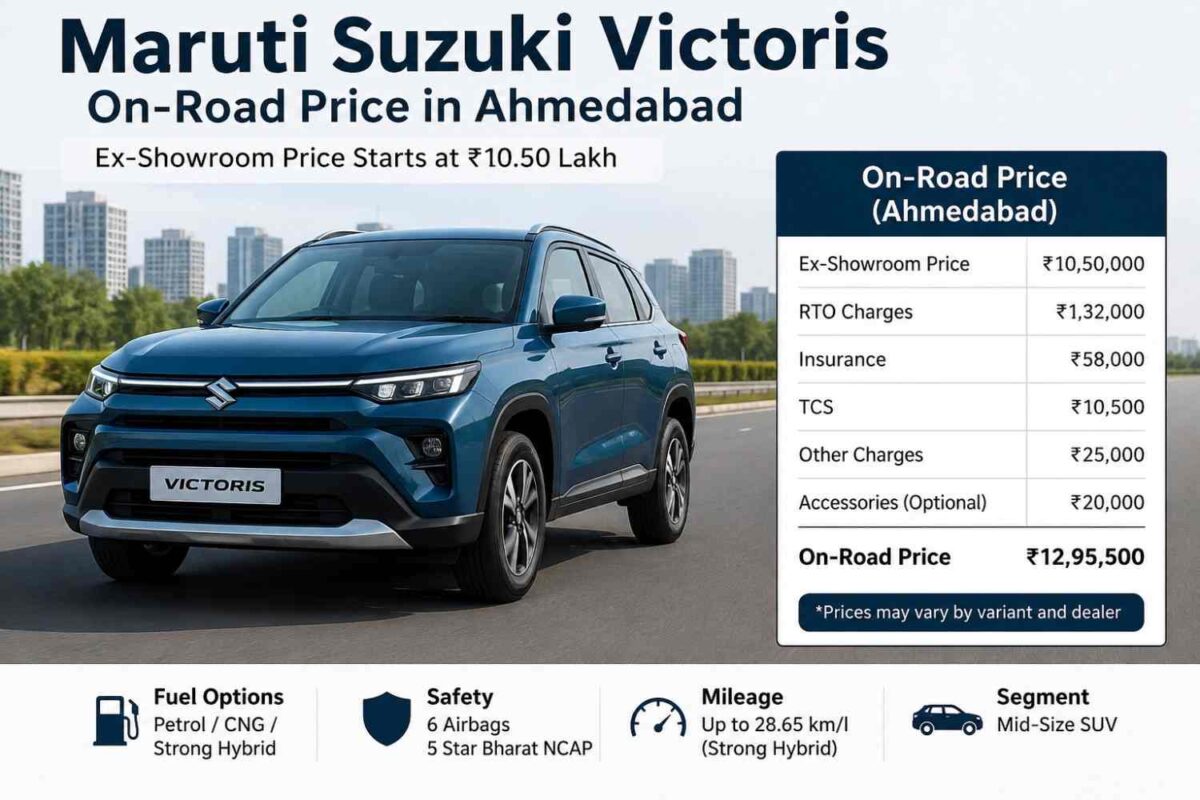
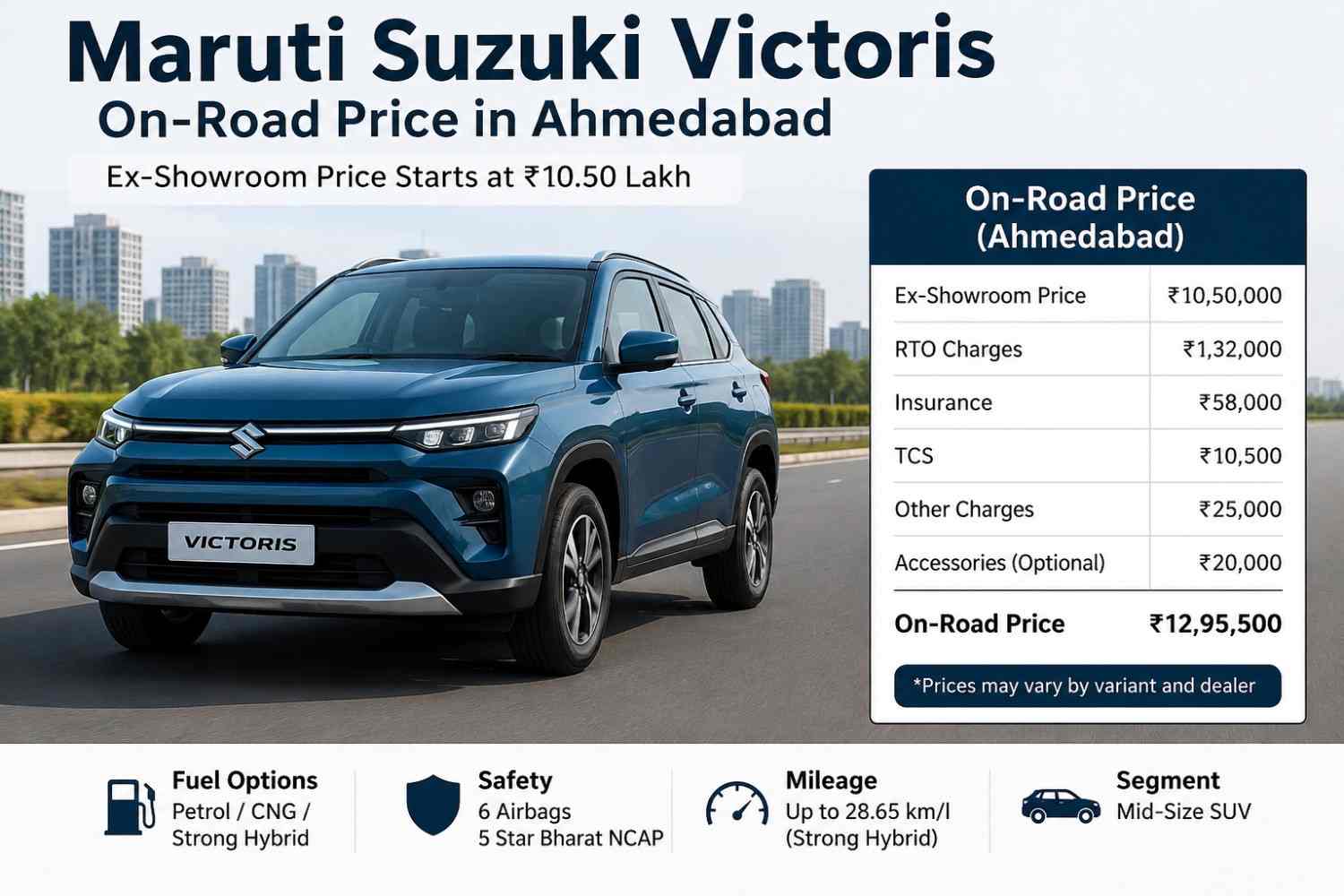
The Victoris currently starts at around ₹10.50 lakh ex-showroom, while Ahmedabad on-road estimates vary depending on registration, insurance, optional charges and the exact variant. Current published Ahmedabad estimates put the base LXI at roughly ₹11.7–₹12.4 lakh on road, while the top variants can cross ₹22 lakh.
And honestly, this is where I want to help.
Because if I were buying this SUV with my own money, I would not simply ask, “Kitna ki hai?”
I would ask:
“Kitna padega ghar tak, kitna deti hai, kitna maintain karna padega, and after five years meri jeb par kitna bhaar rahega?”
That is what this guide is about.
[Image: maruti-victoris-ahmedabad-front-view.jpg | Alt: Maruti Suzuki Victoris SUV front view showing its modern design and road presence in Ahmedabad]
Table of Contents
- Maruti Suzuki Victoris price in Ahmedabad
- What is the Victoris on-road price?
- Victoris variant-wise Ahmedabad price
- Which Victoris variant makes the most sense?
- Petrol vs CNG vs Strong Hybrid
- How much mileage can you expect?
- Will the Victoris survive Gujarat heat and dusty roads?
- What does long-term Victoris maintenance look like?
- My Sihor-style vehicle maintenance philosophy
- Victoris vs competing SUVs
- Five-year ownership and resale thinking
- Who should buy the Victoris?
- Who should save their money?
- Why trust ABTADKA?
- Frequently Asked Questions
- Final Bhavik’s Verdict
- SEO details
- Article + FAQ Schema
Maruti Suzuki Victoris On-Road Price in Ahmedabad 2026
Let us start with the number most buyers actually want.
The Maruti Suzuki Victoris starts at ₹10.50 lakh ex-showroom for the LXI petrol manual. The range extends to ₹19.99 lakh ex-showroom for the top Strong Hybrid variant.
But Ahmedabad buyers should not stop at ₹10.50 lakh.
Once registration, insurance, TCS and other applicable charges are added, the amount increases considerably.
For example, Autocar India’s current Ahmedabad estimate puts the Victoris LXI MT at approximately ₹11.76 lakh on road. ZigWheels lists the same base variant at approximately ₹12.41 lakh, showing why buyers should always ask the dealer for a written final quotation rather than relying on one website’s estimate.
Here is the practical range I would keep in mind:
| Victoris version | Approx. ex-showroom | Approx. Ahmedabad on-road* |
|---|---|---|
| LXI Petrol MT | ₹10.50 lakh | ₹11.7–₹12.4 lakh |
| LXI CNG MT | ₹11.55 lakh | ₹12.8–₹13.6 lakh |
| VXI Petrol MT | ₹11.85 lakh | ₹13.1–₹14.0 lakh |
| VXI Petrol AT | ₹13.41 lakh | ₹14.8–₹15.8 lakh |
| ZXI Petrol MT | ₹13.57 lakh | ₹15.1–₹16.0 lakh |
| ZXI+ Petrol | ₹15 lakh+ | ₹17 lakh+ |
| Strong Hybrid | ₹16 lakh+ | ₹18 lakh+ |
| Top Strong Hybrid | ₹19.99 lakh | ₹22 lakh+ |
*On-road prices are estimates and can change with insurance, registration calculation, dealer charges, accessories, offers and the exact variant. Published Ahmedabad estimates currently differ between sources.
So if a salesperson tells you, “Sir, Victoris ₹10.50 lakh se start hai,” remember that ₹10.50 lakh is not the cheque you should budget for.
Why is the Victoris on-road price so much higher than ex-showroom?
This is a question I hear constantly whenever people discuss car prices.
The simple answer is that ex-showroom is only one part of your purchase cost.
Your final bill can include:
- Registration/RTO charges
- Motor vehicle taxes
- Insurance
- TCS where applicable
- FASTag and statutory charges
- Hypothecation charges if financed
- Optional accessories
- Extended warranty
- Dealer-added packages
For example, CarDekho’s Ahmedabad calculation for the LXI shows ₹10,49,900 ex-showroom, with additional registration, insurance and other charges taking the estimated on-road figure to around ₹12.41 lakh.
This is why I always recommend one simple rule:
Before paying the booking amount, ask for the complete on-road quotation in writing.
Do not accept a verbal “around ₹12 lakh”.
Ask:
“Give me every charge on paper. Optional and mandatory both.”
That one sentence can save you from a surprise accessories bill.
[Internal Link: Maruti Suzuki car buying guide → how to negotiate car price and dealer charges]
Which Victoris variant should you actually buy?
Now we reach the interesting part.
The cheapest car is not always the cheapest car to own.
And the most expensive variant is certainly not automatically the smartest one.
Victoris LXI — for the strict budget buyer
The LXI petrol manual is the entry point.
It gets the basic mechanical package without forcing you into a huge purchase price.
If your priority is:
- Family transportation
- Long ownership
- Manual transmission
- Lower initial investment
- Basic safety equipment
then LXI deserves attention.
Maruti lists six airbags and other safety equipment on the base Victoris.
But I would personally inspect the feature list carefully before buying because the base variant can make you compromise on convenience features.
If your budget is tight, don’t stretch yourself just because the bigger variant looks nicer in the showroom.
Victoris VXI — my practical middle ground
This is where I think many family buyers should start their comparison.
The VXI adds useful equipment while avoiding the huge jump toward the expensive top variants.
You can get features such as Suzuki Connect and TPMS depending on the configuration.
If I were spending my own money and wanted a balance between price and equipment, I would compare the VXI very seriously against the ZXI.
Victoris ZXI — for the buyer who wants the SUV to feel complete
The ZXI brings more premium equipment and is likely to satisfy someone who plans to keep the car for seven to ten years.
The ex-showroom price is around ₹13.57 lakh for the petrol manual according to current published pricing.
The on-road amount in Ahmedabad can move beyond ₹15 lakh depending on the exact configuration and quotation.
This is where I would ask myself one question:
Will I use the extra features for the next 7–10 years?
If yes, spend.
If not, save the money.
Petrol, CNG or Strong Hybrid — which one makes sense?
This is probably the biggest financial decision in the Victoris range.
The Victoris is offered with petrol, CNG and strong-hybrid powertrain choices. Its claimed efficiency varies by powertrain, with published figures reaching up to around 28.65 km/l for the most efficient strong-hybrid configuration.
Petrol
Petrol is the straightforward choice.
Choose it if your annual running is moderate and you don’t want to pay a large upfront premium for efficiency.
For someone driving 8,000–12,000 km a year, the cheaper purchase price can matter more than chasing maximum mileage.
CNG
CNG makes more sense for someone who drives a lot.
If you travel daily between Ahmedabad and nearby towns, run a business vehicle or regularly cover long distances, fuel savings can become meaningful.
But you must consider CNG availability and boot-space requirements.
Strong Hybrid
The strong hybrid is the interesting one.
It costs considerably more upfront, but the combination of petrol and electric assistance is designed to improve fuel efficiency.
If you drive heavily in city traffic, especially with frequent stop-and-go movement, the hybrid deserves a serious calculation.
Don’t buy it simply because “hybrid mileage is high.”
Calculate your yearly kilometres first.
How much mileage can you expect from the Victoris?
Indians have one question that can beat every specification:
“Kitna deti hai?”
I completely understand.
A beautiful SUV is nice for the first month. A fuel-efficient SUV feels good every time you visit the petrol pump.
Published ARAI figures for the Victoris range from roughly 19.07 km/l to 28.65 km/l, depending on the powertrain and variant. The CNG version is listed at around 27.02 km/kg in published specifications.
But please don’t treat ARAI mileage as your guaranteed daily average.
Ahmedabad traffic, AC use, tyre pressure, driving style, road conditions and passenger load all change fuel consumption.
In Gujarat’s summer, where temperatures can reach around 45°C, your air-conditioner is not a luxury.
You will use it.
So your real-world number can be different from the brochure.
[Image: maruti-victoris-gujarat-highway.jpg | Alt: Maruti Suzuki Victoris driving on a Gujarat highway representing long-distance family travel between Ahmedabad and Bhavnagar]
Will the Victoris engine survive Gujarat’s 45°C heat?
This is where Gujarat buyers need to think differently.
A vehicle that works perfectly in a mild European climate still has to deal with our reality:
45°C heat, dust, traffic, AC running for long periods and sometimes rough village roads.
The Victoris is designed for Indian conditions, but that doesn’t mean you can ignore maintenance.
Engine oil matters.
Coolant matters.
Air-filter condition matters.
Tyre pressure matters.
Battery condition matters.
And your driving style matters.
If you regularly drive on dusty roads around Sihor or villages near Bhavnagar, I would pay extra attention to the air filter and underbody.
Dust is not your engine’s friend.
What about salt-air humidity near Bhavnagar?
If you live near the coast, another factor enters the picture: humidity and salty air.
Bhavnagar’s coastal environment can be harder on exposed metal surfaces than a dry inland environment.
That doesn’t mean your Victoris will suddenly rust.
It means you should not ignore small paint chips, scratches and underbody cleanliness.
If a stone hits the paint and exposes metal, repair it rather than leaving it for months.
I would also wash the car properly after travelling through muddy or salty conditions.
And don’t use harsh household detergents just because they are cheap.
My Sihor-style long-term maintenance routine
I have always believed that Indians keep vehicles longer when they maintain them like family rather than treating them like disposable appliances.
Here is the kind of monthly routine I recommend.
1. Check tyre pressure
Do it regularly, preferably when the tyres are cold.
Incorrect pressure affects:
- Mileage
- Braking
- Tyre wear
- Steering feel
A ₹0 maintenance habit can prevent an expensive tyre problem.
2. Inspect the engine bay
Look for unusual fluid leaks.
You don’t need to be a mechanic.
If you see something wet where it should be dry, ask the service centre.
3. Check coolant
Don’t open a hot cooling system just to inspect it.
Wait until the engine is properly cool and follow the owner’s manual.
If the coolant level keeps dropping, don’t simply keep topping it up.
Find the reason.
4. Keep the air filter clean
This is especially important if you regularly drive on dusty Gujarat roads.
A clogged air filter can affect engine breathing and efficiency.
5. Protect the paint
Ahmedabad’s sunlight is brutal.
Parking under shade or using a good-quality car cover when appropriate can help reduce unnecessary paint and interior exposure.
Do not put a dirty cover directly over dusty paint.
You can create scratches.
What about chain cleaning?
This point is important:
The Victoris is a car, so it does not have a motorcycle drive chain.
I am deliberately mentioning this because many generic vehicle-maintenance articles mix car and bike maintenance together.
For a motorcycle, chain cleaning and lubrication matter.
For the Victoris, your focus should instead be on tyres, brakes, fluids, filters, suspension, battery and scheduled servicing.
If you also own a bike, then yes, use a proper motorcycle chain cleaner and lubricant.
I would not recommend pouring kerosene onto every modern motorcycle chain without checking the manufacturer’s recommendation for the chain and seals.
Victoris vs other SUVs: where does the money go?
The Victoris sits in a crowded Indian SUV market.
Depending on variant, fuel type and budget, buyers can also consider models such as the Hyundai Creta and Toyota Urban Cruiser Hyryder.
The Victoris brings its own combination of fuel options, technology and safety.
Published specifications highlight features such as Level 2 ADAS, CNG and strong-hybrid options, while the model has also received a five-star Bharat NCAP rating according to current automotive references.
Here is how I would think about the comparison:
| Factor | Victoris | Hyundai Creta | Toyota Hyryder | What matters to me |
|---|---|---|---|---|
| Entry price | Around ₹10.50 lakh ex-showroom | Similar segment | Similar segment | Initial budget |
| CNG | Yes | No factory CNG equivalent in this comparison | Yes | High running |
| Strong hybrid | Yes | No strong hybrid | Yes | City efficiency |
| AWD | Available on selected variants | Selected versions depending on lineup | Available on selected versions | Bad roads/travel |
| Safety tech | Strong equipment list | Strong equipment list | Strong equipment list | Family safety |
| Mileage focus | Very strong | Moderate to strong | Very strong | Fuel savings |
| Long-term value | Promising | Strong market presence | Strong hybrid reputation | Resale/service |
The important thing is not to choose a winner from a table.
Take a test drive.
Sit in the rear seat.
Check boot space.
Try the AC.
Drive over a broken road.
And ask yourself whether you would still like the car after five years.
[Internal Link: Best family SUVs in India → family SUV buying guide]
What will the Victoris be worth after five years?
Nobody can honestly promise you a fixed resale price today.
The used-car market changes.
Fuel prices change.
New models arrive.
Government regulations change.
And condition matters enormously.
But I can show you the way I think about depreciation.
This is not a guaranteed resale percentage.
It is a simple way to understand the concept.
A clean service history, original paint, good tyres, no major accident history and timely maintenance can help.
A neglected car with damaged panels and skipped services will usually be harder to sell.
Why Indians don’t want to change cars every two years
I understand this mindset because it is deeply Indian.
We don’t necessarily want a new car every two years.
We want a car that says:
“Bas, 8–10 saal chalao aur tension mat lo.”
For a middle-class family, a ₹15 lakh car is not a small purchase.
There may be a home loan.
Children’s education.
Parents.
Insurance.
Fuel.
Unexpected medical or household expenses.
So I don’t recommend buying a car just because the showroom salesperson says:
“Sir, this is the most popular variant.”
Buy according to your financial reality.
If the EMI makes you uncomfortable every month, the car is too expensive.
How can you reduce Victoris ownership costs?
Here is where I would focus.
Don’t overspend on accessories
A dealer may offer floor mats, coating, accessories, extended warranty and other packages.
Some can be useful.
Some are simply expensive.
Compare prices before saying yes.
Don’t skip scheduled servicing
Saving ₹3,000 today and creating a ₹30,000 repair later is not saving.
Don’t drive aggressively
Hard acceleration followed by hard braking is bad for fuel economy and components.
Smooth driving is boring.
It is also cheaper.
Keep tyres correctly inflated
This is one of the easiest things you can do.
Don’t ignore warning lights
If the dashboard tells you something is wrong, don’t cover it with optimism.
Get it checked.
[Image: maruti-victoris-maintenance-service.jpg | Alt: Maruti Suzuki Victoris receiving professional maintenance with focus on long-term ownership costs]
Is Victoris good for Ahmedabad and Gujarat roads?
For a typical Gujarat family, I see a strong use case.
Ahmedabad has crowded traffic.
High summer temperatures put heavy demands on air conditioning.
Outside the city, you can quickly move from smooth highways to dusty village roads.
And if you travel toward Bhavnagar, Sihor or other parts of Gujarat, road conditions can vary considerably.
The Victoris’ SUV format, available powertrain choices and safety equipment make it worth considering.
But remember:
SUV does not mean indestructible.
Avoid hitting potholes at speed.
Don’t overload the vehicle.
Don’t ignore suspension noises.
And don’t assume a large ground clearance gives you permission to drive like a rally driver.
Victoris safety: should families consider it?
Yes, safety should be one of the first things you evaluate.
Current references report that the Victoris has achieved a five-star Bharat NCAP safety rating, while the model also offers six airbags as standard according to Maruti’s published specifications.
The car also offers advanced driver-assistance features on higher variants.
But I want to make one point very clear:
ADAS is an assistance system.
It does not replace the driver.
Keep your eyes on the road.
Don’t use the technology as an excuse to become careless.
What should you check during the Victoris test drive?
I would not spend 20 minutes driving around a showroom and then book the car.
Give yourself time.
Check these things:
- Seat comfort for the driver
- Rear-seat knee room
- Rear AC performance
- Visibility
- Steering weight
- Brake pedal feel
- Automatic gearbox response
- Suspension over broken roads
- Cabin noise
- Boot space
- Infotainment usability
- 360-degree camera if equipped
- ADAS behaviour if equipped
And please take your family.
The person sitting in the back seat for the next seven years deserves a vote.
Should you buy the petrol, CNG or hybrid?
Here is my simple decision logic:
Annual running
       |
       +---- Under 10,000 km
       |          |
       |        PETROL
       |
       +---- 10,000–20,000 km
       |          |
       |      PETROL / CNG
       |
       +---- Heavy city running
                  |
             CNG / HYBRID
                  |
       +---- Very high running
                  |
             Calculate HYBRID
             vs CNG carefully
This is only a starting point.
Your actual fuel prices, route, traffic and purchase premium can change the calculation.
Don’t buy the hybrid only because the brochure says 28.65 km/l.
Calculate your five-year fuel saving.
A simple five-year ownership calculation
Suppose you drive 15,000 km per year.
That means:
15,000 × 5 = 75,000 km
Now compare two vehicles.
If one option saves you even ₹2 per kilometre in fuel, the theoretical five-year difference would be:
75,000 × ₹2 = ₹1,50,000
But this is only an example.
The hybrid/CNG version may cost significantly more upfront.
Therefore, calculate:
Extra purchase cost − expected fuel savings = actual financial benefit
This is the calculation I want every buyer to make.
Not just “mileage kitni hai?”
Why trust ABTADKA?
I started ABTADKA in 2020, and my approach to automobile content has always been simple:
Don’t write what the showroom wants you to read. Write what the buyer needs to know.
I am based in Gujarat, and I understand the local realities that don’t always appear in a specification sheet.
Dust.
Heat.
Traffic.
Long highway trips.
Family use.
Fuel bills.
And the famous Gujarati question:
“Aa gadi ketlu aape chhe?”
I also believe in being transparent.
I am not claiming a personal Bhavnagar-to-Ahmedabad Victoris road test where I have not actually conducted one. The pricing and specifications in this article are based on current manufacturer and automotive-market information, while my ownership advice reflects the practical realities I use when evaluating vehicles for Indian buyers.
That distinction matters.
[Image: maruti-victoris-family-gujarat.jpg | Alt: Indian family with Maruti Suzuki Victoris representing practical family SUV ownership in Gujarat]
Who should buy the Maruti Suzuki Victoris?
I would seriously consider the Victoris if you are:
A family buyer
You want an SUV for family trips, city driving and occasional highway travel.
A high-mileage driver
You cover enough kilometres for CNG or hybrid economics to make sense.
A long-term owner
You want to keep the vehicle for 7–10 years instead of changing it every two years.
Someone upgrading from a smaller car
You want more space, stronger road presence and additional safety technology.
A Gujarat highway traveller
You regularly drive between Ahmedabad, Bhavnagar, Rajkot, Vadodara and other cities.
Who should save their money?
I would hold back if:
You are stretching your EMI
If buying the Victoris means sacrificing your emergency savings, wait.
You drive very little
If your annual running is extremely low, paying a large premium for a hybrid may not make financial sense.
You don’t need an SUV
A smaller hatchback or compact SUV can be much cheaper to run.
You are buying only for status
A ₹20 lakh car won’t improve your financial life if the monthly EMI keeps you awake.
You don’t have a proper parking space
A large SUV sitting in harsh sun every day is not an ideal long-term arrangement.
Maruti Suzuki Victoris On-Road Price Ahmedabad: My Final Verdict
If you came here searching “Victoria car price on road”, the correct model is the Maruti Suzuki Victoris.
And my biggest advice is simple:
Don’t buy the Victoris based on the ₹10.50 lakh headline price.
Your real budget should start with the complete on-road quotation.
For Ahmedabad in August 2026, current published estimates put the Victoris at roughly ₹11.7–₹12.4 lakh on road for the base LXI, with higher variants moving well beyond ₹15 lakh and the top hybrid versions reaching above ₹22 lakh depending on the exact configuration and charges.
For me, the sweet spot is not necessarily the most expensive Victoris.
I would first compare the VXI and ZXI, then decide whether my yearly running justifies CNG or strong hybrid.
If I were buying for a family and planning to keep the car for many years, I would spend more on the things I will use every day rather than paying for features I will rarely touch.
Because a car should make your life easier.
Not make your bank account nervous.
And remember my Sihor-style rule:
“Gadi showroom ma game evi hoy, pan EMI ghar ma shanti thi bharay evi hovi joie.”
That, for me, is the real meaning of value.
Frequently Asked Questions
1. What is the Maruti Victoris on-road price in Ahmedabad?
The base Victoris LXI petrol manual is currently estimated at roughly ₹11.7–₹12.4 lakh on road in Ahmedabad, depending on the calculation method, insurance and other charges. Higher variants can cross ₹22 lakh. Always obtain a final dealer quotation before booking.
2. What is the starting price of the Maruti Victoris?
The Victoris starts at ₹10.50 lakh ex-showroom for the LXI petrol manual. The top Strong Hybrid version is listed at ₹19.99 lakh ex-showroom.
3. Is Victoris available with CNG?
Yes. The Victoris is available with Maruti’s S-CNG powertrain. The LXI CNG starts around ₹11.55 lakh ex-showroom according to Maruti’s current pricing.
4. Is the Victoris good for long-term ownership?
It can be a sensible long-term choice if you maintain it properly. I would focus on scheduled servicing, tyres, brakes, fluids, battery, air filters and keeping a complete service history.
5. Is nitrogen air worth paying extra for?
For normal private-car use, I would not make nitrogen a major buying decision. Correct tyre pressure checked regularly is far more important than paying extra simply because the word “nitrogen” sounds premium.