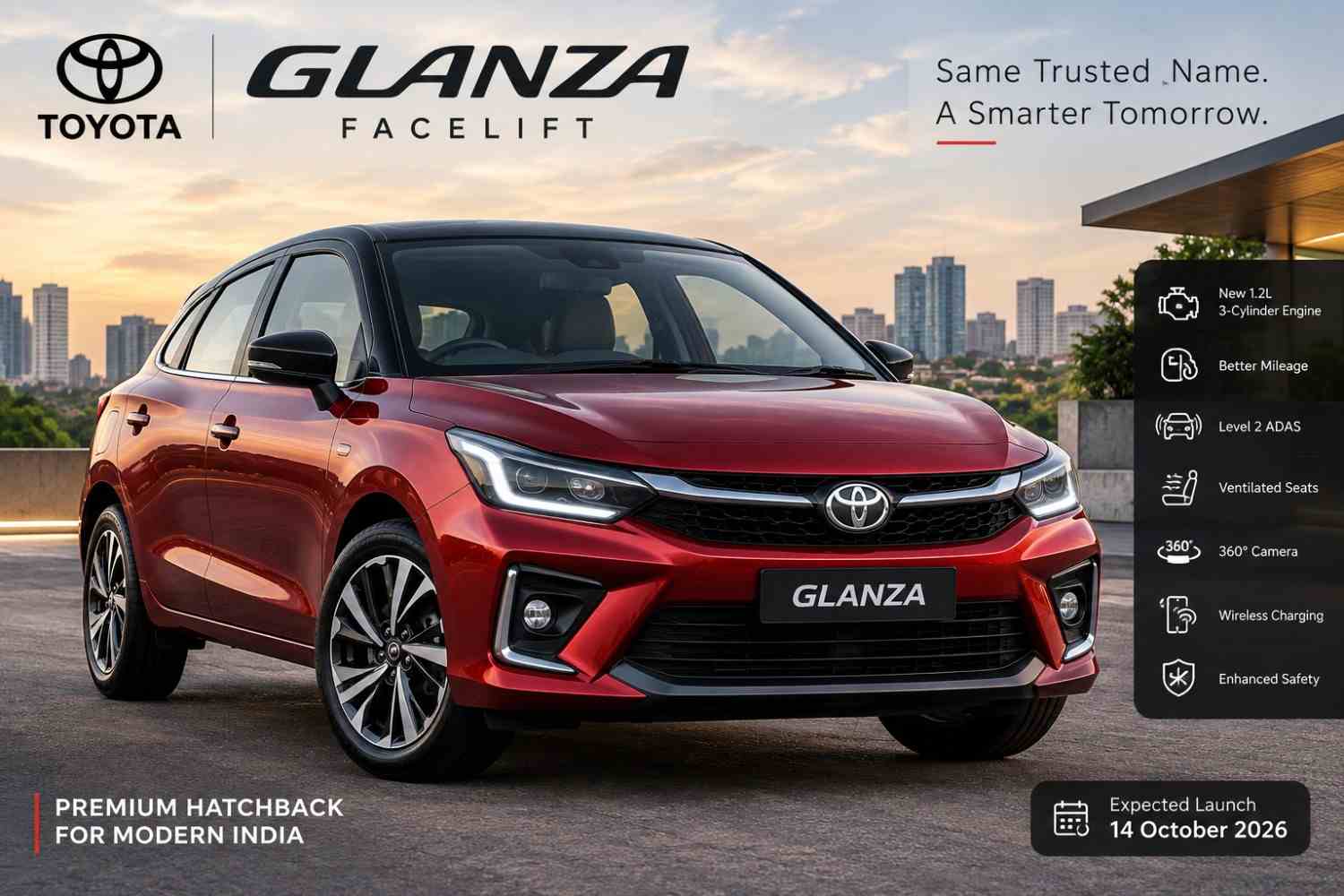
Toyota Glanza Facelift 2026: The Mileage King Is Getting a Big Change
I still remember my first bike purchase in 2020.
Hard-earned money goes into buying a vehicle, so naturally the first questions aren’t about fancy screens or Instagram-worthy interiors.
“Kitna deti hai?”
“Service ketli pade?”
“Five years, pachi pan problem toh nahi aave ne?”
That mindset has stayed with me throughout my years of running ABTADKA.
And that’s exactly why the Toyota Glanza facelift caught my attention.
The Glanza has always been a very straightforward Indian hatchback. It gives you Toyota’s badge, a spacious cabin, decent features, and the familiar Maruti-Toyota mechanical relationship underneath.
But the 2026 facelift is bringing a fairly important mechanical change.
Toyota is expected to replace the existing 1.2-liter four-cylinder petrol engine with the new 1.2-liter three-cylinder Z12E naturally aspirated petrol engine used in the facelifted Maruti Baleno. The engine makes around 83hp and 112Nm and is expected to be offered with a 5-speed manual and AMT. A CNG version is also expected.
And then there are the interesting new features.
Level 2 ADAS.
Ventilated front seats.
Wireless phone charging.
TPMS.
A redesigned front end.
So this isn’t merely a new grille and a fresh brochure.
The bigger question is
Has Toyota finally made the Glanza more attractive without destroying the simple, affordable ownership formula that made it popular?
Let’s talk about it like we’re sitting at a Galla in Sihor.
Toyota Glanza Facelift 2026: What We’ll Cover
- What is changing in the new Glanza?
- Toyota Glanza facelift launch date
- Expected Glanza facelift price
- New 1.2-litre three-cylinder engine
- Petrol mileage expectations
- CNG mileage and practicality
- Is the three-cylinder engine better?
- New exterior design
- Interior and comfort features
- Level 2 ADAS explained
- Safety features
- Will it survive Gujarat’s 45°C heat?
- Ahmedabad-to-Bhavnagar highway practicality
- Maintenance and longevity
- Glanza vs Baleno vs i20 vs Altroz
- Five-year ownership calculation
- Who should buy it?
- Who should wait?
- FAQ
What is changing in the Toyota Glanza facelift?
Let’s start with the most important thing.
The facelift is expected to follow the changes introduced with the 2026 Maruti Suzuki Baleno facelift, because the Glanza and Baleno are closely related models. The Glanza facelift is expected to receive the new engine, updated front styling, and several of the Baleno’s new convenience and safety features.
The current Glanza uses a 1.2-liter four-cylinder petrol engine.
The facelift is expected to move to a 1.2-liter three-cylinder naturally aspirated engine.
That’s the big mechanical story.
But Toyota isn’t stopping there.
The facelift is also expected to bring:
- Revised grille
- New front bumper
- Level 2 ADAS
- Ventilated front seats
- Wireless phone charger
- TPMS
- Updated feature package
The overall silhouette is expected to remain familiar rather than becoming a completely different car.
When will the Toyota Glanza facelift launch in India?
This part is fairly clear now.
The Toyota Glanza facelift is expected to debut on October 14, 2026.
The information comes from dealer sources reported by Autocar India, and the launch is expected roughly a month after the related Maruti Baleno facelift arrived in September.
So if you’re planning to buy a Glanza around October or November 2026, I would definitely wait for the facelift before making the final booking decision.
Why?
Because buying the outgoing model just before a facelift can affect:
- Features
- Resale value
- Negotiation
- Warranty/stock age
- Long-term desirability
There may be discounts on outgoing cars, though.
And that’s where the calculation becomes interesting.
Toyota Glanza facelift price: How much could it cost?
The current Glanza starts around ₹6.73 lakh ex-showroom and goes up to about ₹9.99 lakh, depending on variant and powertrain.
The facelift is expected to command a slight premium.
Current listings put the expected facelift around the ₹6.75–₹7.65 lakh range, although variant-wise pricing isn’t official yet and different city pages are showing estimated on-road figures.
So don’t treat ₹6.75 lakh as the final confirmed showroom price.
Toyota will announce the actual variant pricing around launch.
My expectation is simple:
Expected positioning
Entry: Around ₹7 lakh
Top petrol: Around ₹10 lakh+
CNG: Likely above equivalent petrol variants
The exact number will matter because the Glanza competes in an extremely price-sensitive segment.
A ₹30,000–₹50,000 difference can completely change a buyer’s decision.
New Toyota Glanza engine: Why did Toyota move from 4 cylinders to 3?
This is the question I expect many existing Glanza owners to ask.
The current Glanza’s 1.2-litre petrol engine produces around 90 hp and 113 Nm.
The facelift is expected to use the new Z12E 1.2-liter three-cylinder naturally aspirated engine, producing approximately 83 hp and 112 Nm.
So on paper:
Power goes down.
Torque stays almost identical.
Then why change?
Fuel efficiency and emissions are major reasons.
The same engine in the 2026 Baleno produces a claimed fuel economy of 23.80 kmpl with the manual and 24.77 kmpl with the AMT.
That’s an important gain.
And this is where the Indian “Kitna Deti Hai?” mentality comes back.
If Toyota can give you slightly less power but better efficiency without making everyday driving frustrating, many buyers will accept the trade-off.
Will the three-cylinder Glanza feel underpowered?
This is something I would not decide purely from the specification sheet.
83 hp sounds modest.
But the Glanza isn’t a sports hatchback.
It is designed primarily for:
- City commuting
- Family use
- Office travel
- Highway cruising
- Daily errands
- Occasional long-distance trips
For a person driving from Sihor to Bhavnagar or Ahmedabad, smoothness and fuel economy may matter more than winning a traffic-light drag race.
The bigger question will be:
How does the three-cylinder engine feel when four adults and luggage are inside?
That’s where a proper road test matters.
Three-cylinder engines can have a different vibration and sound character compared with four-cylinder engines.
I would specifically test the Glanza:
- At idle
- At 20–40 km/h
- During overtaking
- With four passengers
- On an incline
- At 80–100 km/h
- With AC running hard
Only then can I tell you whether the lower power figure actually matters.
6. Toyota Glanza mileage: The question everyone will ask
Let’s be honest.
If you are looking at a Glanza, mileage is probably one of the first five things you care about.
The current Glanza has an ARAI-certified petrol efficiency of around 22.35 kmpl for manual variants and 22.94 kmpl for AMT, while its CNG version is rated around 30.61 km/kg.
The facelift’s new engine is expected to improve efficiency.
The corresponding Baleno facelift returns:
| Powertrain | Claimed efficiency |
|---|---|
| 1.2 Petrol MT | 23.80 kmpl |
| 1.2 Petrol AMT | 24.77 kmpl |
| 1.2 CNG | 33.61 km/kg |
Those are the Baleno’s certified figures, not confirmed Glanza figures.
Toyota’s final India-spec Glanza figures should be confirmed after launch.
And remember:
ARAI mileage ≠ your Gujarat mileage.
What mileage should you realistically expect?
Suppose you’re driving around Ahmedabad.
Traffic.
Signals.
AC.
Two-wheelers cutting through gaps.
Short trips.
That environment can reduce fuel efficiency considerably compared with laboratory testing.
On a highway between Bhavnagar and Ahmedabad, things change.
You may cruise more consistently.
That usually helps efficiency.
So rather than promising you “25 kmpl guaranteed,” I would track:
City average
Highway average
Mixed average
That’s far more useful.
If I get the opportunity to test the facelift myself, I’d reset the trip computer before a fixed route and record fuel consumption honestly.
What about the Toyota Glanza CNG?
This could be one of the most interesting versions for value-conscious buyers.
The current Glanza already has a factory-fitted CNG option with a claimed 30.61 km/kg efficiency.
The facelift is expected to continue with a CNG version using the new engine, producing around 70hp and 102Nm, with a manual gearbox expected.
For someone doing high annual kilometers, this is important.
Imagine:
Daily office commute.
Regular Ahmedabad city driving.
Frequent trips between towns.
Commercial or family usage.
CNG can potentially reduce fuel expenditure substantially compared with petrol.
But there is a trade-off.
You need easy access to CNG stations.
And you should understand the boot-space impact of the CNG hardware.
Toyota Glanza facelift exterior: What actually changes?
Don’t expect a completely new Glanza.
The basic silhouette is expected to remain familiar.
The facelift’s biggest exterior changes are expected around the front fascia.
That includes:
- Revised grille
- Redesigned front bumper
- New styling details
- Updated visual treatment
The headlamps, rear design, and overall body shape are expected to remain broadly familiar.
Honestly, I think that’s sensible.
A facelift doesn’t need to reinvent everything.
If the existing proportions work, improve the areas people actually see.
And the Glanza already has a reasonably mature premium-hatchback shape.
Will the Glanza get a sunroof?
This is where I want to save you from a common expectation.
Current reporting says the Glanza facelift is not expected to get a sunroof.
A digital driver display is also not expected.
Instead, Toyota appears to be focusing on features such as
HUD
360-degree camera
ADAS
ventilated seats
wireless charging
That is a reasonable approach.
Personally, I would rather have better safety technology than a glass roof that I rarely use.
Toyota Glanza interior: What will change?
The cabin design is expected to remain largely familiar.
The big difference will be additional equipment.
The Baleno facelift, which provides a strong indication of what Toyota could bring to the Glanza, gets:
The Baleno also retains analogue dials with a colour MID rather than switching to a full digital instrument cluster.
Ventilated seats: Useful or just a gimmick in Gujarat?
This is one feature I actually appreciate for Gujarat.
Try entering a black car after it has been parked outside in Ahmedabad at 45°C.
You sit down.
Your back starts sweating immediately.
That’s where ventilated seats can be genuinely useful.
Instead of simply calling it a “premium feature,” think about the actual daily benefit.
If you commute 30–40 minutes every day in summer, ventilated seats can make that experience more comfortable.
That’s the kind of feature I consider more meaningful than decorative ambient lighting.
Toyota Glanza Level 2 ADAS: What does it mean?
This is probably the biggest technology upgrade.
The 2026 Baleno has introduced Level 2 ADAS, including functions such as
- Adaptive cruise control
- Lane-keep assist
- Lane-departure warning
- Automatic emergency braking
- High-beam assist
The Glanza facelift is expected to receive similar technology.
But please understand what “Level 2” means.
It does not mean the car drives itself.
The driver remains responsible.
On Indian roads, this distinction is extremely important.
A highway system can assist with maintaining speed and lane position, but a motorcycle can suddenly appear beside you.
A tractor may enter from a side road.
A pedestrian may cross unexpectedly.
ADAS is assistance.
Not permission to stop paying attention.
Is ADAS useful on Ahmedabad highways?
Yes, potentially.
But calibration matters.
Indian traffic is messy.
Lane markings aren’t always perfect.
Traffic can be unpredictable.
And two-wheelers frequently occupy spaces cars don’t.
The 2026 Baleno’s ADAS was reported to appear reasonably well calibrated during a brief test drive, although real-world experience can vary.
So if Toyota brings this system to the Glanza, I would want to test it on:
- Ahmedabad expressway conditions
- Highway traffic
- Night driving
- Curves
- Stop-and-go traffic
And I’d always keep my hands and attention where they belong.
Toyota Glanza safety: What do we know?
The Glanza currently has important basic safety equipment, including six airbags, ABS with EBD, electronic stability control, and hill-hold assist. Comparative data also lists a 360-degree camera for the Glanza.
The facelift is expected to add more advanced technology, potentially including ADAS and TPMS.
That combination is much more useful to me than simply adding cosmetic features.
For a middle-class family buying one car for five or seven years, safety technology can have genuine value.
Will the Glanza engine survive Gujarat’s 45°C heat?
This is where brochure specifications stop being enough.
I have driven and tested vehicles in Indian conditions where summer temperatures can be brutal.
Gujarat gives us:
45°C heat
Dust
Heavy AC use
Stop-and-go traffic
Hot asphalt
Village roads
And around Bhavnagar, you can also get humid, salt-heavy coastal air.
So I would look at:
Engine cooling
Does the engine maintain temperature in slow traffic?
AC performance
How quickly does the cabin cool after sitting outside?
AMT behavior
Does the gearbox remain smooth when traffic becomes stop-start?
Tyres
How do they behave on hot asphalt?
Paint
How well does the finish handle constant sun exposure?
These are the things that matter after three or four years.
Not just on delivery day.
Toyota Glanza facelift maintenance: Will it remain cheap to own?
This is where Toyota’s reputation attracts buyers.
But I would still tell you:
Don’t confuse the Toyota badge with zero maintenance.
Every car needs servicing.
Engine oil.
Filters.
Brake inspection.
Coolant.
Tyres.
Battery.
AC maintenance.
Alignment.
Suspension components.
And eventually wear items.
The advantage of a simple naturally aspirated petrol hatchback is that the mechanical package is relatively familiar.
That’s good for long-term ownership.
And if you choose CNG, maintenance discipline becomes even more important.
My Sihor-style monthly Glanza maintenance routine
I always like keeping maintenance simple.
Week 1—Tyres
Check tire pressure.
Look for cuts and uneven wear.
Week 2 — Engine
Check oil level.
Look for unusual sounds.
Check warning lights.
Week 3 — AC
Run the AC properly.
Check cooling performance.
If cooling suddenly feels weak, don’t ignore it.
Week 4 — Exterior
Wash Gujarat dust properly.
Don’t rub dry dust directly against the paint.
Check for scratches.
Inspect the windshield.
And after driving near the Bhavnagar coast, wash the car properly rather than allowing salty grime to remain for days.
What about chain cleaning with kerosene?
This is a good example of why vehicle-specific maintenance matters.
My bike has a chain.
The Glanza doesn’t.
So kerosene versus chain lube isn’t relevant to the Glanza.
For a motorcycle, I would discuss chain cleaning and lubrication.
For the Glanza, I’d focus on engine oil, tires, brakes, coolant, battery, suspension, and scheduled service.
Don’t blindly copy a bike maintenance routine onto a car.
Toyota Glanza vs Baleno vs Hyundai i20 vs Tata Altroz
This is the comparison most buyers will make.
| Feature | Glanza Facelift | Baleno Facelift | Hyundai i20 | Tata Altroz |
|---|---|---|---|---|
| Expected/Current price | ₹7 lakh+ expected | ₹5.99 lakh+ | ₹6 lakh+ | ₹6.30 lakh+ |
| Petrol engine | 1.2L 3-cyl expected | 1.2L 3-cyl | 1.2L 4-cyl | 1.2L 3-cyl |
| Power | ~83 hp expected | 83 hp | ~83 hp | ~88 hp |
| Automatic | AMT expected | AMT | IVT | AMT/DCT |
| CNG | Expected | Yes. | No | Yes. |
| ADAS | Expected | Level 2 | No | No |
| 360 camera | Expected | Yes. | No | Yes. |
| Ventilated seats | Expected | Yes. | No | No |
| Sunroof | No expected | No | Yes. | Yes. |
| Head-up display | Expected | Yes. | No | No |
The Baleno’s 2026 update gives it a particularly technology-heavy equipment list, while the Glanza is expected to mirror many of those additions.
Glanza facelift: The mileage chart I would use
Remember, this is not a resale-value prediction.
It’s simply a way to visualize the ownership priorities.
VALUE FACTOR

Mileage         ████████████████████
Maintenance     ██████████████████
Safety          █████████████████
Comfort         ███████████████
Performance     ████████████
Features        █████████████████
For a typical Indian buyer, the first three categories often matter more than outright performance.
That’s exactly where I think the Glanza makes sense.
Five-year ownership: Why Indians don’t change cars every two years
Most Indian families don’t buy a car, thinking:
“Two years baad exchange kar denge.”
We buy with a longer mindset.
Five years.
Seven years.
Sometimes ten.
That’s why I always recommend looking beyond the showroom.
Before buying the Glanza, ask:
Can I maintain it properly for seven years?
If the answer is yes, the initial purchase decision becomes much easier.
Petrol vs. CNG: Which Glanza makes more sense?
Here’s the simplest way I see it.
Choose petrol if:
You drive a moderate number of kilometers.
You want better performance.
You travel frequently on highways.
You don’t want to think about CNG stations.
Choose CNG if:
You drive a lot every year.
Your routes have reliable CNG availability.
Fuel cost is a major priority.
You don’t mind the manual transmission expected with the CNG version.
The “best” version depends heavily on your annual kilometers.
If you drive 1,000km per month
Suppose petrol costs around ₹100/liter and your real-world average is 18 kmpl.
Fuel consumption:
1,000 ÷ 18 = 55.5 liters
Approximate monthly fuel cost:
55.5 × ₹100 = ₹5,550
Now suppose CNG costs ₹75/kg and you achieve 25 km/kg in real-world conditions.
Consumption:
1,000 ÷ 25 = 40 kg
Approximate monthly cost:
40 × ₹75 = ₹3,000
That’s an illustrative calculation, not a promise of real-world mileage.
But it shows why high-mileage drivers often consider CNG.
What if you drive only 500km a month?
Then the calculation changes.
Your fuel savings may not justify paying a significant premium for CNG.
This is why I don’t tell everyone:
“CNG le lo.”
Calculate your annual kilometers first.
If you drive 15,000–20,000km annually, the equation can look very different from someone driving 5,000–7,000km.
What about resale value after five years?
Nobody can honestly guarantee a future resale price for a facelift that hasn’t even launched yet.
So instead of inventing numbers, let’s look at the factors.
5-YEAR RESALE VALUE DRIVERS

Service History       ████████████████████
Condition              ██████████████████
Mileage                █████████████████
Accident History       ███████████████████
Demand                  █████████████████
Variant                 ███████████████
Fuel Type               ██████████████
Colour                  ███████████
Keep every service invoice.
Don’t ignore body damage.
Use good tires.
Maintain the interior.
And don’t modify the electrical system with questionable accessories.
That’s what protects resale value.
Can the Glanza be a good first family car?
Yes, this is actually where I see its strongest use case.
Imagine:
A young professional in Ahmedabad.
A couple with one child.
Parents occasionally travelling with them.
Daily office commute.
Weekend trips.
Occasional Bhavnagar or Rajkot highway drives.
You don’t necessarily need a large SUV.
A premium hatchback can do the job.
The Glanza gives you a manageable footprint, decent cabin space, and relatively straightforward running costs.
And with the facelift’s expected technology upgrades, it becomes more attractive as a long-term family car.
Who should buy the Toyota Glanza facelift?
I’d seriously consider it if you want:
- A compact premium hatchback
- Good fuel efficiency
- CNG availability
- Toyota’s service network
- Simple petrol ownership
- 360-degree camera
- Head-up display
- Modern safety assistance
- Automatic option
- Comfortable city driving
- Long-term ownership
For a middle-class family, the combination of purchase price, fuel economy, and practicality is more important than having the biggest engine.
Who should save their money?
If you already own a good hatchback and the facelift doesn’t add something you genuinely need, don’t upgrade just because the grille changed.
That’s an important point.
A facelift doesn’t automatically make your existing car obsolete.
If your current car:
- Runs reliably
- Has good tires
- Is maintained
- Meets your space needs
- Gives acceptable mileage
Keep it.
Use your money elsewhere.
That’s one of the simplest ways to save thousands of rupees.
Toyota Glanza Facelift FAQ
1. When will the Toyota Glanza facelift launch?
The Toyota Glanza facelift is expected to debut on October 14, 2026, according to dealer-source information reported by Autocar India.
2. What engine will the new Glanza get?
The facelift is expected to receive a 1.2-liter three-cylinder Z12E naturally aspirated petrol engine producing around 83 hp and 112 Nm. A 5-speed manual and AMT are expected.
3. Will the Toyota Glanza facelift get CNG?
A CNG version is expected, using the new engine and producing approximately 70hp and 102Nm in CNG mode. A manual gearbox is expected.
4. Will the Glanza facelift get ADAS?
The facelift is expected to receive a Level 2 ADAS package, following the equipment introduced on the 2026 Baleno facelift. Expected functions include adaptive cruise control, lane-keep assistance, and automatic emergency braking.
5. Will the Toyota Glanza facelift get ventilated seats?
Yes, ventilated front seats are among the features expected to be added to the facelifted Glanza, based on the equipment introduced on the related Baleno facelift.
- New BMW 3 Series Revealed: G50 Design, Engines & India Launch
- Toyota Glanza Facelift 2026: Big Changes, Better Mileage?

Bhavik is the founder, administrator, and driving force behind ABTadka and TechBhavik. As a passionate automotive enthusiast and tech visionary, he bridges the gap between horsepower and processing power. At abTadka, Bhavik delivers the latest Auto trends, breaking Cars News, and comprehensive Bike News. Meanwhile, through TechBhavik, he dives deep into the digital frontier, sharing expert insights on Tech & Technology, Artificial Intelligence (AI), and breaking down complex tech information for everyday readers. Dedicated to authority and accuracy, Bhavik ensures his audiences are always ahead of the curve.