
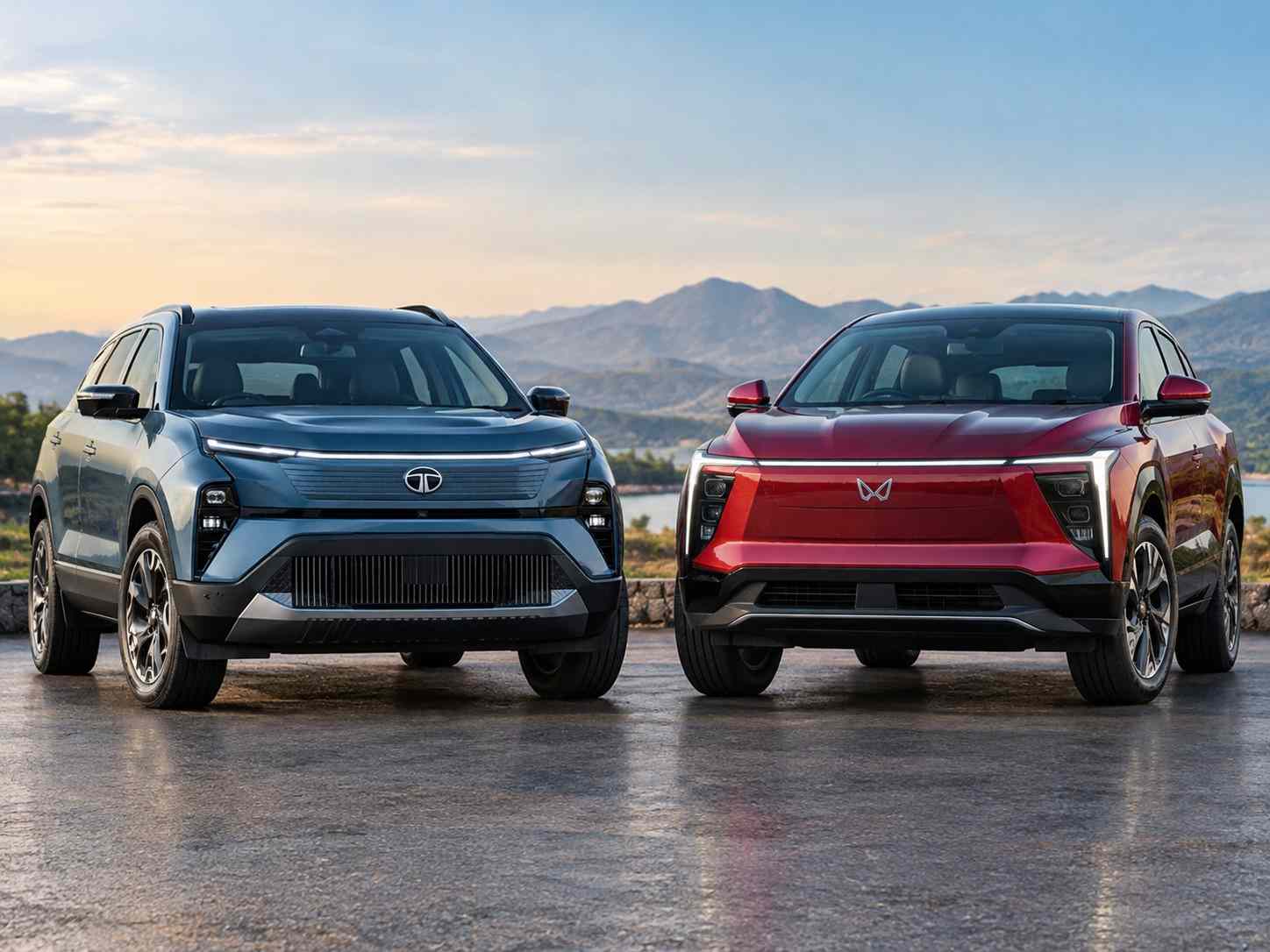
Two Indian brands, two electric SUVs, and almost the same starting price. The Tata Harrier EV and the Mahindra XEV 9e are two of the most talked-about electric SUVs in India right now, and many buyers cannot decide between them.
In this guide, I compare them in simple words so you can choose with confidence. No heavy technical talk, only the points that matter in daily use.
Quick Snapshot
- Launched: June 2025
- Starting price: Rs 21.49 lakh (ex-showroom)
- Battery options: 65 kWh and 75 kWh
- Claimed range: up to 627 km (MIDC)
- Drive: rear-wheel drive or all-wheel drive
Mahindra XEV 9e:
- Launched: November 2024
- Starting price: Rs 21.90 lakh (ex-showroom)
- Battery options: 59 kWh and 79 kWh
- Claimed range: up to 656 km (MIDC)
- Drive: rear-wheel drive only
Price: Almost Equal at the Start
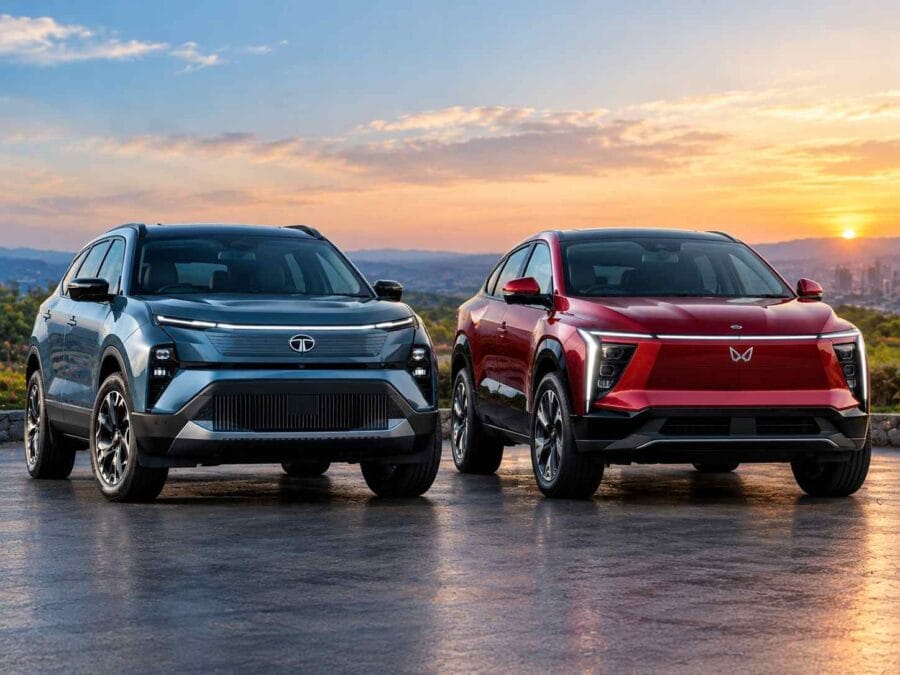
Both SUVs start close to Rs 22 lakh, so the entry price will not decide this contest. The Harrier EV starts at Rs 21.49 lakh, while the XEV 9e starts at Rs 21.90 lakh. Mahindra’s price does not include a home charger, so ask your dealer what is included in the final bill.
At the top end, the XEV 9e Pack Three was listed at Rs 30.50 lakh, and the Harrier EV’s all-wheel-drive variants sit in a similar range. When the Harrier EV was launched, it was priced about 5% lower on average than comparable XEV 9e variants. Both companies update prices and offers from time to time, so check before you decide.
Range: The XEV 9e Claims More, But Real Roads Matter
On paper, the XEV 9e wins. Its 79 kWh battery claims up to 656 km, against 627 km for the Harrier EV’s 75 kWh battery.
Claimed range is measured in ideal test conditions, so look at real-world figures too. Autocar India’s testing found about 456 km for the XEV 9e 79 kWh. The Harrier EV 75 kWh rear-wheel-drive version is estimated to be about 480 to 505 km in real conditions. The gap between the two is small, and your driving style will matter more than the numbers.
Power and Performance
The Harrier EV is the quicker car. Its dual-motor all-wheel-drive version makes 313 horsepower and 504 Nm of torque, and it reaches 100 km/h in about 6.3 seconds.
The XEV 9e uses a single rear motor. The 79 kWh version makes 286 horsepower and 380 Nm of torque, and it reaches 100 km/h in about 6.8 seconds. This is still quick, and most drivers will feel no weakness in city or highway use.
The bigger difference is the drive layout. Only the Harrier EV offers all-wheel drive, with six terrain modes. If you often drive on rough roads, hill roads, or wet surfaces, this is a real advantage.
Charging
The Harrier EV supports 120 kW fast charging, which takes the battery from 20% to 80% in about 25 minutes. With a 7.2 kW home charger, a full charge from 10% takes about 10.7 hours, which suits overnight charging.
The XEV 9e offers a 7.2 kW or an 11 kW home charger option. With the 79 kWh battery, a full charge takes about 11.7 hours on the 7.2 kW charger and about 8 hours on the 11 kW charger. If you plan to charge at home every night, both cars will fit your routine.
Safety
Here the contest is a tie. Both SUVs have earned a 5-star rating from Bharat NCAP, India’s own crash-test program. Either one is a strong choice for a family.
Space and Practicality
The XEV 9e is the more practical car for luggage. It has a boot of about 663 liters and an extra 150-liter storage space under the front bonnet, often called a frunk. This is useful for charging cables or small bags.
The Harrier EV is a five-seat SUV, 4,607 mm long with a 2,741 mm wheelbase, so it is comfortable for a family. It also brings a 540-degree surround view system, a 10-speaker JBL sound system, and a panoramic sunroof on selected variants.
Battery Warranty
Both brands understand that battery cost is the biggest worry for EV buyers. Tata offers a lifetime battery warranty for the first private owner of the Harrier EV. Mahindra also offers a lifetime warranty on the XEV 9e with the 79 kWh battery. Ask the dealer to show the exact terms in writing, because conditions can differ by variant. Mahindra Thar four-wheel powers.
Related: Toyota Fortuner Legender Bigger
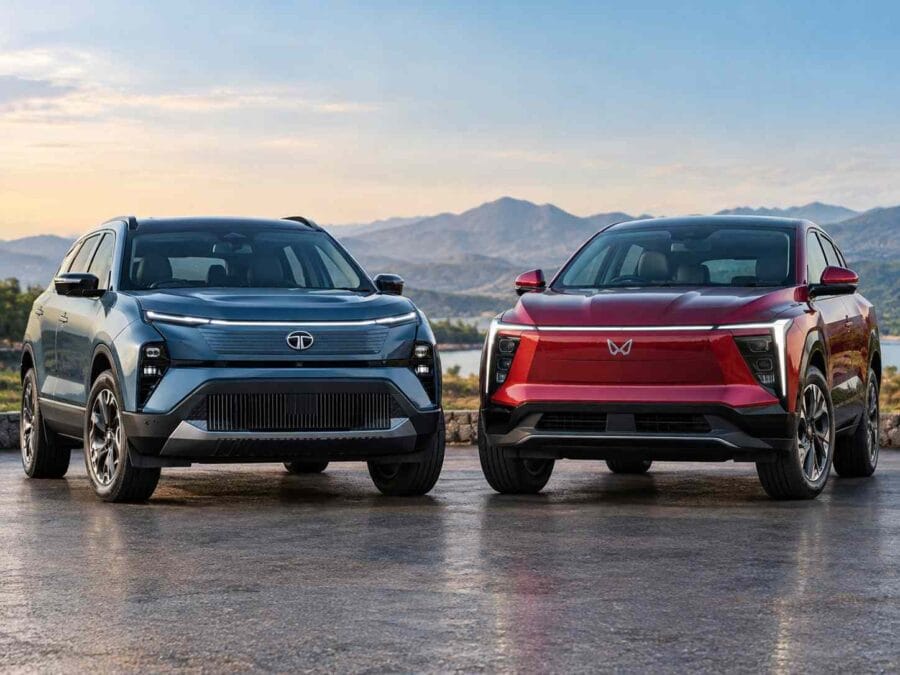
Head-to-Head Specification Comparison
| Feature / Metric | Tata Harrier EV | Mahindra XEV 9e |
|---|---|---|
| Platform Base | Acti.ev + OMEGA Architecture | INGLO Born-EV Platform |
| Drive Setup | FWD (Single) / AWD (Dual-Motor) | RWD (Rear-Wheel Drive Only) |
| Max Power Output | 235 bhp to 390 bhp (AWD) | 228 bhp to 286 bhp |
| Peak Torque | 504 Nm (AWD) | 380 Nm |
| Battery Sizes | 65 kWh & 75 kWh | 59 kWh & 79 kWh |
| Claimed Range (MIDC) | 538 km – 627 km | 542 km – 656 km |
| DC Fast Charging Speed | 20-80% in 25 mins | 20-80% in 20 mins (175 kW DC) |
| Boot Space | 502 liters | 663 liters + 150 liters trunk |
| Cockpit Displays | 14.5″ center screen + 10.25″ digital cluster | Triple 12.3-inch Panoramic Screens |
| Starting Price (Ex-sh) | ₹21.49 Lakh – ₹21.79 Lakh | ₹21.90 Lakh |
Related: Tata Tiago EV 2026 Review: Is This ₹6.99 Lakh EV Actually Worth It?
Which One Should You Buy?
Choose the Tata Harrier EV if:
You want all-wheel drive and strong acceleration.
You often drive on rough or hilly roads.
You prefer a faster-charging car for highway trips.
Choose the Mahindra XEV 9e if:
You want the highest claimed range.
You need extra boot space for luggage.
You like a modern, technology-focused design.
My Final Thoughts
There is no single winner here, and that is good news for buyers. The Harrier EV is better for people who want power, all-wheel-drive confidence, and quick charging. The XEV 9e is better for people who want a longer claimed range and a bigger boot.
My honest advice is simple: book a test drive of both cars on the same day. Sit in the back seat, check the boot, and ask about the service centre nearest to your home. The right car is the one that fits your life, not only the one with the best numbers.
I have not owned these cars; we are finding a source of official websites for this article.
Check if you buy on a car loan EMI calculator
Frequently Asked Questions
Q: Which is cheaper, the Harrier EV or the XEV 9e?
A: The Harrier EV starts at Rs 21.49 lakh and the XEV 9e at Rs 21.90 lakh (both ex-showroom), so the starting prices are very close.
Q: Which has more range?
A: The XEV 9e claims up to 656 km, and the Harrier EV claims up to 627 km. Real-world range is lower for both.
Q: Does the XEV 9e have all-wheel drive?
A: No. It is rear-wheel drive only. The Harrier EV offers an all-wheel-drive version.
Q: Which is safer?
A: Both have a 5-star Bharat NCAP rating.
Sources: Tata Motors official website, Mahindra official website